Pickens Sabrina, Daniel Mary, Jones Erick C, Jefferson Felicia
Department of Research, University of Texas Health Science Center at Houston, Jane and Robert Cizik School of Nursing, Houston, TX, United States.
College of Engineering, Industrial, Manufacturing and Systems Engineering Department, University of Texas Arlington, Arlington, TX, United States.
Front Med (Lausanne). 2021 May 17;8:654627. doi: 10.3389/fmed.2021.654627. eCollection 2021.
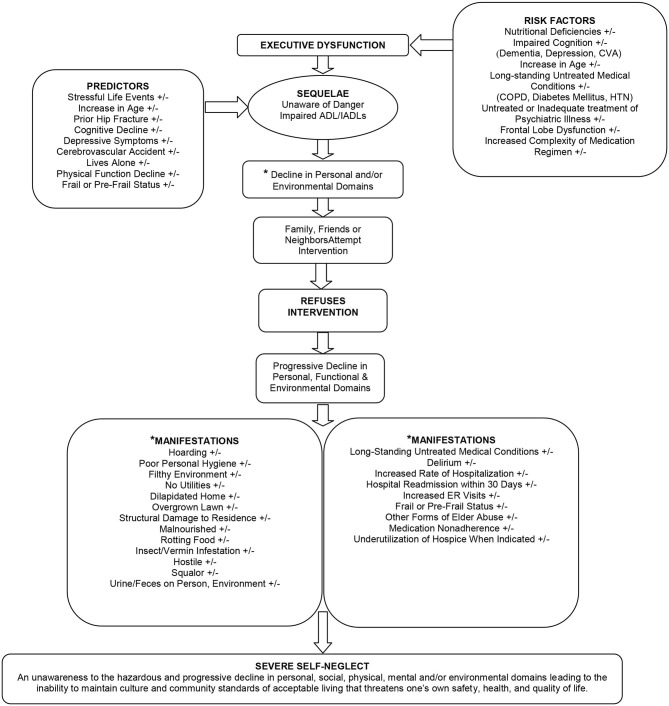
Self-neglect is an inability or refusal to meet one's own basic needs as accepted by societal norms and is the most common report received by state agencies charged with investigating abuse, neglect and exploitation of vulnerable adults. Self-neglect is often seen in addition to one or multiple conditions of frailty, mild to severe dementia, poor sleep and depression. While awareness of elder self-neglect as a public health condition and intervention has significantly risen in the past decade as evidenced by the increasing amount of literature available, research on self-neglect still lacks comprehensiveness and clarity since its inception to the medical literature in the late 1960s. With the burgeoning of the older adult population, commonness of self-neglect will most likely increase as the current incidence rate represents only the "tip of the iceberg" theory given that most cases are unreported. The COVID-19 pandemic has exacerbated the incidence of self-neglect in aged populations and the need for the use of intervention tools for aging adults and geriatric patients living alone, many of which may include in-home artificial intelligence systems. Despite this, little research has been conducted on aspects of self-neglect other than definition and identification. Substantial further study of this disorder's etiology, educating society on early detection, and conceivably preventing this syndrome altogether or at least halting progression and abating its severity is needed. The purpose of this research is to provide a definition of severe self-neglect, identify key concepts related to self-neglect, comprehensively describe this syndrome, present a conceptual framework and analyze the model for its usefulness, generalizability, parsimony, and testability.
自我忽视是指无法或拒绝满足自己符合社会规范的基本需求,这是负责调查对弱势成年人的虐待、忽视和剥削的国家机构收到的最常见报告。自我忽视通常还伴有一种或多种虚弱状况、轻度至重度痴呆、睡眠不佳和抑郁。尽管在过去十年中,作为一种公共卫生状况和干预措施,对老年人自我忽视的认识显著提高,这从现有文献数量的增加就可以看出,但自20世纪60年代末其在医学文献中首次出现以来,对自我忽视的研究仍缺乏全面性和清晰度。随着老年人口的迅速增长,自我忽视的普遍性很可能会增加,因为鉴于大多数病例未被报告,目前的发病率仅代表“冰山一角”理论。COVID-19大流行加剧了老年人群中自我忽视的发生率,以及对独居老年人和老年患者使用干预工具的需求,其中许多工具可能包括家用人工智能系统。尽管如此,除了定义和识别之外,关于自我忽视其他方面的研究很少。需要对这种疾病的病因进行大量进一步研究,对社会进行早期检测教育,并设想完全预防这种综合征,或者至少阻止其进展并减轻其严重程度。本研究的目的是提供严重自我忽视的定义,确定与自我忽视相关的关键概念,全面描述这种综合征,提出一个概念框架,并分析该模型的有用性、可推广性、简约性和可测试性。