Yunus Raudah Mohd, Wazid Syeda Wasfeea, Hairi Noran N, Choo Wan Yuen, Hairi Farizah M, Sooryanarayana Rajini, Ahmad Sharifah N, Razak Inayah A, Peramalah Devi, Aziz Suriyati A, Mohamad Zaiton L, Mohamad Rosmala, Ali Zainudin M, Bulgiba Awang
Julius Centre University of Malaya (JCUM), Department of Social and Preventive Medicine, University of Malaya, Kuala Lumpur.
Department of Population Health and Preventive Medicine, Universiti Teknologi MARA, Sungai Buloh, Selangor.
PLoS One. 2017 Jul 7;12(7):e0180222. doi: 10.1371/journal.pone.0180222. eCollection 2017.
To examine the association between elder abuse and poor sleep using a Malay validated version of Pittsburgh Sleep Quality Index (PSQI).
This study was divided into two phases. Phase I tested the construct validity and reliability of the Malay version of PSQI. Phase II was a population-based, cross-sectional study with a multi-stage cluster sampling method. Home-based interviews were conducted by trained personnel using a structured questionnaire, to determine exposure and outcome.
Kuala Pilah, a district in Negeri Sembilan which is one of the fourteen states in Malaysia.
1648 community-dwelling older Malaysians.
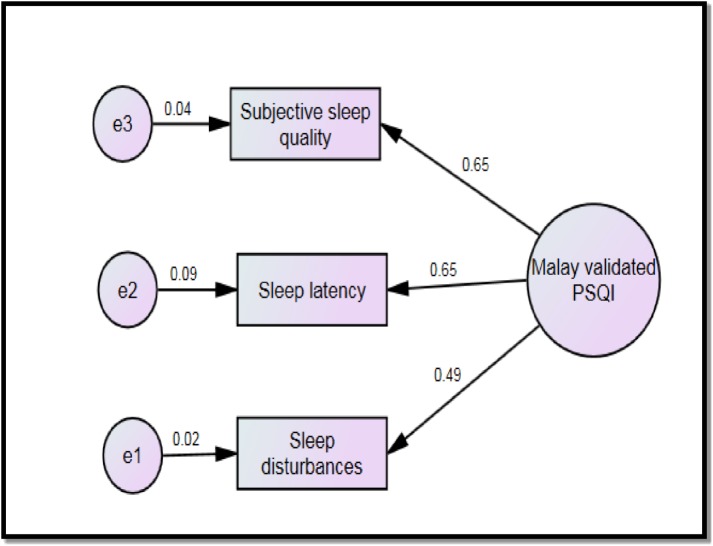
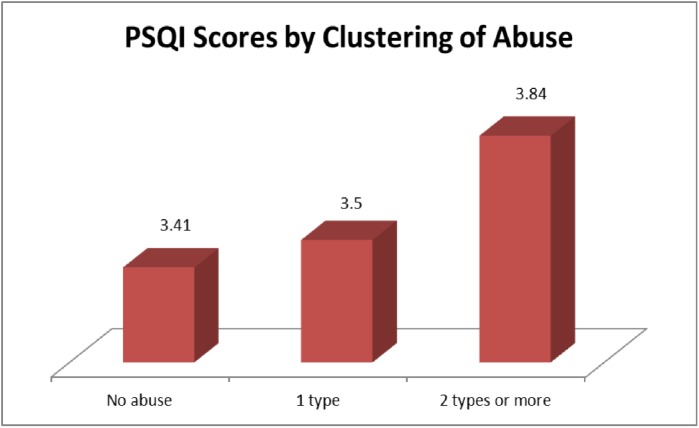
The Malay version of PSQI had significant test re-test reliability with intra-class correlation coefficients of 0.62. Confirmatory factor analyses revealed that one factor PSQI scale with three components (subjective sleep quality, sleep latency, and sleep disturbances) was most suitable. Cronbach's Alpha was 0.60 and composite reliability was 0.63. PSQI scores were highest among neglect (4.11), followed by physical (4.10), psychological (3.96) and financial abuse (3.60). There was a dose-response relationship between clustering of abuse and PSQI scores; 3.41, 3.50 and 3.84 for "no abuse", "1 type of abuse" and "2 types or more". Generalized linear models revealed six variables as significant determinants of sleep quality-abuse, co-morbidities, self-rated health, income, social support and gait speed. Among abuse subtypes, only neglect was significantly associated with poor sleep.
The Malay PSQI was valid and reliable. Abuse was significantly associated with poor sleep. As sleep is essential for health and is a good predictor for mortality among older adults, management of abuse victims should entail sleep assessment. Interventions or treatment modalities which focus on improving sleep quality among abuse victims should be designed.
使用马来语验证版匹兹堡睡眠质量指数(PSQI)来研究虐待老年人与睡眠质量差之间的关联。
本研究分为两个阶段。第一阶段测试马来语版PSQI的结构效度和信度。第二阶段是一项基于人群的横断面研究,采用多阶段整群抽样方法。由经过培训的人员使用结构化问卷进行家庭访谈,以确定暴露因素和结果。
马来西亚十四个州之一的森美兰州的瓜拉庇拉区。
1648名居住在社区的马来西亚老年人。
马来语版PSQI具有显著的重测信度,组内相关系数为0.62。验证性因素分析表明,单因素PSQI量表及其三个组成部分(主观睡眠质量、入睡潜伏期和睡眠障碍)最为合适。克朗巴哈系数为0.60,组合信度为0.63。PSQI得分在忽视虐待类型中最高(4.11),其次是身体虐待(4.10)、心理虐待(3.96)和经济虐待(3.60)。虐待聚集与PSQI得分之间存在剂量反应关系;“无虐待”、“一种虐待类型”和“两种或更多种虐待类型”的得分分别为3.41、3.50和3.84。广义线性模型显示,有六个变量是睡眠质量虐待、合并症、自我健康评价、收入、社会支持和步速的显著决定因素。在虐待亚型中,只有忽视虐待与睡眠质量差显著相关。
马来语版PSQI有效且可靠。虐待与睡眠质量差显著相关。由于睡眠对健康至关重要,并且是老年人死亡率的良好预测指标,对虐待受害者的管理应包括睡眠评估。应设计旨在改善虐待受害者睡眠质量的干预措施或治疗方式。