Callmann Cassandra E, Kusmierz Caroline D, Dittmar Jasper W, Broger Leah, Mirkin Chad A
Department of Chemistry, International Institute for Nanotechnology, Department of Biomedical Engineering, Northwestern University, Evanston, Illinois 60208, United States.
ACS Cent Sci. 2021 May 26;7(5):892-899. doi: 10.1021/acscentsci.1c00181. Epub 2021 Apr 15.
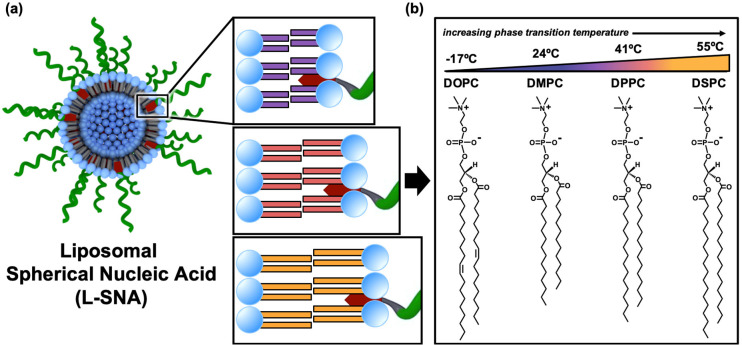
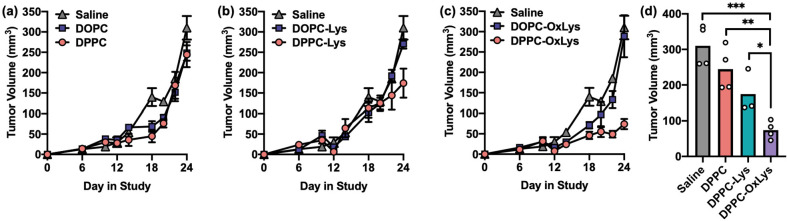
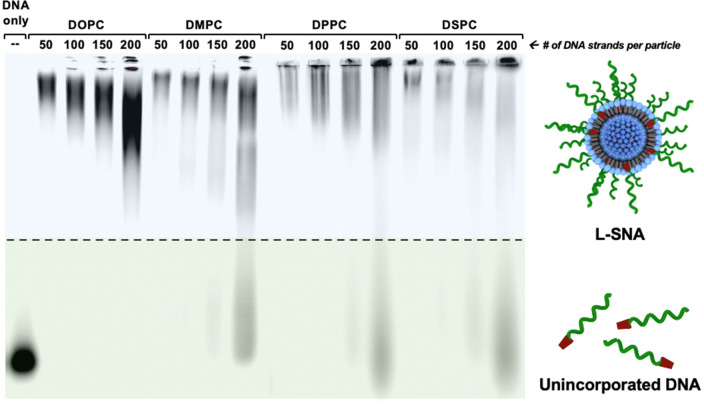
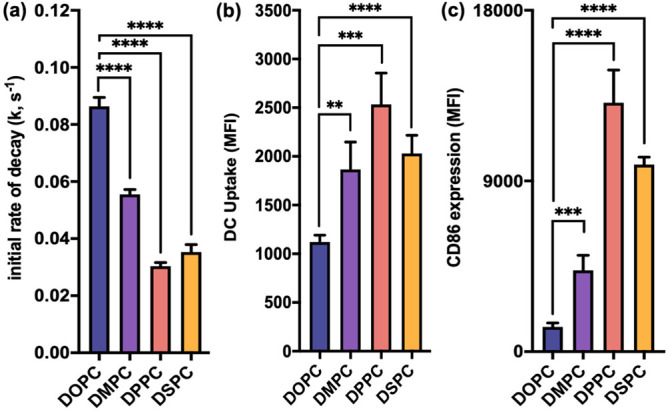
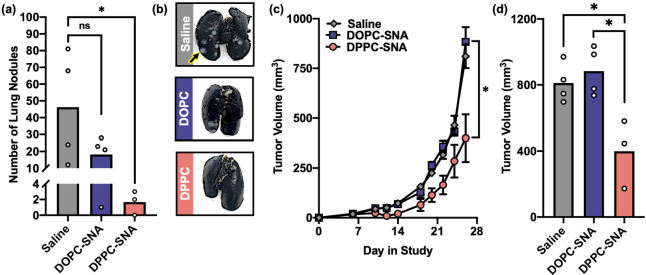
Liposomal spherical nucleic acids (L-SNAs) show significant promise as cancer immunotherapeutics. L-SNAs are highly modular nanoscale assemblies defined by a dense, upright radial arrangement of oligonucleotides around a liposomal core. Herein, we establish a set of L-SNA design rules by studying the biological and immunological properties of L-SNAs as a function of liposome composition. To achieve this, we synthesized liposomes where the lipid phosphatidylcholine headgroup was held constant, while the diacyl lipid tail chain length and degree of saturation were varied, using either 1,2-dioleylphosphatidylcholine (DOPC), 1,2-dimyristoyl-phosphatidylcholine (DMPC), 1,2-dipalmitoylphosphatidylcholine (DPPC), or 1,2-distearoyl-phosphatidylcholine (DSPC). These studies show that the identity of the constituent lipid dictates the DNA loading, cellular uptake, serum stability, immunostimulatory activity, and lymph node accumulation of the L-SNA. Furthermore, in the 4T1 mouse model of triple-negative breast cancer (TNBC), the subcutaneous administration of immunostimulatory L-SNAs synthesized with DPPC significantly decreases the production of lung metastases and delays tumor growth as compared to L-SNAs synthesized using DOPC, due to the enhanced stability of L-SNAs synthesized with DPPC over those synthesized with DOPC. Moreover, the inclusion of cell lysates derived from Py8119 TNBC cells as antigen sources in L-SNAs leads to a significant increase in antitumor efficacy in the Py8119 model when lysates are encapsulated in the cores of L-SNAs synthesized with DPPC rather than DOPC, presumably due to increased codelivery of adjuvant and antigen to dendritic cells . This difference is further amplified when using lysates from oxidized Py8119 cells as a more potent antigen source, revealing synergy between the lysate preparation method and liposome composition in synthesizing immunotherapeutic L-SNAs. Together, this work shows that the biological properties and immunomodulatory activity of L-SNAs can be modulated by exchanging liposome components, providing another handle for the rational design of nanoscale immunotherapeutics.
脂质体球形核酸(L-SNAs)作为癌症免疫疗法显示出巨大的前景。L-SNAs是高度模块化的纳米级组装体,由围绕脂质体核心的密集、直立的寡核苷酸径向排列定义。在此,我们通过研究L-SNAs的生物学和免疫学特性作为脂质体组成的函数,建立了一套L-SNA设计规则。为了实现这一点,我们合成了脂质体,其中脂质磷脂酰胆碱头部基团保持不变,而二酰基脂质尾链长度和饱和度不同,使用1,2-二油酰磷脂酰胆碱(DOPC)、1,2-二肉豆蔻酰磷脂酰胆碱(DMPC)、1,2-二棕榈酰磷脂酰胆碱(DPPC)或1,2-二硬脂酰磷脂酰胆碱(DSPC)。这些研究表明,组成脂质的特性决定了L-SNA的DNA负载、细胞摄取、血清稳定性、免疫刺激活性和淋巴结积累。此外,在三阴性乳腺癌(TNBC)的4T1小鼠模型中,与使用DOPC合成的L-SNAs相比,皮下注射用DPPC合成的免疫刺激L-SNAs显著降低了肺转移的发生率并延迟了肿瘤生长,这是因为用DPPC合成的L-SNAs比用DOPC合成的L-SNAs稳定性更高。此外,当将源自Py8119 TNBC细胞的细胞裂解物作为抗原源包含在L-SNAs中时,当裂解物封装在用DPPC而非DOPC合成的L-SNAs的核心中时,在Py8119模型中抗肿瘤功效显著增加,这可能是由于佐剂和抗原向树突状细胞的共递送增加。当使用来自氧化Py8119细胞的裂解物作为更强效的抗原源时,这种差异会进一步放大,揭示了裂解物制备方法和脂质体组成在合成免疫治疗性L-SNAs中的协同作用。总之,这项工作表明,通过交换脂质体成分可以调节L-SNAs的生物学特性和免疫调节活性,为纳米级免疫疗法的合理设计提供了另一种手段。