Mahajan Akanksha S, Stegh Alexander H
Ken and Ruth Davee Department of Neurology, The International Institute for Nanotechnology, The Malnati Brain Tumor Institute, Feinberg School of Medicine, The Robert H. Lurie Comprehensive Cancer Center, Northwestern University, Chicago, IL 60611, USA.
Department of Neurological Surgery, The Brain Tumor Center, Washington University School of Medicine, Alvin J. Siteman Comprehensive Cancer Center, St. Louis, MO 63110, USA.
Cancers (Basel). 2022 Mar 23;14(7):1615. doi: 10.3390/cancers14071615.
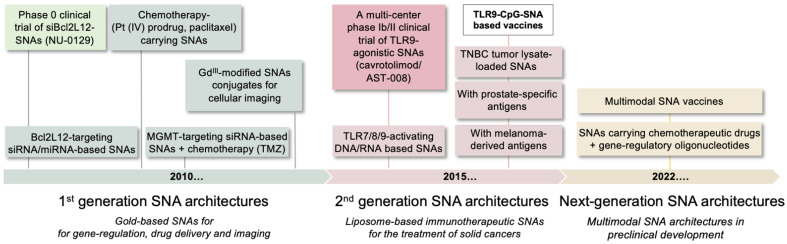
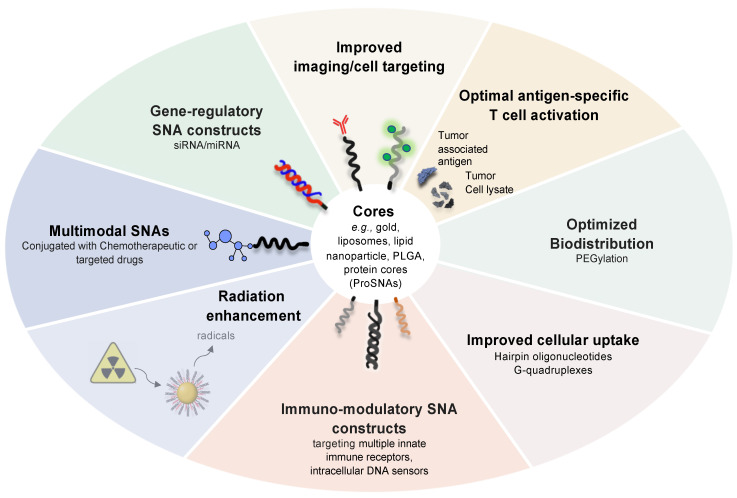
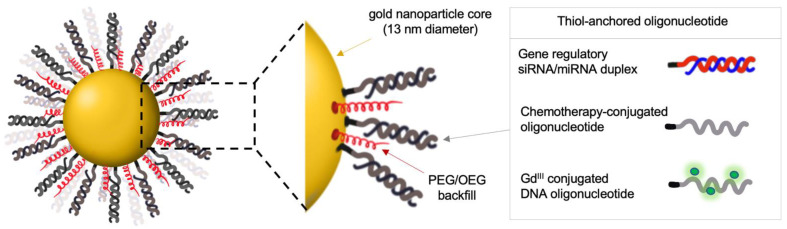
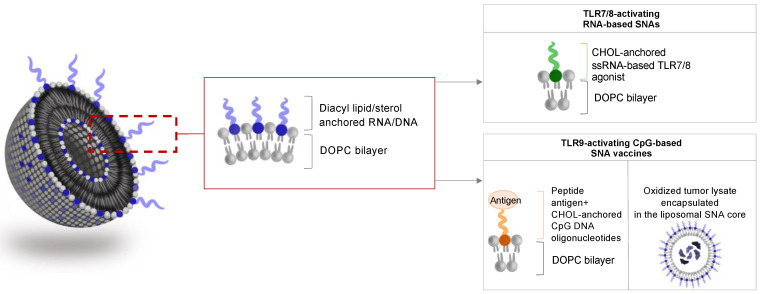
Spherical Nucleic Acids (SNAs) emerged as a new class of nanotherapeutics consisting of a nanoparticle core densely functionalized with a shell of radially oriented synthetic oligonucleotides. The unique three-dimensional architecture of SNAs protects the oligonucleotides from nuclease-mediated degradation, increases oligonucleotide bioavailability, and in the absence of auxiliary transfection agents, enables robust uptake into tumor and immune cells through polyvalent association with cell surface pattern recognition receptors. When composed of gene-regulatory small interfering (si)RNA or immunostimulatory DNA or RNA oligonucleotides, SNAs silence gene expression and induce immune responses superior to those raised by the oligonucleotides in their "free" form. Early phase clinical trials of gene-regulatory siRNA-based SNAs in glioblastoma (NCT03020017) and immunostimulatory Toll-like receptor 9 (TLR9)-agonistic SNAs carrying unmethylated CpG-rich oligonucleotides in solid tumors (NCT03086278) have shown that SNAs represent a safe, brain-penetrant therapy for inhibiting oncogene expression and stimulating immune responses against tumors. This review focuses on the application of SNAs as precision cancer therapeutics, summarizes the findings from first-in-human clinical trials of SNAs in solid tumors, describes the most recent preclinical efforts to rationally design next-generation multimodal SNA architectures, and provides an outlook on future efforts to maximize the anti-neoplastic activity of the SNA platform.
球形核酸(SNA)作为一类新型纳米治疗药物出现,它由一个纳米颗粒核心组成,该核心被一层径向排列的合成寡核苷酸紧密功能化。SNA独特的三维结构可保护寡核苷酸免受核酸酶介导的降解,提高寡核苷酸的生物利用度,并且在没有辅助转染剂的情况下,通过与细胞表面模式识别受体的多价结合,能够强力被肿瘤细胞和免疫细胞摄取。当由基因调控的小干扰(si)RNA或免疫刺激DNA或RNA寡核苷酸组成时,SNA能够使基因表达沉默,并诱导产生比“游离”形式的寡核苷酸更强的免疫反应。基于基因调控siRNA的SNA在胶质母细胞瘤中的早期临床试验(NCT03020017)以及在实体瘤中携带富含未甲基化CpG寡核苷酸的免疫刺激Toll样受体9(TLR9)激动型SNA的早期临床试验(NCT03086278)表明,SNA是一种安全的、可穿透血脑屏障的疗法,可用于抑制癌基因表达和刺激针对肿瘤的免疫反应。本综述重点关注SNA作为精准癌症治疗药物的应用,总结SNA在实体瘤人体首次临床试验中的发现,描述合理设计下一代多模式SNA结构的最新临床前研究工作,并展望未来为最大化SNA平台的抗肿瘤活性所做的努力。