Department of Psychology, Columbia University, New York, USA.
Graduate School of Education, University of California, Riverside, California, USA.
Dev Sci. 2021 Nov;24(6):e13133. doi: 10.1111/desc.13133. Epub 2021 May 26.
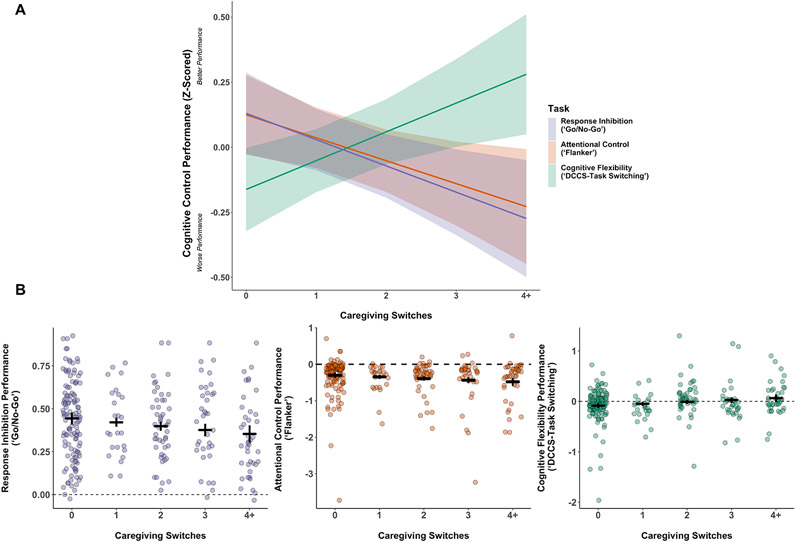
Cognitive control is typically described as disrupted following exposure to early caregiving instability. While much of the work within this field has approached cognitive control broadly, evidence from adults retrospectively reporting early-life instability has shown more nuanced effects on cognitive control, even demonstrating enhancements in certain subdomains. That is, exposure to unstable caregiving may disrupt some areas of cognitive control, yet promote adaptation in others. Here, we investigated three domains of cognitive control in a sample of school-age children (N = 275, Age = 6-12 years) as a function of early caregiving instability, defined as the total number of caregiving switches. Results demonstrated that caregiving instability was associated with reduced response inhibition (Go/No-Go) and attentional control (Flanker), but enhanced cognitive flexibility (Dimensional Change Card Sort Task Switching). Conversely, there were no statistically significant associations with group (i.e., institutional care versus foster care) or maltreatment exposure and these patterns. These findings build on the specialization framework, suggesting that caregiving instability results in both decrements and enhancements in children's cognitive control, consistent with the hypothesis that cognitive control development is scaffolded by early environmental pressures.
认知控制通常被描述为在早期照护不稳定后受到干扰。尽管该领域的大部分工作都广泛地研究了认知控制,但来自成人回顾性报告早期生活不稳定的证据表明,认知控制存在更细微的影响,甚至在某些子领域表现出增强。也就是说,暴露于不稳定的照护环境中可能会破坏某些认知控制领域,同时促进其他领域的适应。在这里,我们研究了在校儿童(N=275,年龄=6-12 岁)样本中认知控制的三个领域,其功能取决于早期照护不稳定,定义为照护者的更换总数。结果表明,照护不稳定与反应抑制(Go/No-Go)和注意力控制(Flanker)降低有关,但认知灵活性(维度变化卡片分类任务转换)增强。相反,与组(即机构照顾与寄养照顾)或虐待暴露无关,也没有统计学意义。这些发现基于专业化框架,表明照护不稳定导致儿童认知控制的既有下降也有增强,这与认知控制发展由早期环境压力支撑的假设一致。