Kato Risako, Zhang Edlyn R, Mallari Olivia G, Moody Olivia A, Vincent Kathleen F, Melonakos Eric D, Siegmann Morgan J, Nehs Christa J, Houle Timothy T, Akeju Oluwaseun, Solt Ken
Department of Anesthesia, Critical Care and Pain Medicine, Massachusetts General Hospital, Boston, MA, United States.
Department of Anaesthesia, Harvard Medical School, Boston, MA, United States.
Front Pharmacol. 2021 May 18;12:668285. doi: 10.3389/fphar.2021.668285. eCollection 2021.
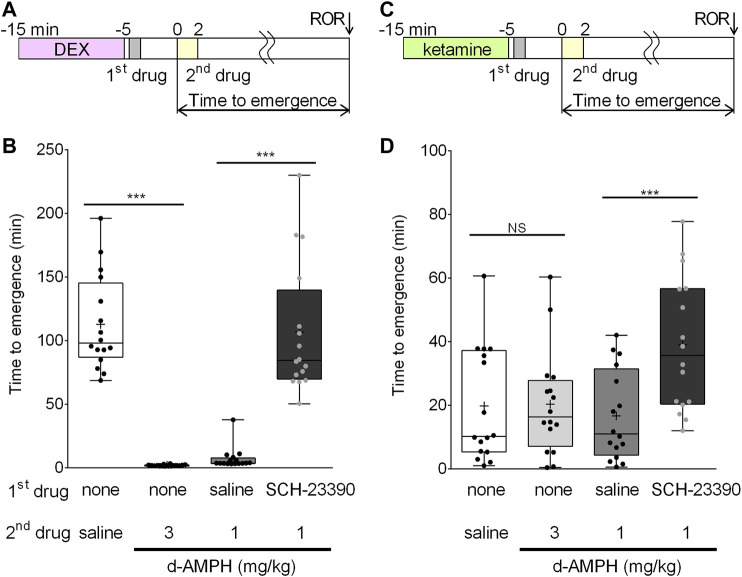
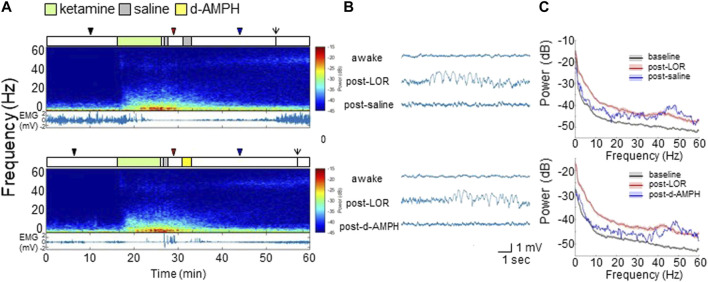
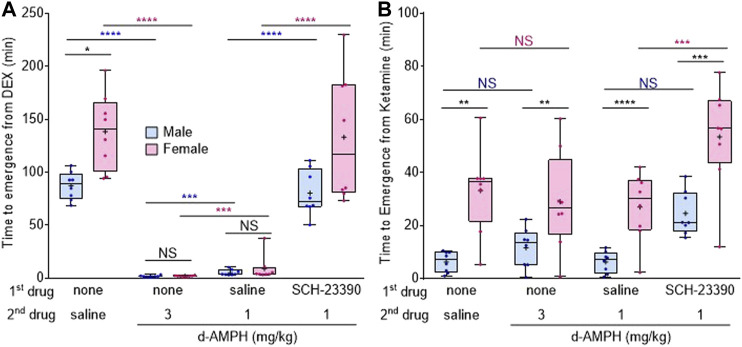
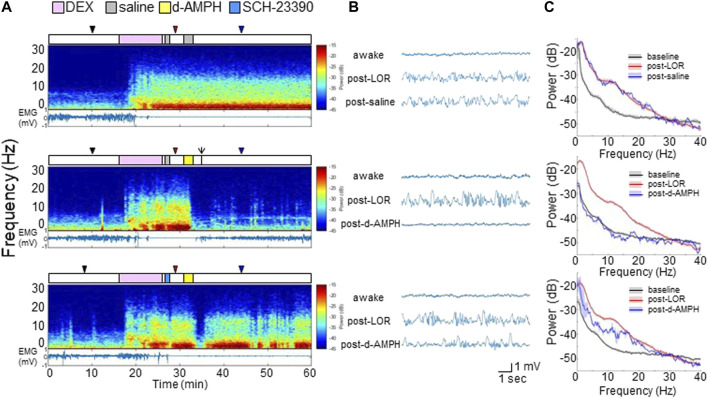
D-amphetamine induces emergence from sevoflurane and propofol anesthesia in rats. Dexmedetomidine is an α-adrenoreceptor agonist that is commonly used for procedural sedation, whereas ketamine is an anesthetic that acts primarily by inhibiting NMDA-type glutamate receptors. These drugs have different molecular mechanisms of action from propofol and volatile anesthetics that enhance inhibitory neurotransmission mediated by GABA receptors. In this study, we tested the hypothesis that d-amphetamine accelerates recovery of consciousness after dexmedetomidine and ketamine. Sixteen rats (Eight males, eight females) were used in a randomized, blinded, crossover experimental design and all drugs were administered intravenously. Six additional rats with pre-implanted electrodes in the prefrontal cortex (PFC) were used to analyze changes in neurophysiology. After dexmedetomidine, d-amphetamine dramatically decreased mean time to emergence compared to saline (saline:112.8 ± 37.2 min; d-amphetamine:1.8 ± 0.6 min, < 0.0001). This arousal effect was abolished by pre-administration of the D/D dopamine receptor antagonist, SCH-23390. After ketamine, d-amphetamine did not significantly accelerate time to emergence compared to saline (saline:19.7 ± 18.0 min; d-amphetamine:20.3 ± 16.5 min, = 1.00). Prefrontal cortex local field potential recordings revealed that d-amphetamine broadly decreased spectral power at frequencies <25 Hz and restored an awake-like pattern after dexmedetomidine. However, d-amphetamine did not produce significant spectral changes after ketamine. The duration of unconsciousness was significantly longer in females for both dexmedetomidine and ketamine. In conclusion, d-amphetamine rapidly restores consciousness following dexmedetomidine, but not ketamine. Dexmedetomidine reversal by d-amphetamine is inhibited by SCH-23390, suggesting that the arousal effect is mediated by D and/or D receptors. These findings suggest that d-amphetamine may be clinically useful as a reversal agent for dexmedetomidine.
右旋苯丙胺可诱导大鼠从七氟醚和丙泊酚麻醉中苏醒。右美托咪定是一种α-肾上腺素能受体激动剂,常用于手术镇静,而氯胺酮是一种主要通过抑制NMDA型谷氨酸受体起作用的麻醉剂。这些药物的分子作用机制与丙泊酚和挥发性麻醉剂不同,丙泊酚和挥发性麻醉剂可增强由GABA受体介导的抑制性神经传递。在本研究中,我们检验了右旋苯丙胺可加速右美托咪定和氯胺酮麻醉后意识恢复的假设。16只大鼠(8只雄性,8只雌性)采用随机、双盲、交叉实验设计,所有药物均通过静脉给药。另外6只在额叶前皮质(PFC)预先植入电极的大鼠用于分析神经生理学变化。给予右美托咪定后,与生理盐水相比,右旋苯丙胺显著缩短了平均苏醒时间(生理盐水组:112.8±37.2分钟;右旋苯丙胺组:1.8±0.6分钟,P<0.0001)。预先给予D1/D2多巴胺受体拮抗剂SCH-23390可消除这种唤醒作用。给予氯胺酮后,与生理盐水相比,右旋苯丙胺并未显著加速苏醒时间(生理盐水组:19.7±18.0分钟;右旋苯丙胺组:20.3±16.5分钟,P= 1.00)。额叶前皮质局部场电位记录显示,右旋苯丙胺可广泛降低频率<25Hz的频谱功率,并在给予右美托咪定后恢复类似清醒的模式。然而,给予氯胺酮后,右旋苯丙胺并未产生显著的频谱变化。右美托咪定和氯胺酮麻醉后,雌性大鼠的无意识持续时间均显著延长。总之,右旋苯丙胺可使右美托咪定麻醉后的意识迅速恢复,但对氯胺酮无效。SCH-23390可抑制右旋苯丙胺对右美托咪定的逆转作用,提示唤醒作用是由D1和/或D2受体介导的。这些发现表明,右旋苯丙胺可能作为右美托咪定的逆转剂在临床上具有应用价值。