Holleb Peter, Patel Priya, Saxena Pranay, Beniwal Jagbir, Zuberi Jamshed
St. George's University School of Medicine, True Blue, Grenada, West Indies.
Department of Surgery, CarePoint Health, Bayonne, NJ, USA.
J Surg Case Rep. 2021 May 28;2021(5):rjab198. doi: 10.1093/jscr/rjab198. eCollection 2021 May.
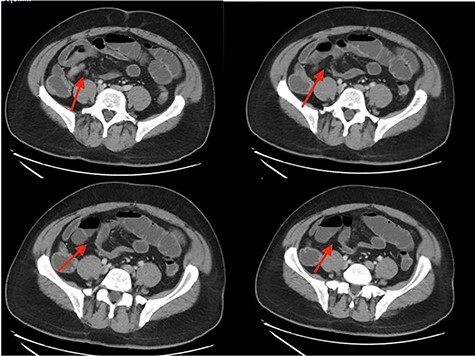
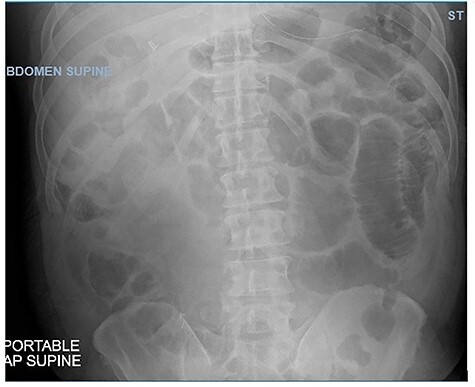
Although primarily a respiratory virus, coronavirus-19 acts on the gastrointestinal tract to cause symptoms such as anorexia, nausea, vomiting and diarrhea. One possible mechanism involves the ACE2 receptor, which serves as the primary receptor for virus entry into the gastrointestinal epithelium. We describe the case of a 54-year-old-male with recent coronavirus disease 2019 (COVID-19) infection, who later presented with nausea, vomiting, diarrhea and progressively worsening diffuse abdominal pain for 1 week. He was diagnosed to have a small bowel obstruction; however, continued to have progressively worsening pain and failed conservative management. No cause for the obstruction was found in the operating room. Gastrointestinal involvement occurs in at least two-thirds of patients with coronavirus infection. Viral entry into the small bowel, triggering an inflammatory response, and virus-induced microthrombosis of the microcirculation have been postulated as a possible mechanism for paralytic ileus/small bowel obstruction.
虽然冠状病毒病-19主要是一种呼吸道病毒,但它会作用于胃肠道,引起食欲不振、恶心、呕吐和腹泻等症状。一种可能的机制涉及血管紧张素转换酶2(ACE2)受体,它是病毒进入胃肠道上皮细胞的主要受体。我们描述了一例54岁男性病例,该患者近期感染了2019冠状病毒病(COVID-19),随后出现恶心、呕吐、腹泻,并伴有进行性加重的弥漫性腹痛达1周。他被诊断为小肠梗阻;然而,疼痛持续进行性加重,保守治疗无效。在手术室未发现梗阻原因。至少三分之二的冠状病毒感染患者会出现胃肠道受累。病毒进入小肠,引发炎症反应,以及病毒诱导的微循环微血栓形成被认为是麻痹性肠梗阻/小肠梗阻的一种可能机制。