Mundy Jessica, Hübel Christopher, Gelernter Joel, Levey Daniel, Murray Robin M, Skelton Megan, Stein Murray B, Vassos Evangelos, Breen Gerome, Coleman Jonathan R I
Social, Genetic and Developmental Psychiatry Centre; Institute of Psychiatry, Psychology & Neuroscience, King's College London, London, UK.
UK National Institute for Health Research (NIHR) Biomedical Research Centre, South London and Maudsley National Health Service (NHS) Trust, London, UK.
Psychol Med. 2021 Jun 4;52(16):1-10. doi: 10.1017/S0033291721000830.
Posttraumatic stress disorder (PTSD) and major depressive disorder (MDD) are commonly reported co-occurring mental health consequences of psychological trauma exposure. The disorders have high genetic overlap. Trauma is a complex phenotype but research suggests that trauma sensitivity has a heritable basis. We investigated whether sensitivity to trauma in those with MDD reflects a similar genetic component in those with PTSD.
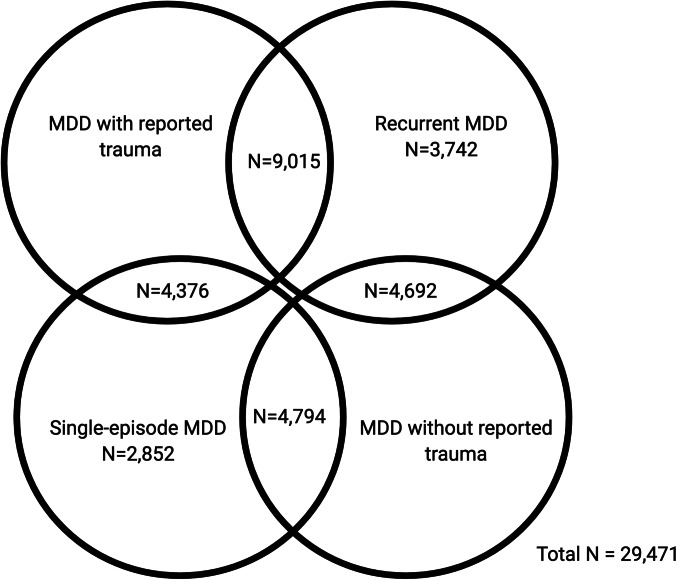
Genetic correlations between PTSD and MDD in individuals reporting trauma and MDD in individuals not reporting trauma were estimated, as well as with recurrent MDD and single-episode MDD, using genome-wide association study (GWAS) summary statistics. Genetic correlations were replicated using PTSD data from the Psychiatric Genomics Consortium and the Million Veteran Program. Polygenic risk scores were generated in UK Biobank participants who met the criteria for lifetime MDD (N = 29 471). We investigated whether genetic loading for PTSD was associated with reporting trauma in these individuals.
Genetic loading for PTSD was significantly associated with reporting trauma in individuals with MDD [OR 1.04 (95% CI 1.01-1.07), Empirical-p = 0.02]. PTSD was significantly more genetically correlated with recurrent MDD than with MDD in individuals not reporting trauma (rg differences = ~0.2, p < 0.008). Participants who had experienced recurrent MDD reported significantly higher rates of trauma than participants who had experienced single-episode MDD (χ2 > 166, p < 0.001).
Our findings point towards the existence of genetic variants associated with trauma sensitivity that might be shared between PTSD and MDD, although replication with better powered GWAS is needed. Our findings corroborate previous research highlighting trauma exposure as a key risk factor for recurrent MDD.
创伤后应激障碍(PTSD)和重度抑郁症(MDD)是心理创伤暴露后常见的共病心理健康后果。这两种疾病具有高度的遗传重叠性。创伤是一种复杂的表型,但研究表明创伤敏感性具有遗传基础。我们调查了患有MDD的个体对创伤的敏感性是否反映了患有PTSD的个体中类似的遗传成分。
使用全基因组关联研究(GWAS)汇总统计数据,估计报告创伤的个体中PTSD与MDD之间以及未报告创伤的个体中MDD与复发性MDD和单发性MDD之间的遗传相关性。使用来自精神病基因组学联盟和百万退伍军人计划的PTSD数据重复进行遗传相关性分析。在符合终生MDD标准的英国生物银行参与者(N = 29471)中生成多基因风险评分。我们调查了这些个体中PTSD的遗传负荷是否与报告创伤有关。
PTSD的遗传负荷与患有MDD的个体报告创伤显著相关[比值比1.04(95%可信区间1.01 - 1.07),经验p值 = 0.02]。与未报告创伤的个体相比,PTSD与复发性MDD的遗传相关性显著高于与MDD的遗传相关性(遗传相关性差异约为0.2,p < 0.008)。经历过复发性MDD的参与者报告的创伤发生率显著高于经历过单发性MDD的参与者(χ2 > 166,p < 0.001)。
我们的研究结果表明,可能存在与创伤敏感性相关的遗传变异,这些变异可能在PTSD和MDD之间共享,尽管需要通过更强大的GWAS进行重复验证。我们的研究结果证实了先前的研究,强调创伤暴露是复发性MDD的关键风险因素。