Servicio de Microbiología, Hospital Universitario Marqués de Valdecilla, Santander, Spain.
Instituto de Investigación Valdecilla-IDIVAL, Santander, Spain.
Sci Rep. 2021 Jun 4;11(1):11875. doi: 10.1038/s41598-021-90382-5.
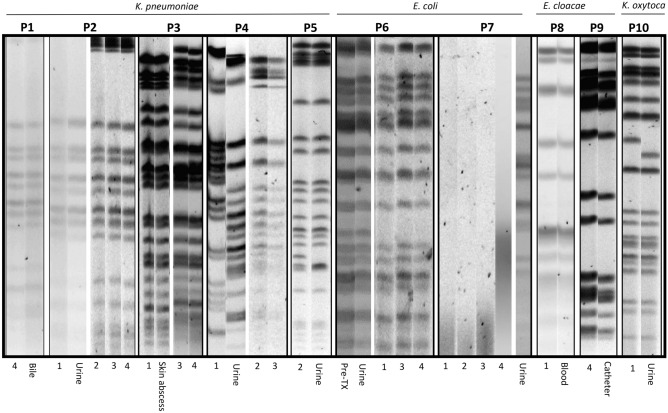
The objective of this study was to analyse the mechanisms of resistance to carbapenems and other extended-spectrum-β-lactams and to determine the genetic relatedness of multidrug-resistant Enterobacterales (MDR-E) causing colonization or infection in solid-organ transplantation (SOT) recipients. Prospective cohort study in kidney (n = 142), liver (n = 98) or kidney/pancreas (n = 7) transplant recipients between 2014 and 2018 in seven Spanish hospitals. We included 531 MDR-E isolates from rectal swabs obtained before transplantation and weekly for 4-6 weeks after the procedure and 10 MDR-E from clinical samples related to an infection. Overall, 46.2% Escherichia coli, 35.3% Klebsiella pneumoniae, 6.5% Enterobacter cloacae, 6.3% Citrobacter freundii and 5.7% other species were isolated. The number of patients with MDR-E colonization post-transplantation (176; 71.3%) was 2.5-fold the number of patients colonized pre-transplantation (71; 28.7%). Extended-spectrum β-lactamases (ESBLs) and carbapenemases were detected in 78.0% and 21.1% of MDR-E isolates respectively. In nine of the 247 (3.6%) transplant patients, the microorganism causing an infection was the same strain previously cultured from surveillance rectal swabs. In our study we have observed a low rate of MDR-E infection in colonized patients 4-6 weeks post-transplantation. E. coli producing bla and K. pneumoniae harbouring bla alone or with bla were the most prevalent MDR-E colonization strains in SOT recipients.
本研究旨在分析耐碳青霉烯类和其他扩展谱β-内酰胺类药物的机制,并确定引起实体器官移植(SOT)受者定植或感染的多药耐药肠杆菌科(MDR-E)的遗传相关性。2014 年至 2018 年,在西班牙的 7 家医院,对 142 例肾移植、98 例肝移植或肾/胰移植受者进行了前瞻性队列研究。我们纳入了 531 例来自直肠拭子的 MDR-E 分离株,这些分离株在移植前获得,并在手术后 4-6 周内每周获得一次,另外还纳入了 10 例与感染相关的 MDR-E 临床样本。总体而言,分离出 46.2%的大肠埃希菌、35.3%的肺炎克雷伯菌、6.5%的阴沟肠杆菌、6.3%的弗氏柠檬酸杆菌和 5.7%的其他种属。移植后 MDR-E 定植的患者(176 例;71.3%)是定植于移植前的患者(71 例;28.7%)的 2.5 倍。MDR-E 分离株中分别检出 78.0%的超广谱β-内酰胺酶(ESBLs)和 21.1%的碳青霉烯酶。在 247 例(3.6%)移植患者中,引起感染的微生物与之前从监测直肠拭子中培养出的相同菌株。在我们的研究中,我们观察到移植后 4-6 周定植患者的 MDR-E 感染率较低。在 SOT 受者中,产 bla 的大肠埃希菌和携带 bla 或 bla 的肺炎克雷伯菌是最常见的 MDR-E 定植株。