Innovation Center, Amano Enzyme Inc., Technoplaza, Kakamigahara, Gifu, 509-0109, Japan.
Division of Applied Chemistry, Graduate School of Natural Science and Technology, Okayama University, Tsushima, Okayama, 700-8530, Japan.
Sci Rep. 2021 Jun 4;11(1):11883. doi: 10.1038/s41598-021-91339-4.
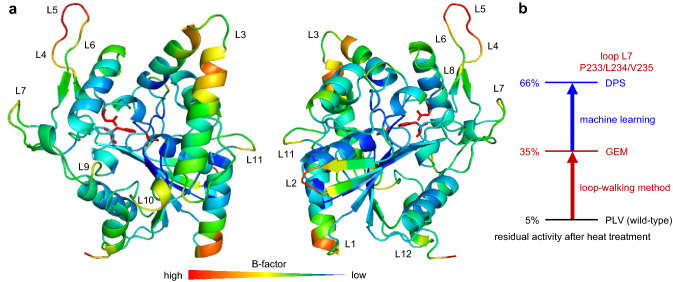
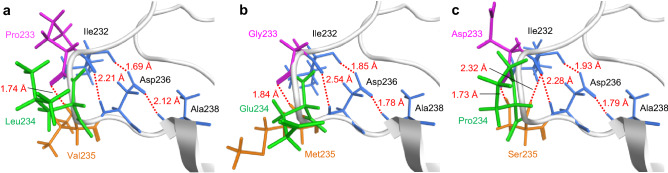
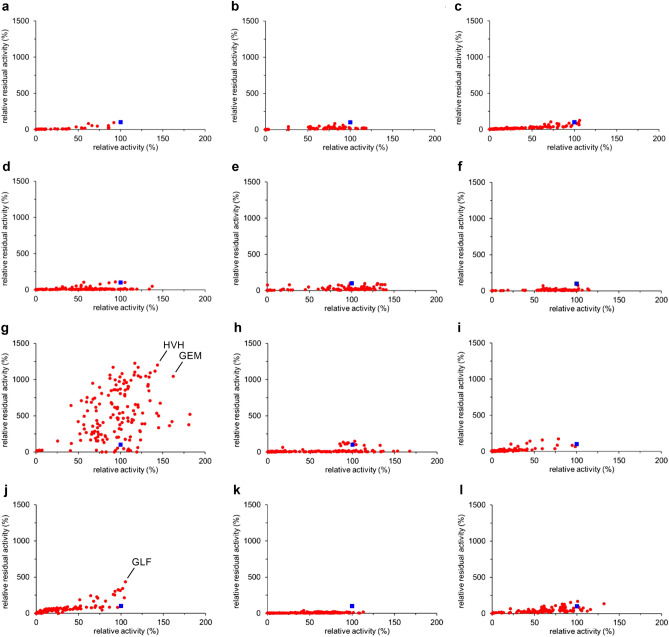
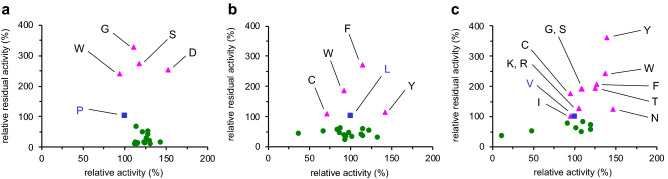
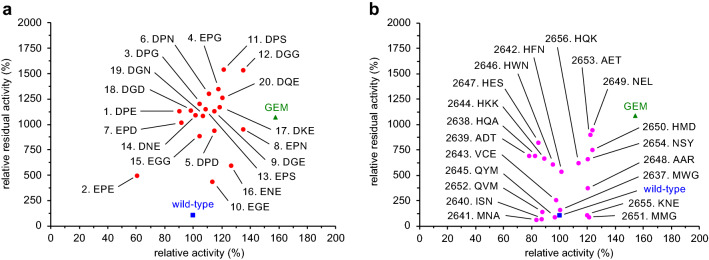
We developed a method to improve protein thermostability, "loop-walking method". Three consecutive positions in 12 loops of Burkholderia cepacia lipase were subjected to random mutagenesis to make 12 libraries. Screening allowed us to identify L7 as a hot-spot loop having an impact on thermostability, and the P233G/L234E/V235M mutant was found from 214 variants in the L7 library. Although a more excellent mutant might be discovered by screening all the 8000 P233X/L234X/V235X mutants, it was difficult to assay all of them. We therefore employed machine learning. Using thermostability data of the 214 mutants, a computational discrimination model was constructed to predict thermostability potentials. Among 7786 combinations ranked in silico, 20 promising candidates were selected and assayed. The P233D/L234P/V235S mutant retained 66% activity after heat treatment at 60 °C for 30 min, which was higher than those of the wild-type enzyme (5%) and the P233G/L234E/V235M mutant (35%).
我们开发了一种提高蛋白质热稳定性的方法,即“环行走方法”。对伯克霍尔德氏菌脂肪酶的 12 个环中的 3 个连续位置进行随机诱变,得到 12 个文库。通过筛选,我们确定 L7 是一个对热稳定性有影响的热点环,并且在 L7 文库的 214 个变体中发现了 P233G/L234E/V235M 突变体。尽管通过筛选所有 8000 个 P233X/L234X/V235X 突变体可能会发现更优秀的突变体,但要对它们进行测定是很困难的。因此,我们采用了机器学习。使用 214 个突变体的热稳定性数据,构建了一个计算判别模型来预测热稳定性潜力。在计算机模拟的 7786 种组合中,选择了 20 个有前途的候选者进行测定。在 60°C 下加热 30 分钟后,P233D/L234P/V235S 突变体保留了 66%的活性,高于野生型酶(5%)和 P233G/L234E/V235M 突变体(35%)。