Laurent Alexandra, Fournier Alicia, Lheureux Florent, Louis Guillaume, Nseir Saad, Jacq Gwenaelle, Goulenok Cyril, Muller Grégoire, Badie Julio, Bouhemad Bélaïd, Georges Marjolaine, Mertes Paul-Michel, Merdji Hamid, Castelain Vincent, Abdulmalak Caroline, Lesieur Olivier, Plantefeve Gaëtan, Lacherade Jean-Claude, Rigaud Jean-Philippe, Sedillot Nicholas, Roux Damien, Terzi Nicolas, Beuret Pascal, Monsel Antoine, Poujol Anne-Laure, Kuteifan Khaldoun, Vanderlinden Thierry, Renault Anne, Vivet Bérengère, Vinsonneau Christophe, Barbar Saber Davide, Capellier Gilles, Dellamonica Jean, Ehrmann Stephan, Rimmelé Thomas, Bohé Julien, Bouju Pierre, Gibot Sébastien, Lévy Bruno, Temime Johanna, Pichot Cyrille, Schnell David, Friedman Diane, Asfar Pierre, Lebas Eddy, Mateu Philippe, Klouche Kada, Audibert Juliette, Ecarnot Fiona, Meunier-Beillard Nicolas, Loiseau Mélanie, François-Pursell Irène, Binquet Christine, Quenot Jean-Pierre
Laboratoire de Psychologie: Dynamiques Relationnelles et Processus Identitaires (PsyDREPI), Université de Bourgogne Franche-Comté, Dijon, France.
Department of Anaesthesiology and Critical Care Medicine, Dijon University Medical Centre, Dijon, France.
Ann Intensive Care. 2021 Jun 4;11(1):90. doi: 10.1186/s13613-021-00880-y.
We investigated the impact of the COVID-19 crisis on mental health of professionals working in the intensive care unit (ICU) according to the intensity of the epidemic in France.
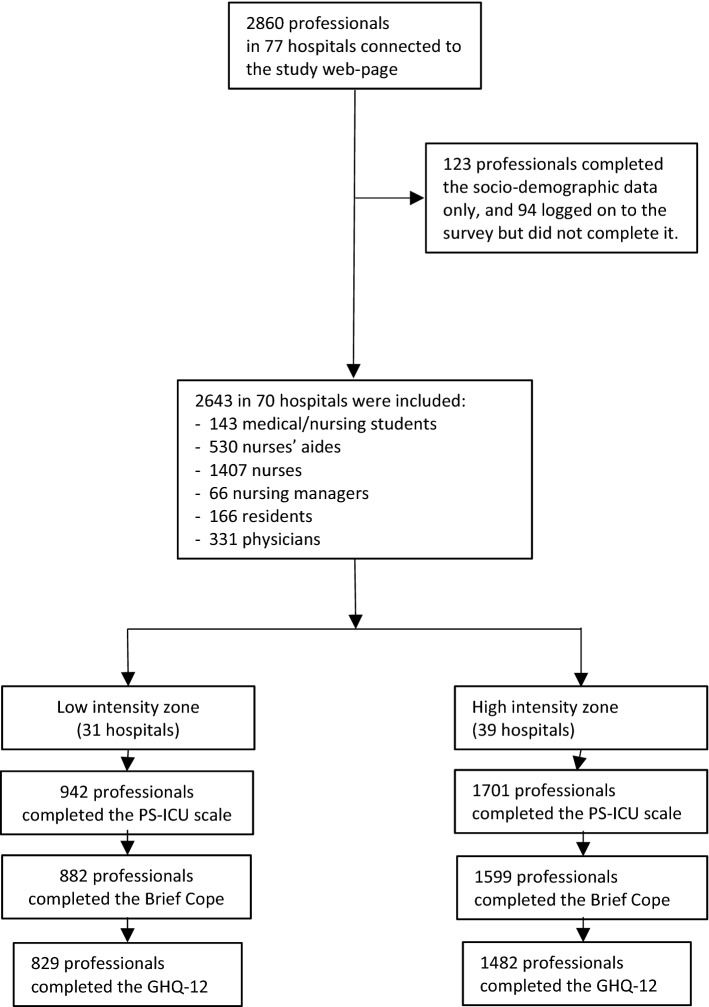
This cross-sectional survey was conducted in 77 French hospitals from April 22 to May 13 2020. All ICU frontline healthcare workers were eligible. The primary endpoint was the mental health, assessed using the 12-item General Health Questionnaire. Sources of stress during the crisis were assessed using the Perceived Stressors in Intensive Care Units (PS-ICU) scale. Epidemic intensity was defined as high or low for each region based on publicly available data from Santé Publique France. Effects were assessed using linear mixed models, moderation and mediation analyses.
In total, 2643 health professionals participated; 64.36% in high-intensity zones. Professionals in areas with greater epidemic intensity were at higher risk of mental health issues (p < 0.001), and higher levels of overall perceived stress (p < 0.001), compared to low-intensity zones. Factors associated with higher overall perceived stress were female sex (B = 0.13; 95% confidence interval [CI] = 0.08-0.17), having a relative at risk of COVID-19 (B = 0.14; 95%-CI = 0.09-0.18) and working in high-intensity zones (B = 0.11; 95%-CI = 0.02-0.20). Perceived stress mediated the impact of the crisis context on mental health (B = 0.23, 95%-CI = 0.05, 0.41) and the impact of stress on mental health was moderated by positive thinking, b = - 0.32, 95% CI = - 0.54, - 0.11.
COVID-19 negatively impacted the mental health of ICU professionals. Professionals working in zones where the epidemic was of high intensity were significantly more affected, with higher levels of perceived stress. This study is supported by a grant from the French Ministry of Health (PHRC-COVID 2020).
我们根据法国疫情的严重程度,调查了新型冠状病毒肺炎(COVID-19)危机对重症监护病房(ICU)医护人员心理健康的影响。
这项横断面调查于2020年4月22日至5月13日在法国77家医院进行。所有ICU一线医护人员均符合条件。主要终点是心理健康,采用12项一般健康问卷进行评估。危机期间的压力源使用重症监护病房感知压力源(PS-ICU)量表进行评估。根据法国公共卫生署公开的数据,将每个地区的疫情严重程度定义为高或低。使用线性混合模型、调节和中介分析评估影响。
共有2643名医护人员参与;64.36%在高强度地区。与低强度地区相比,疫情强度较大地区的专业人员出现心理健康问题的风险更高(p<0.001),总体感知压力水平也更高(p<0.001)。与总体感知压力较高相关的因素包括女性(B=0.13;95%置信区间[CI]=0.08-0.17)、有感染COVID-19风险的亲属(B=0.14;95%-CI=0.09-0.18)以及在高强度地区工作(B=0.11;95%-CI=0.02-0.20)。感知压力介导了危机背景对心理健康的影响(B=0.23,95%-CI=0.05,0.41),压力对心理健康的影响通过积极思维得到调节,b=-0.32,95%CI=-0.54,-0.11。
COVID-19对ICU专业人员的心理健康产生了负面影响。在疫情高强度地区工作的专业人员受到的影响明显更大,感知压力水平更高。本研究得到了法国卫生部(PHRC-COVID 2020)的资助。