Martínez Juan Pedro, Méndez Inmaculada, Ruiz-Esteban Cecilia, Fernández-Sogorb Aitana, García-Fernández José Manuel
Department of Developmental Psychology and Education, University of Murcia, Murcia, Spain.
Department of Developmental Psychology and Didactics, Faculty of Education, University of Alicante, Alicante, Spain.
Front Psychol. 2020 Apr 2;11:591. doi: 10.3389/fpsyg.2020.00591. eCollection 2020.
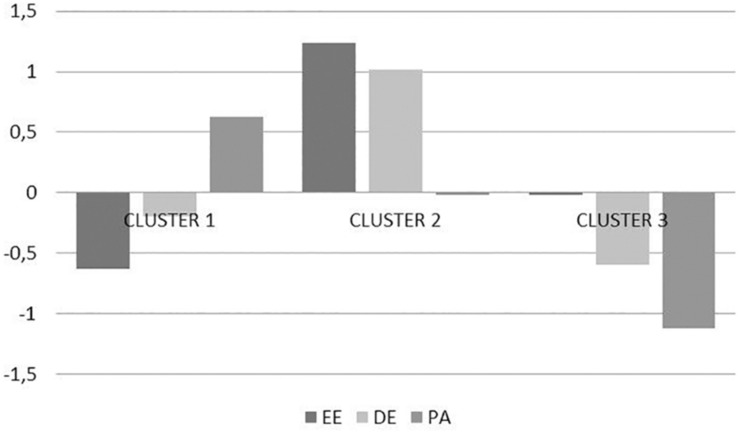
Burnout syndrome is has been associated with mental health problems such as depression, anxiety, and stress. Given this fact, some teachers implement various coping strategies for emotional control that are not always functional to mitigate such difficulties. Accordingly, this study aimed to identify different burnout profiles that vary in the levels of the three underlying dimensions: depersonalization (DE), emotional exhaustion (EE), and personal accomplishment (PA). Further, this study aimed to examine whether there are significant differences in depressive symptomatology, coping strategies, and the quality of interpersonal relationships at school between teachers with varying burnout profiles. The Maslach Burnout Inventory (MBI), Zung Self-Rating Depression Scale (SDS), Coping with Stress Questionnaire, and a questionnaire that measured sociodemographic characteristics were administered to 215 teachers (men: 42.8%) who were recruited from various secondary schools. Cluster analysis identified three different burnout profiles: groups of teachers with a predominance of (a) low levels of EE and high levels of PA, (b) high levels of EE and DE, and (c) low levels of DE and PA. The results revealed that there were significant differences in coping strategies, depressive symptomatology, and the quality of interpersonal relationships at school between teachers with different burnout profiles. These results have important implications for educational professionals. Specifically, the findings underscore the need for prevention and intervention programs that enhance teachers' emotional skills, especially their ability to cope with exhaustion. These skills will alleviate their depression and consequently offer both teachers and students a conducive learning environment.
职业倦怠综合征与抑郁、焦虑和压力等心理健康问题有关。鉴于这一事实,一些教师实施了各种情绪控制应对策略,但这些策略并不总是能有效缓解此类困难。因此,本研究旨在识别在去个性化(DE)、情绪耗竭(EE)和个人成就感(PA)这三个潜在维度水平上存在差异的不同职业倦怠类型。此外,本研究旨在考察不同职业倦怠类型的教师在抑郁症状、应对策略以及学校人际关系质量方面是否存在显著差异。对从各所中学招募的215名教师(男性占42.8%)进行了马氏职业倦怠量表(MBI)、zung自评抑郁量表(SDS)、应对压力问卷以及一份测量社会人口学特征的问卷。聚类分析确定了三种不同的职业倦怠类型:主要为(a)低水平EE和高水平PA、(b)高水平EE和DE、(c)低水平DE和PA的教师群体。结果显示,不同职业倦怠类型的教师在应对策略、抑郁症状以及学校人际关系质量方面存在显著差异。这些结果对教育专业人员具有重要意义。具体而言,研究结果强调了开展预防和干预项目的必要性,这些项目应提升教师的情绪技能,尤其是他们应对耗竭的能力。这些技能将减轻他们的抑郁情绪,从而为教师和学生都提供一个有利的学习环境。