Research Unit Lung Repair and Regeneration, Helmholtz Zentrum München-German Research Center for Environmental Health, Ludwig Maximilian University of Munich, University Hospital Großhadern, Member of the German Center for Lung Research (DZL), Munich, Germany.
Institute of Virology, Helmholtz Zentrum München-German Research Center for Environmental Health, Neuherberg, Germany.
Br J Pharmacol. 2021 Oct;178(19):4026-4041. doi: 10.1111/bph.15581. Epub 2021 Jul 31.
Emphysema is an incurable disease characterized by loss of lung tissue leading to impaired gas exchange. Wnt/β-catenin signalling is reduced in emphysema, and exogenous activation of the pathway in experimental models in vivo and in human ex vivo lung tissue improves lung function and structure. We sought to identify a pharmaceutical able to activate Wnt/β-catenin signalling and assess its potential to activate lung epithelial cells and repair.
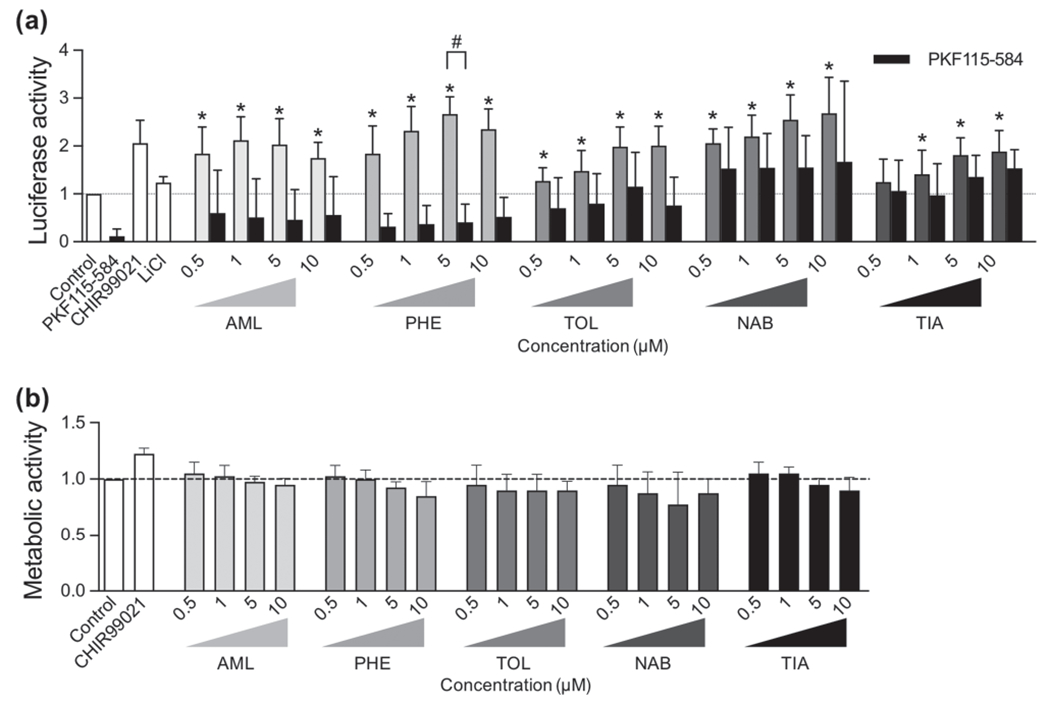
We screened 1216 human-approved compounds for Wnt/β-catenin signalling activation using luciferase reporter cells and selected candidates based on their computationally predicted protein targets. We further performed confirmatory luciferase reporter and metabolic activity assays. Finally, we studied the regenerative potential in murine adult epithelial cell-derived lung organoids and in vivo using a murine elastase-induced emphysema model.
The primary screen identified 16 compounds that significantly induced Wnt/β-catenin-dependent luciferase activity. Selected compounds activated Wnt/β-catenin signalling without inducing cell toxicity or proliferation. Two compounds were able to promote organoid formation, which was reversed by pharmacological Wnt/β-catenin inhibition, confirming the Wnt/β-catenin-dependent mechanism of action. Amlexanox was used for in vivo evaluation, and preventive treatment resulted in improved lung function and structure in emphysematous mouse lungs. Moreover, gene expression of Hgf, an important alveolar repair marker, was increased, whereas disease marker Eln was decreased, indicating that amlexanox induces pro-regenerative signalling in emphysema.
Using a drug screen based on Wnt/β-catenin activity, organoid assays and a murine emphysema model, amlexanox was identified as a novel potential therapeutic agent for emphysema.
肺气肿是一种不可治愈的疾病,其特征是肺组织丧失导致气体交换受损。Wnt/β-连环蛋白信号在肺气肿中减少,体内实验模型和人离体肺组织中外源性激活该途径可改善肺功能和结构。我们试图寻找一种能够激活 Wnt/β-连环蛋白信号的药物,并评估其激活肺上皮细胞和修复的潜力。
我们使用荧光素酶报告细胞筛选了 1216 种人类批准的化合物,以寻找激活 Wnt/β-连环蛋白信号的化合物,并根据其预测的蛋白质靶标选择候选化合物。我们进一步进行了确认荧光素酶报告和代谢活性测定。最后,我们在鼠成年上皮细胞衍生的肺类器官和使用弹性蛋白酶诱导的肺气肿模型的体内研究了再生潜力。
初级筛选确定了 16 种可显著诱导 Wnt/β-连环蛋白依赖性荧光素酶活性的化合物。选定的化合物激活了 Wnt/β-连环蛋白信号,而不会诱导细胞毒性或增殖。两种化合物能够促进类器官的形成,而这种形成可以被药理学 Wnt/β-连环蛋白抑制所逆转,证实了 Wnt/β-连环蛋白依赖性作用机制。氨苯砜用于体内评估,预防性治疗可改善肺气肿小鼠的肺功能和结构。此外,重要的肺泡修复标志物 Hgf 的基因表达增加,而疾病标志物 Eln 减少,表明氨苯砜在肺气肿中诱导了促再生信号。
使用基于 Wnt/β-连环蛋白活性的药物筛选、类器官测定和鼠肺气肿模型,鉴定出氨苯砜是一种治疗肺气肿的新型潜在治疗药物。