Reconstructive Orthopaedic Surgery Innovative Techniques, Musculoskeletal Tissue Bank, IRCCS Istituto Ortopedico Rizzoli, via G.C. Pupilli, 1, 40136, Bologna, Italy.
, Via di Casaglia 28, 40135, Bologna, Italy.
J Orthop Traumatol. 2021 Jun 5;22(1):21. doi: 10.1186/s10195-021-00582-y.
Nonunions remain a significant burden in orthopedics, often afflicting young males of working age. Positive findings have been published using bone marrow aspirate concentrate (BMAC) and platelet-rich fibrin (PRF) for the treatment augmentation of lower limb nonunions. The aim of this study was to investigate if the treatment augmentation with BMAC and PRF can also accelerate the healing of nonunions of the upper limb.
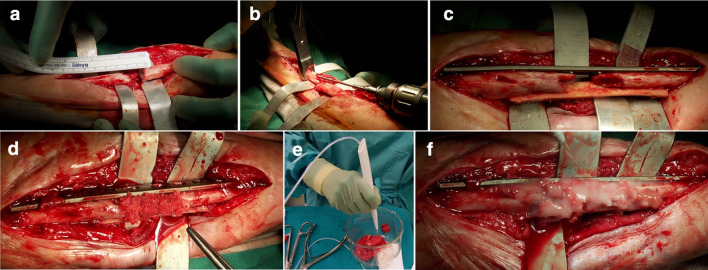
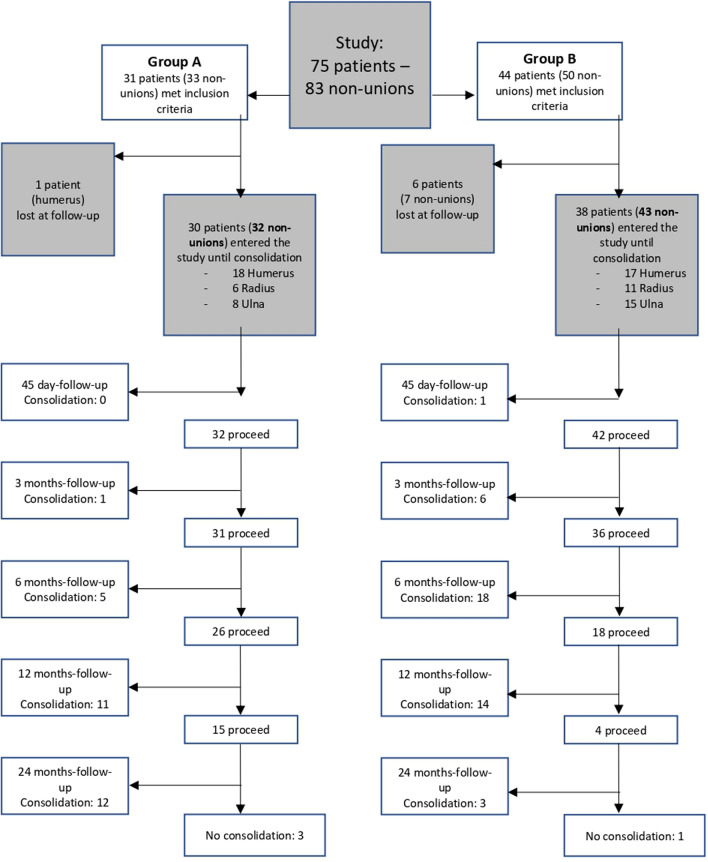
Sixty-eight patients (45 men, 23 women) affected by 75 nonunions of long bones of the upper limb were treated and divided into two groups. The first series was treated with standard surgery alone (group A); afterwards, the second series benefited from standard surgery with the addition of BMAC and PRF applied on lyophilized bone chips. Nonunions were classified radiographically according to the Weber-Cech method and prognostically using the Calori and Moghaddam scores. All patients were radiographically assessed at 1.5, 3, 6, 12, and 24 months of follow-up.
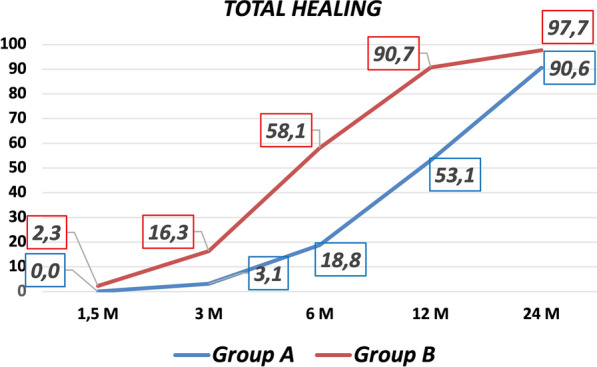
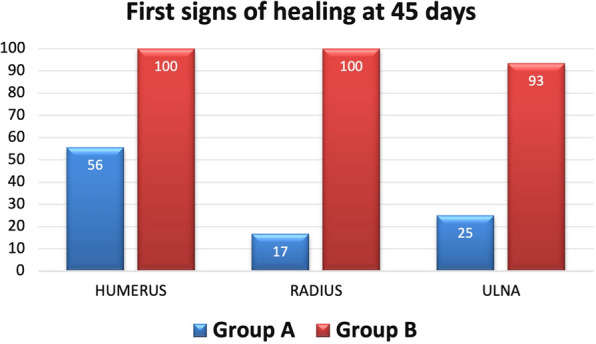
Baseline demographic characteristics did not present differences between groups. No differences were documented in terms of complications (two in group A and three in group B). Significant differences were instead documented in terms of healing time. The first healing signs were observed 1.5 months after surgery in 90.7% of patients in group B and 34.4% of group A (p < 0.0005). At 1.5, 3, 6, and 12 months, a higher radiographic score was found for group B (all p < 0.0005), while no difference was found at final follow-up of 24 months (90.6% of group A and 97.7% of group B achieved radiological healing). Faster healing with BMAC/PRF augmentation was confirmed for all bones, as well as for the subgroup of patients affected by atrophic nonunions (p = 0.001).
This study showed the benefits of restoring both mechanical and biological aspects when addressing nonunions of the long bones of the upper limb. In particular, the association of BMAC and PRF to lyophilized bone chips was safe and able to accelerate healing time. These good results were confirmed for humerus, radius, and ulna sites, as well as for challenging atrophic nonunions of the upper limb.
骨不连仍然是骨科的一个重大负担,常影响到处于工作年龄的年轻男性。已经有研究报道使用骨髓抽吸浓缩物(BMAC)和富含血小板的纤维蛋白(PRF)来治疗下肢骨不连并取得了积极的效果。本研究旨在探讨 BMAC 和 PRF 治疗是否也能加速上肢骨不连的愈合。
68 名患者(45 名男性,23 名女性)患有 75 处上肢长骨骨不连,分为两组。第一组仅接受标准手术治疗(A 组);之后,第二组在标准手术的基础上,在冻干骨屑上应用 BMAC 和 PRF。根据 Weber-Cech 方法进行影像学分类,并根据 Calori 和 Moghaddam 评分进行预后评估。所有患者均在术后 1.5、3、6、12 和 24 个月进行影像学评估。
两组患者的基线人口统计学特征无差异。两组在并发症方面无差异(A 组 2 例,B 组 3 例)。愈合时间方面存在显著差异。B 组有 90.7%的患者在术后 1.5 个月出现首次愈合迹象,而 A 组仅为 34.4%(p<0.0005)。在 1.5、3、6 和 12 个月时,B 组的影像学评分更高(均 p<0.0005),但在 24 个月的最终随访时无差异(A 组 90.6%和 B 组 97.7%的患者达到影像学愈合)。BMAC/PRF 增强治疗可加速所有骨骼的愈合,以及治疗萎缩性骨不连的亚组患者(p=0.001)。
本研究表明,在上肢长骨骨不连的治疗中,恢复力学和生物学方面均有益处。特别是将 BMAC 和 PRF 与冻干骨屑结合使用是安全的,能够加速愈合时间。这些良好的结果在肱骨、桡骨和尺骨部位以及上肢具有挑战性的萎缩性骨不连中得到了证实。