Talotta Rossella, Robertson Erle S
Rheumatology Unit, Department of Clinical and Experimental Medicine, University of Messina, AOU "Gaetano Martino", via Consolare Valeria 1, 98124, Messina, Italy.
Department of Otorhinolaryngology-Head and Neck Surgery, Perelman School of Medicine, University of Pennsylvania, 3610 Hamilton Walk, 201E JP, Philadelphia, PA, 19104, USA.
Cytokine Growth Factor Rev. 2021 Aug;60:52-60. doi: 10.1016/j.cytogfr.2021.05.001. Epub 2021 May 28.
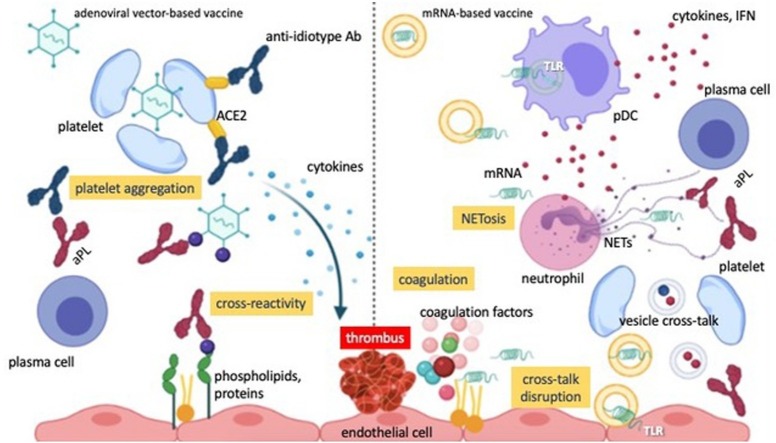
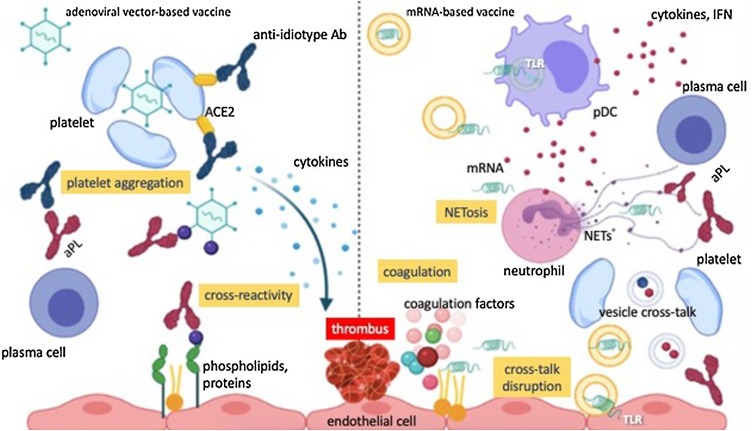
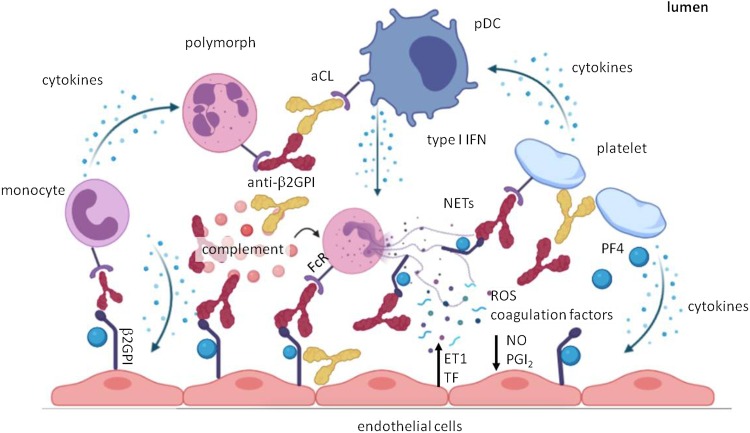
Antiphospholipid antibodies (aPLs), present in 1-5 % of healthy individuals, are associated with the risk of antiphospholipid syndrome (APS), which is the most common form of acquired thrombophilia. APLs may appear following infections or vaccinations and have been reported in patients with COronaVIrus Disease-2019 (COVID-19). However, their association with COVID-19 vaccination is unclear. Notably, a few cases of thrombocytopenia and thrombotic events resembling APS have been reported to develop in recipients of either adenoviral vector- or mRNA-based COVID-19 vaccines. The aim of this review is therefore to speculate on the plausible role of aPLs in the pathogenesis of these rare adverse events. Adenoviral vector-based vaccines can bind platelets and induce their destruction in the reticuloendothelial organs. Liposomal mRNA-based vaccines may instead favour activation of coagulation factors and confer a pro-thrombotic phenotype to endothelial cells and platelets. Furthermore, both formulations may trigger a type I interferon response associated with the generation of aPLs. In turn, aPLs may lead to aberrant activation of the immune response with participation of innate immune cells, cytokines and the complement cascade. NETosis, monocyte recruitment and cytokine release may further support endothelial dysfunction and promote platelet aggregation. These considerations suggest that aPLs may represent a risk factor for thrombotic events following COVID-19 vaccination, and deserve further investigations.
抗磷脂抗体(aPLs)存在于1%至5%的健康个体中,与抗磷脂综合征(APS)的风险相关,APS是获得性血栓形成倾向最常见的形式。aPLs可能在感染或接种疫苗后出现,并且在2019冠状病毒病(COVID-19)患者中也有报道。然而,它们与COVID-19疫苗接种的关联尚不清楚。值得注意的是,据报道,接受腺病毒载体或mRNA新冠疫苗的受种者中出现了几例类似APS的血小板减少和血栓形成事件。因此,本综述的目的是推测aPLs在这些罕见不良事件发病机制中的可能作用。基于腺病毒载体的疫苗可以结合血小板并在网状内皮器官中诱导其破坏。基于脂质体mRNA的疫苗则可能有利于凝血因子的激活,并赋予内皮细胞和血小板促血栓形成表型。此外,两种制剂都可能引发与aPLs产生相关的I型干扰素反应。反过来,aPLs可能导致先天免疫细胞、细胞因子和补体级联反应参与的免疫反应异常激活。中性粒细胞胞外诱捕网形成、单核细胞募集和细胞因子释放可能进一步支持内皮功能障碍并促进血小板聚集。这些考虑表明,aPLs可能是COVID-19疫苗接种后血栓形成事件的一个危险因素,值得进一步研究。