Arnaud Catherine, Ehlinger Virginie, Delobel-Ayoub Malika, Klapouszczak Dana, Perra Oliver, Hensey Owen, Neubauer David, Hollódy Katalin, Virella Daniel, Rackauskaite Gija, Greitane Andra, Himmelmann Kate, Ortibus Els, Dakovic Ivana, Andersen Guro L, Papavasiliou Antigone, Sellier Elodie, Platt Mary Jane, Krägeloh-Mann Inge
UMR 1027 SPHERE Team, Inserm, Toulouse 3 Paul Sabatier University, Toulouse, France.
Childhood Disability Registry in Haute-Garonne, University Hospital of Toulouse, Toulouse, France.
Front Neurol. 2021 May 20;12:624884. doi: 10.3389/fneur.2021.624884. eCollection 2021.
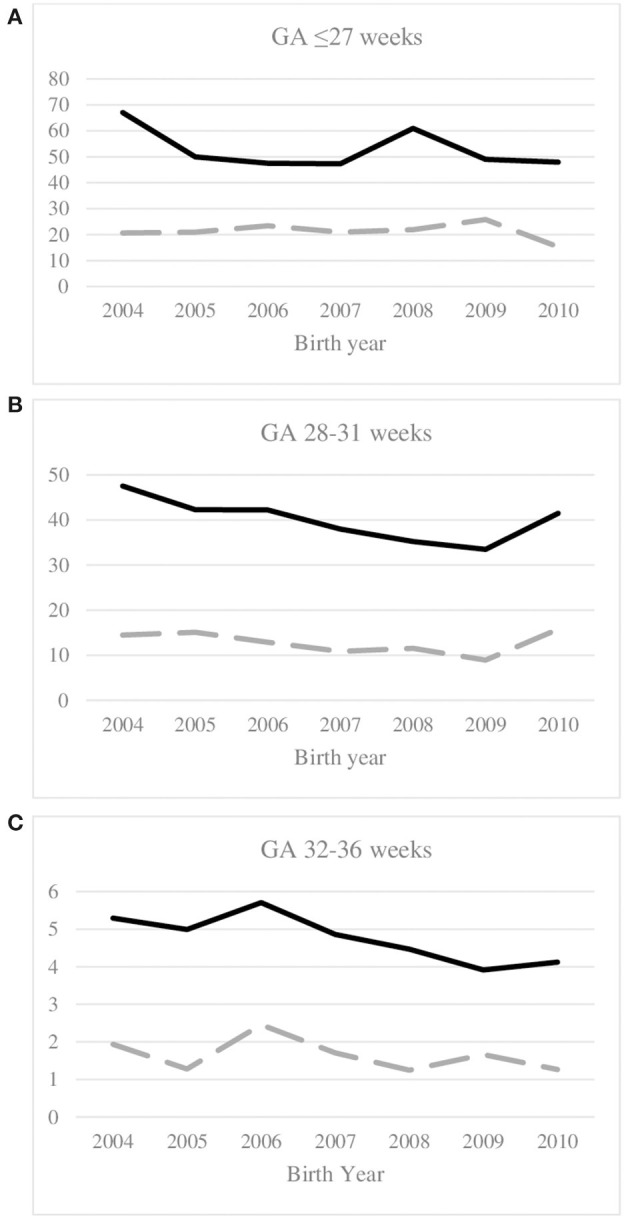
To report on prevalence of cerebral palsy (CP), severity rates, and types of brain lesions in children born preterm 2004 to 2010 by gestational age groups. Data from 12 population-based registries of the Surveillance of Cerebral Palsy in Europe network were used. Children with CP were eligible if they were born preterm (<37 weeks of gestational age) between 2004 and 2010, and were at least 4 years at time of registration. Severity was assessed using the impairment index. The findings of postnatal brain imaging were classified according to the predominant pathogenic pattern. Prevalences were estimated per 1,000 live births with exact 95% confidence intervals within each stratum of gestational age: ≤27, 28-31, 32-36 weeks. Time trends of both overall prevalence and prevalence of severe CP were investigated using multilevel negative binomial regression models. The sample comprised 2,273 children. 25.8% were born from multiple pregnancies. About 2-thirds had a bilateral spastic CP. 43.5% of children born ≤27 weeks had a high impairment index compared to 37.0 and 38.5% in the two other groups. Overall prevalence significantly decreased (incidence rate ratio per year: 0.96 [0.92-1.00[) in children born 32-36 weeks. We showed a decrease until 2009 for children born 28-31 weeks but an increase in 2010 again, and a steady prevalence (incidence rate ratio per year = 0.97 [0.92-1.02] for those born ≤27 weeks. The prevalence of the most severely affected children with CP revealed a similar but not significant trend to the overall prevalence in the corresponding GA groups. Predominant white matter injuries were more frequent in children born <32 weeks: 81.5% (≤27 weeks) and 86.4% (28-31 weeks), compared to 63.6% for children born 32-36 weeks. Prevalence of CP in preterm born children continues to decrease in Europe excepting the extremely immature children, with the most severely affected children showing a similar trend.
报告2004年至2010年按胎龄分组的早产儿童脑性瘫痪(CP)患病率、严重程度率及脑损伤类型。使用了欧洲脑性瘫痪监测网络12个基于人群的登记处的数据。符合条件的CP儿童为2004年至2010年之间早产(胎龄<37周)且登记时至少4岁的儿童。使用损伤指数评估严重程度。根据主要致病模式对出生后脑成像结果进行分类。在每个胎龄层(≤27周、28 - 31周、32 - 36周)中,按每1000例活产估计患病率及确切的95%置信区间。使用多级负二项回归模型研究总体患病率和重度CP患病率的时间趋势。样本包括2273名儿童。25.8%为多胎妊娠出生。约三分之二为双侧痉挛性CP。胎龄≤27周出生的儿童中有43.5%损伤指数高,而其他两组分别为37.0%和38.5%。32 - 36周出生的儿童总体患病率显著下降(每年发病率比:0.96 [0.92 - 1.00])。我们发现28 - 31周出生的儿童在2009年之前患病率下降,但在2010年再次上升,而胎龄≤27周出生的儿童患病率稳定(每年发病率比 = 0.97 [0.92 - 1.02])。CP最严重受影响儿童的患病率在相应胎龄组中显示出与总体患病率相似但不显著的趋势。胎龄<32周出生的儿童中主要白质损伤更常见:胎龄≤27周的为81.5%,28 - 31周的为86.4%,而胎龄32 - 36周出生的儿童为63.6%。欧洲除极不成熟儿童外,早产儿童CP患病率持续下降,最严重受影响儿童呈现类似趋势。