Cerebral Palsy Alliance Research Institute, Sydney Medical School, The University of Sydney, Camperdown, New South Wales, Australia.
Murdoch Children's Research Institute, The Royal Children's Hospital, University of Melbourne, Melbourne, Victoria, Australia.
Dev Med Child Neurol. 2022 Sep;64(9):1114-1122. doi: 10.1111/dmcn.15195. Epub 2022 Mar 8.
To investigate temporal trends in birth prevalence, disability severity, and motor type for singletons with prenatal or perinatally acquired cerebral palsy (CP).
Numerator data, number of children with CP born a singleton between 1995 and 2014, confirmed at 5 years of age, were drawn from three state registers with population-level ascertainment. Birth prevalence estimates and 95% confidence intervals (CI) were calculated per 1000 singleton live births for the three states combined, overall, by gestational age group, by dichotomized disability severity, and spastic laterality. Poisson regression models were used to analyse trends. Using data from all eight registers, trends in the proportional distribution of CP subtypes overall and stratified by gestational age were examined.
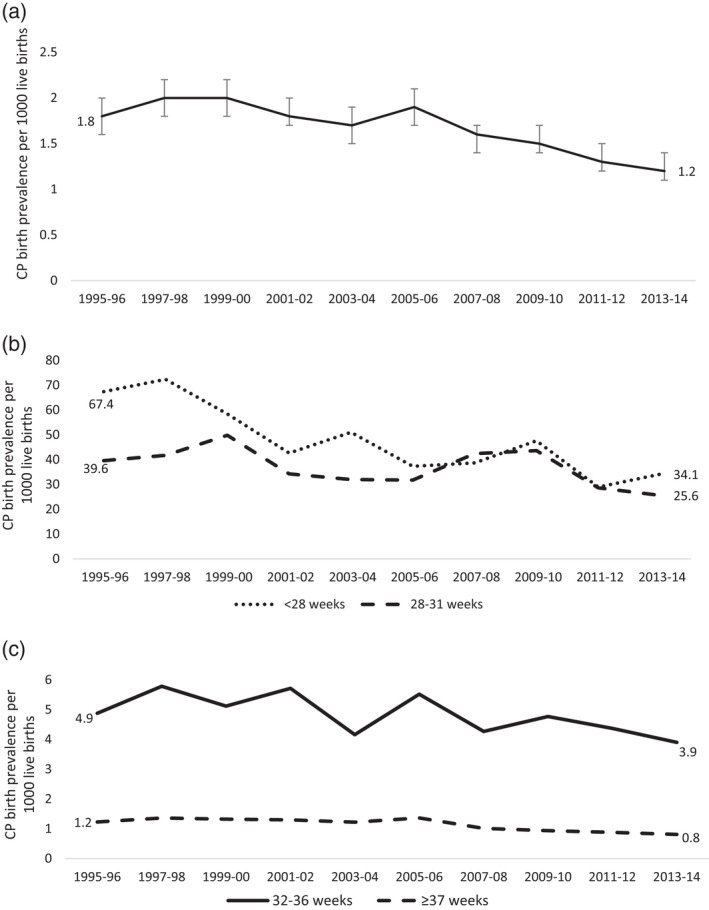
Birth prevalence of CP declined from 1.8 (95% CI 1.6-2.0) in 1995 to 1996 to 1.2 (95% CI 1.1-1.4) in 2013 to 2014 (average 5% per 2-year epoch, p < 0.001). Declines in birth prevalence were observed across all gestational age groups with the largest decline in children born at <28 weeks (average 8% per epoch, p < 0.001). Prevalence of moderate-severe disability declined for children born at <28 and ≥37 weeks (average 11% and 7% per epoch respectively, p < 0.001). The proportions of bilateral spastic CP declined (p < 0.001) at <28 weeks (p = 0.014) and ≥37 weeks (p < 0.001). The proportion of children with dyskinesia increased (28-31 weeks: p = 0.021, 32-36 weeks: p = 0.001, and ≥37 weeks: p < 0.001).
Birth prevalence of CP and moderate-severe disability (<28 and ≥37 weeks) declined in Australian singletons between 1995 and 2014, reflecting changes in prenatal and perinatal care over time.
Declines in birth prevalence of prenatal or perinatally acquired cerebral palsy were observed for singletons born in Australia between 1995 and 2014. These declines were evident across all gestational age groups. Declines in birth prevalence of moderate-severe disability were observed for children born at <28 weeks and ≥37 weeks.
研究产前或围产期获得性脑瘫(CP)单胎的发病流行率、残疾严重程度和运动类型的时间趋势。
从三个具有人群水平确认的州登记处抽取了 1995 年至 2014 年间出生的、5 岁时确诊为 CP 的单胎儿童的分子数据,即儿童人数。计算了三个州合并的每 1000 例活产儿的流行率估计值和 95%置信区间(CI),整体上按胎龄组、残疾严重程度二分法和痉挛性偏侧性进行计算。使用泊松回归模型分析趋势。利用来自所有八个登记处的数据,检查了 CP 亚型的比例分布在总体和按胎龄分层的趋势。
CP 的发病流行率从 1995 年至 1996 年的 1.8(95%CI 1.6-2.0)降至 2013 年至 2014 年的 1.2(95%CI 1.1-1.4)(平均每 2 年时段下降 5%,p<0.001)。所有胎龄组均观察到发病流行率下降,胎龄<28 周的儿童下降幅度最大(平均每时段 8%,p<0.001)。胎龄<28 周和≥37 周出生的儿童中,中度至重度残疾的患病率下降(平均每时段分别为 11%和 7%,p<0.001)。双侧痉挛性 CP 的比例下降(p<0.001),胎龄<28 周(p=0.014)和≥37 周(p<0.001)。胎龄 28-31 周(p=0.021)、32-36 周(p=0.001)和≥37 周(p<0.001)时,多动性 CP 的比例增加。
1995 年至 2014 年间,澳大利亚单胎 CP 和中度至重度残疾(<28 周和≥37 周)的发病流行率下降,反映了随时间推移产前和围产期护理的变化。
在澳大利亚,1995 年至 2014 年间出生的产前或围产期获得性脑瘫的单胎儿童,其发病流行率呈下降趋势。这些下降在所有胎龄组中均有体现。胎龄<28 周和≥37 周出生的儿童中,中度至重度残疾的发病流行率下降。