
作为微反应器的共价有机框架:限域增强电化学发光
Covalent organic frameworks as micro-reactors: confinement-enhanced electrochemiluminescence.
作者信息
Zeng Wei-Jia, Wang Kun, Liang Wen-Bin, Chai Ya-Qin, Yuan Ruo, Zhuo Ying
机构信息
Chongqing Engineering Laboratory of Nanomaterials & Sensor Technologies, College of Chemistry and Chemical Engineering, Southwest University Chongqing 400715 China
National Engineering Research Center for Modernization of Traditional Chinese Medicine-Hakka Medical Resources Branch, College of Pharmacy, Gannan Medical University Ganzhou 341000 China.
出版信息
Chem Sci. 2020 Apr 30;11(21):5410-5414. doi: 10.1039/d0sc01817a.
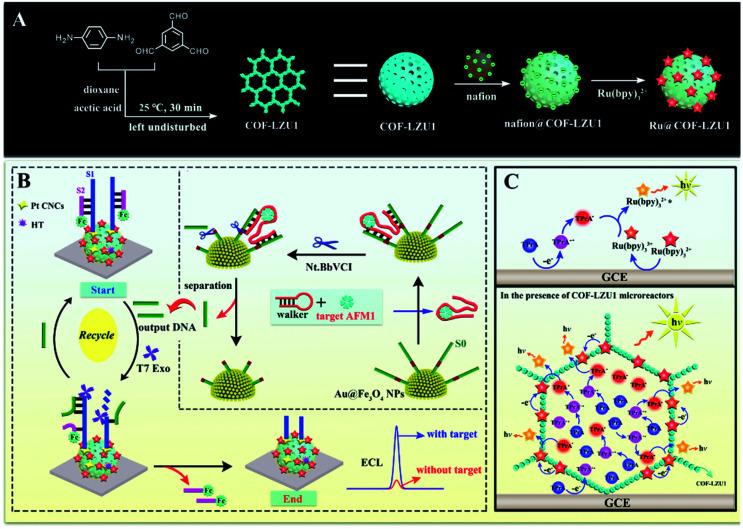
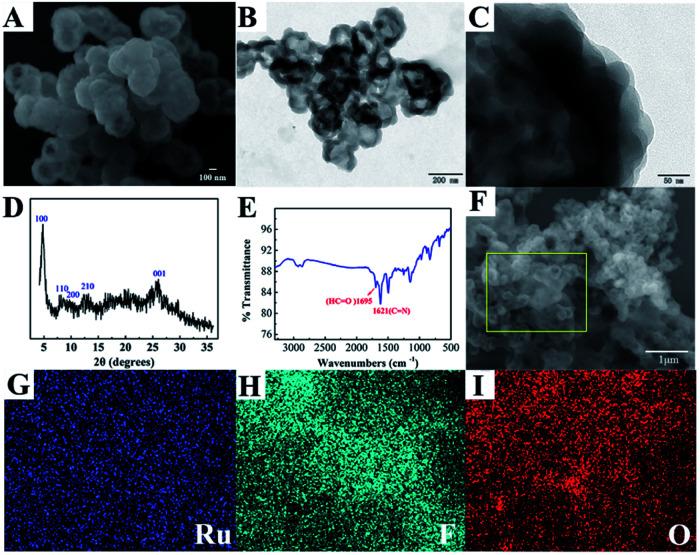
Electrochemiluminescence (ECL) micro-reactors with enhanced intensity and extreme stability were first established by the assembly of tris(2,2'-bipyridyl) ruthenium(ii) (Ru(bpy) ) onto covalent organic frameworks (COFs), in which a type of imine-linked COF (denoted as COF-LZU1) was employed as a model for ECL micro-reactors. Compared with the dominant ECL system of Ru(bpy) /tri--propylamine (TPrA) (TPrA as a co-reactant), the intensity of the COF-LZU1 micro-reactor-based electrode was significantly increased nearly 5-fold under the same experimental conditions, which is unprecedented in other Ru(bpy) -based ECL systems. This enhancement can be attributed to the large surface area, delimited space, and stable and hydrophobic porous structure of COF-LZU1, which not only enabled a huge amount of Ru(bpy) to be loaded in/on COF-LZU1, but also enriched a large amount of TPrA from the aqueous solution into its inner hydrophobic cavity due to the lipophilicity of TPrA. More importantly, with its hydrophobic porous nanochannels, COF-LZU1 could act as micro-reactors to provide a delimited reaction micro-environment for the electrochemical oxidation of TPrA and the survival of TPrA˙, achieving significant confinement-enhanced ECL. To prove this principle, these Ru@COF-LZU1 micro-reactors were developed to prepare an ECL aptasensor for aflatoxin M1 (AFM1) detection with a wide detection range and a low detection limit. Overall, this work is the first report in which ECL micro-reactors are constructed with COFs to enhance the intensity and stability of the Ru(bpy) -based ECL system, and opens a new route to the design of other ECL micro-reactors for bioanalysis applications.
通过将三(2,2'-联吡啶)钌(II)(Ru(bpy) )组装到共价有机框架(COF)上,首次构建了具有增强强度和极高稳定性的电化学发光(ECL)微反应器,其中一种亚胺连接的COF(表示为COF-LZU1)被用作ECL微反应器的模型。与占主导地位的Ru(bpy) /三丙胺(TPrA)(TPrA作为共反应物)的ECL体系相比,在相同实验条件下,基于COF-LZU1微反应器的电极强度显著提高了近5倍,这在其他基于Ru(bpy) 的ECL体系中是前所未有的。这种增强可归因于COF-LZU1的大表面积、限定空间以及稳定且疏水的多孔结构,这不仅使大量的Ru(bpy) 能够负载在COF-LZU1内部/表面,而且由于TPrA的亲脂性,还能将大量的TPrA从水溶液富集到其内部疏水腔中。更重要的是,凭借其疏水多孔纳米通道,COF-LZU1可以作为微反应器,为TPrA的电化学氧化和TPrA˙的存活提供限定的反应微环境,实现显著的限域增强ECL。为了证明这一原理,开发了这些Ru@COF-LZU1微反应器,用于制备用于黄曲霉毒素M1(AFM1)检测的ECL适配体传感器,具有宽检测范围和低检测限。总体而言,这项工作是首次报道用COF构建ECL微反应器以增强基于Ru(bpy) 的ECL体系的强度和稳定性,并为设计用于生物分析应用的其他ECL微反应器开辟了一条新途径。



 Zotero 插件