Richard-Greenblatt Melissa, Ziegler Matthew J, Bromberg Valerie, Huang Elizabeth, Abdallah Hatem, Tolomeo Pam, Lautenbach Ebbing, Glaser Laurel, Kelly Brendan J
Department of Pathology and Laboratory Medicine, Perelman School of Medicine, University of Pennsylvania, Philadelphia, Pennsylvania, USA.
Division of Infectious Diseases, Department of Medicine, Perelman School of Medicine, University of Pennsylvania, Philadelphia, Pennsylvania, USA.
Open Forum Infect Dis. 2021 May 12;8(6):ofab235. doi: 10.1093/ofid/ofab235. eCollection 2021 Jun.
The severe acute respiratory syndrome coronavirus 2 (SARS-CoV-2) reverse-transcription polymerase chain reaction (RT-PCR) cycle threshold (Ct) has been used to estimate quantitative viral load, with the goal of targeting isolation precautions for individuals with coronavirus disease 2019 (COVID-19) and guiding public health interventions. However, variability in specimen quality can alter the Ct values obtained from SARS-CoV-2 clinical assays. We sought to define how variable nasopharyngeal (NP) swab quality impacts clinical SARS-CoV-2 test sensitivity.
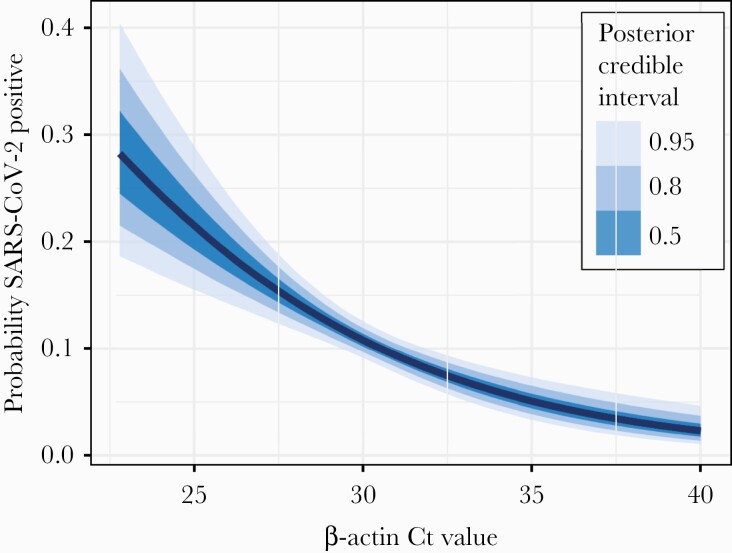
We performed amplification of a human gene target (β-actin) in parallel with a clinical RT-PCR targeting the SARS-CoV-2 gene for 1282 NP specimens collected from patients with clinical concern for COVID-19. We evaluated the relationship between NP specimen quality, characterized by late Ct values for the human gene target β-actin Ct, and the probability of SARS-CoV-2 detection via logistic regression, as well as the linear relationship between SARS-CoV-2 and β-actin Ct.
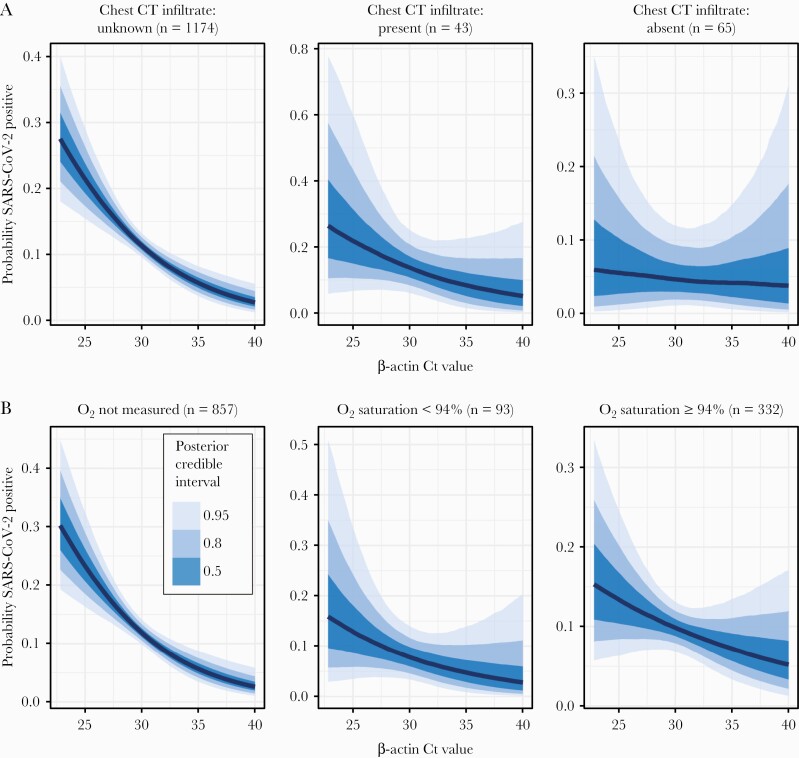
Low-quality NP swabs are less likely to detect SARS-CoV-2 (odds ratio, 0.607 [95% credible interval {CrI}, .487-.753]). We observed a positive linear relationship between SARS-CoV-2 and β-actin Ct values (slope, 0.181 [95% CrI, .097-.264]), consistent with a reduction in detection of 0.181 cycles for each additional cycle of the β-actin target. COVID-19 disease severity was not associated with β-actin Ct values.
Variability in NP specimen quality significantly impacts the performance of clinical SARS-CoV-2 assays, and caution should be taken when interpreting quantitative SARS-CoV-2 Ct results. If unrecognized, low-quality NP specimens, which are characterized by a low level of amplifiable human DNA target, may limit the successful application of SARS-CoV-2 Ct values to direct infection control and public health interventions.
严重急性呼吸综合征冠状病毒2(SARS-CoV-2)逆转录聚合酶链反应(RT-PCR)循环阈值(Ct)已被用于估计病毒载量,目的是针对2019冠状病毒病(COVID-19)患者确定隔离预防措施,并指导公共卫生干预。然而,样本质量的变异性会改变从SARS-CoV-2临床检测中获得的Ct值。我们试图确定鼻咽(NP)拭子质量的变异性如何影响临床SARS-CoV-2检测的敏感性。
我们对1282份从临床怀疑患有COVID-19的患者中采集的NP样本,同时进行人类基因靶点(β-肌动蛋白)的扩增以及针对SARS-CoV-2基因的临床RT-PCR。我们通过逻辑回归评估了以人类基因靶点β-肌动蛋白Ct的晚期Ct值为特征的NP样本质量与SARS-CoV-2检测概率之间的关系,以及SARS-CoV-2与β-肌动蛋白Ct之间的线性关系。
低质量的NP拭子检测到SARS-CoV-2的可能性较小(优势比,0.607 [95%可信区间{CrI},0.487 - 0.753])。我们观察到SARS-CoV-2与β-肌动蛋白Ct值之间呈正线性关系(斜率,0.181 [95% CrI,0.097 - 0.264]),这与β-肌动蛋白靶点每增加一个循环检测减少0.181个循环一致。COVID-19疾病严重程度与β-肌动蛋白Ct值无关。
NP样本质量的变异性显著影响临床SARS-CoV-2检测的性能,在解释定量SARS-CoV-2 Ct结果时应谨慎。如果未被识别,以可扩增人类DNA靶点水平低为特征的低质量NP样本,可能会限制SARS-CoV-2 Ct值在指导感染控制和公共卫生干预方面的成功应用。