Ariansen Inger, Degerud Eirik, Gjesdal Knut, Tell Grethe S, Næss Øyvind
Division of Mental and Physical Health, Norwegian Institute of Public Health, Oslo, Norway.
Department of Occupational Health Surveillance, National Institute of Occupational Health, Oslo, Norway.
Int J Cardiol Heart Vasc. 2020 Nov 29;31:100679. doi: 10.1016/j.ijcha.2020.100679. eCollection 2020 Dec.
Evidence is sparse on the association between alcohol intakes in the lower range and risk of atrial fibrillation (AF). We aimed to investigate self-reported low and moderate alcohol intakes and subsequent risk of incident AF among current drinkers.
Norwegian population-based health examination surveys assessing self-reported daily alcohol intake (mean grams per day) were linked to health and population registers. Hazard ratios (HR) (95% confidence interval) for time to incident (first) hospitalization with AF by alcohol intake level were assessed by Cox regression, with adjustment for educational level and cardiovascular risk factors except blood pressure.
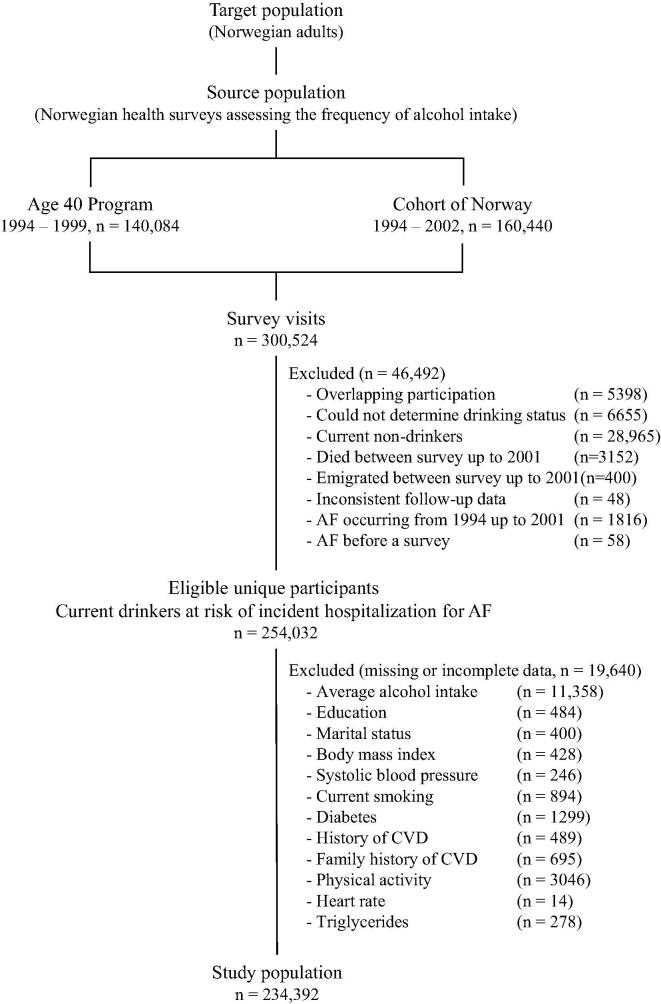
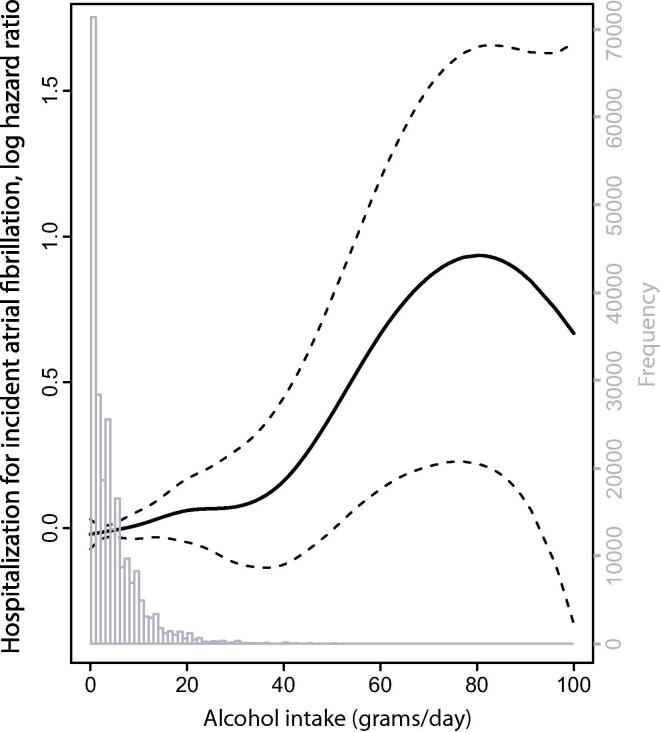
The study population included 234,392 participants (49% men). Incident hospitalization with AF was identified in 5043 (2.2%) persons during a mean follow-up of 9 years. Compared to a very low alcohol intake of <1 unit weekly, a moderate consumption in the range of 1 to <2 units daily increased the risk of incident AF by 18% (HR 1.18 [1.06-1.32]). The average risk of incident AF increased by 9% per daily alcohol unit of 12 g (HR 1.09 [1.03, 1.14]). In sex-stratified analyses significant associations were found in men only.
We found that less than two alcohol units/day significantly increased the risk of incident AF, however, in men only. Reduction of even a moderate alcohol intake may thus reduce the risk of AF at the population level.
关于低水平酒精摄入量与心房颤动(AF)风险之间关联的证据稀少。我们旨在调查当前饮酒者自我报告的低水平和适度酒精摄入量以及随后发生AF的风险。
将挪威基于人群的健康检查调查中自我报告的每日酒精摄入量(平均每天克数)与健康和人口登记册相联系。通过Cox回归评估按酒精摄入量水平计算的首次因AF住院的时间的风险比(HR)(95%置信区间),并对教育水平和除血压外的心血管危险因素进行调整。
研究人群包括234,392名参与者(49%为男性)。在平均9年的随访期间,5043人(2.2%)发生了因AF住院。与每周<1单位的极低酒精摄入量相比,每天1至<2单位的适度饮酒使发生AF的风险增加了18%(HR 1.18 [1.06 - 1.32])。每12克每日酒精单位,发生AF的平均风险增加9%(HR 1.09 [1.03, 1.14])。在按性别分层的分析中,仅在男性中发现了显著关联。
我们发现每天少于两个酒精单位会显著增加发生AF的风险,但仅在男性中如此。因此,即使适度减少酒精摄入量也可能在人群层面降低AF的风险。