Department of Cardiology, University Heart & Vascular Center Hamburg, Martinistraße 52, 20246 Hamburg, Germany.
Mediterranea Cardiocentro, Via Orazio 2, 80122 Napoli, Italy.
Eur Heart J. 2021 Mar 21;42(12):1170-1177. doi: 10.1093/eurheartj/ehaa953.
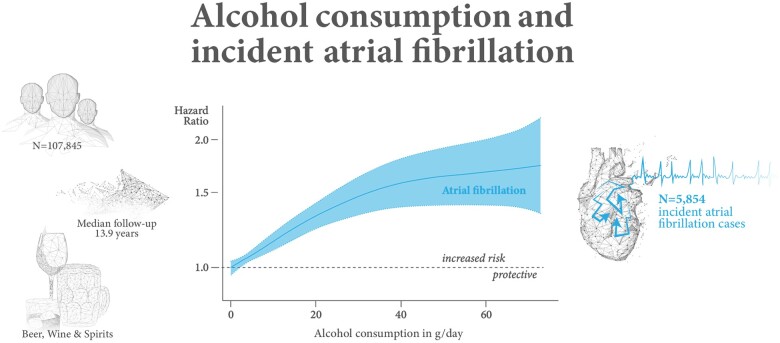
There is inconsistent evidence on the relation of alcohol intake with incident atrial fibrillation (AF), in particular at lower doses. We assessed the association between alcohol consumption, biomarkers, and incident AF across the spectrum of alcohol intake in European cohorts.
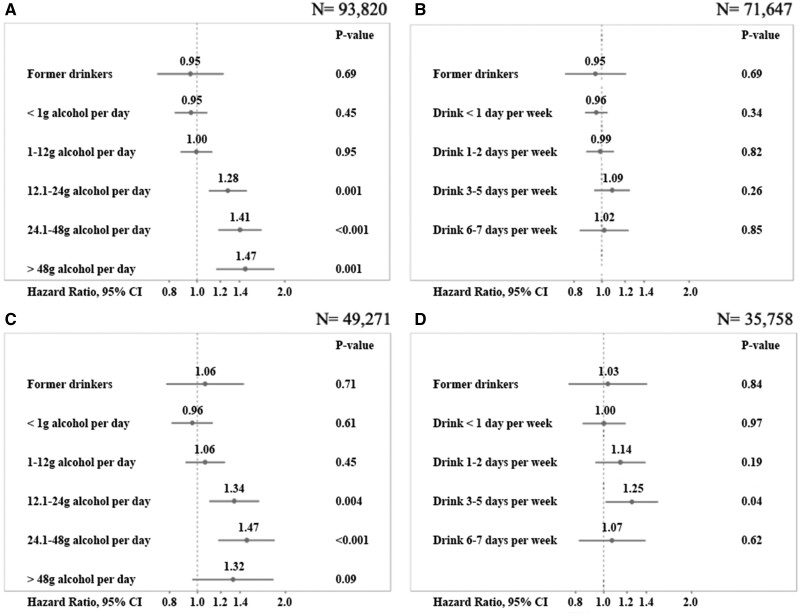
In a community-based pooled cohort, we followed 107 845 individuals for the association between alcohol consumption, including types of alcohol and drinking patterns, and incident AF. We collected information on classical cardiovascular risk factors and incident heart failure (HF) and measured the biomarkers N-terminal pro-B-type natriuretic peptide and high-sensitivity troponin I. The median age of individuals was 47.8 years, 48.3% were men. The median alcohol consumption was 3 g/day. N = 5854 individuals developed AF (median follow-up time: 13.9 years). In a sex- and cohort-stratified Cox regression analysis alcohol consumption was non-linearly and positively associated with incident AF. The hazard ratio for one drink (12 g) per day was 1.16, 95% CI 1.11-1.22, P < 0.001. Associations were similar across types of alcohol. In contrast, alcohol consumption at lower doses was associated with reduced risk of incident HF. The association between alcohol consumption and incident AF was neither fully explained by cardiac biomarker concentrations nor by the occurrence of HF.
In contrast to other cardiovascular diseases such as HF, even modest habitual alcohol intake of 1.2 drinks/day was associated with an increased risk of AF, which needs to be considered in AF prevention.
关于饮酒与房颤(AF)事件的关系,特别是在较低剂量下,证据并不一致。我们评估了在欧洲队列中,酒精摄入量范围内,酒精消耗、生物标志物与房颤事件之间的关联。
在一项基于社区的队列研究中,我们对 107845 名个体进行了随访,以评估酒精摄入(包括饮酒类型和饮酒模式)与房颤事件之间的关联。我们收集了关于经典心血管危险因素和心力衰竭(HF)事件的信息,并测量了 N 末端脑钠肽前体和高敏肌钙蛋白 I 等生物标志物。个体的中位年龄为 47.8 岁,48.3%为男性。酒精摄入量的中位数为 3 克/天。5854 名个体发生了房颤(中位随访时间:13.9 年)。在按性别和队列分层的 Cox 回归分析中,酒精摄入与房颤事件呈非线性正相关。每天饮用一杯(12 克)酒的风险比为 1.16,95%CI 为 1.11-1.22,P<0.001。不同类型的酒精与房颤事件之间的关联相似。相比之下,较低剂量的酒精摄入与 HF 事件风险降低相关。酒精摄入与房颤事件之间的关联既不能完全用心脏生物标志物浓度来解释,也不能用 HF 来解释。
与其他心血管疾病(如 HF)不同,即使是 1.2 杯/天这样适度的习惯性饮酒也与房颤风险增加相关,这在房颤预防中需要加以考虑。