Division of Nursing, Midwifery and Social Work, School of Health Sciences, Faculty of Biology, Medicine and Health, University of Manchester, Manchester Academic Health Science Centre, Manchester, UK.
Division of Population Health, Health Services Research & Primary Care, Faculty of Biology, Medicine and Health, University of Manchester, Manchester, UK.
Cochrane Database Syst Rev. 2021 May 6;5(5):CD013621. doi: 10.1002/14651858.CD013621.pub2.
Pressure ulcers (also known as pressure injuries) are localised injuries to the skin or underlying soft tissue, or both, caused by unrelieved pressure, shear or friction. Foam surfaces (beds, mattresses or overlays) are widely used with the aim of preventing pressure ulcers.
To assess the effects of foam beds, mattresses or overlays compared with any support surface on the incidence of pressure ulcers in any population in any setting.
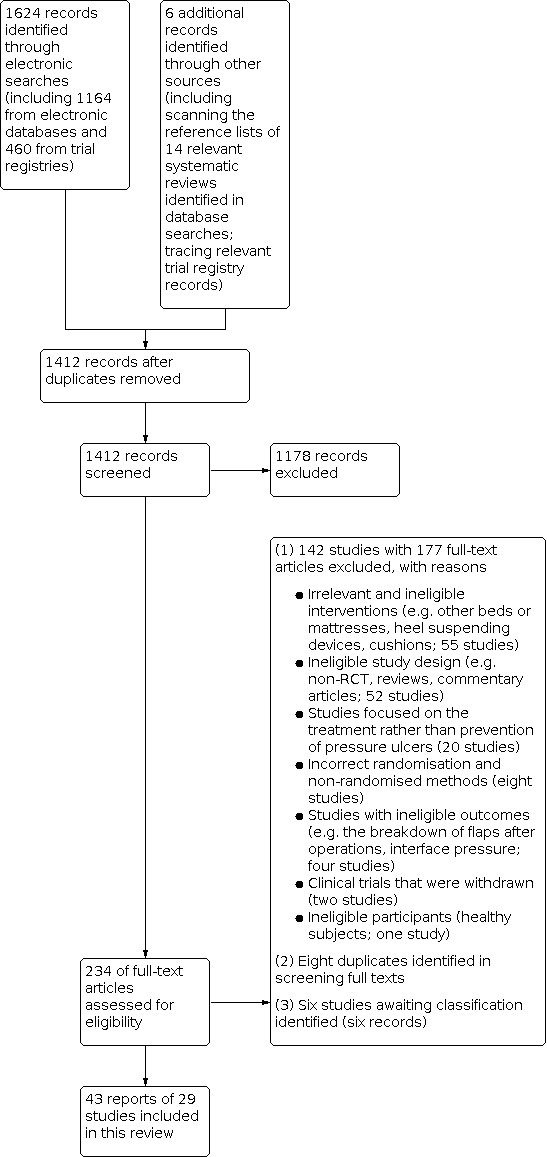
In November 2019, we searched the Cochrane Wounds Specialised Register; the Cochrane Central Register of Controlled Trials (CENTRAL); Ovid MEDLINE (including In-Process & Other Non-Indexed Citations); Ovid Embase and EBSCO CINAHL Plus. We also searched clinical trials registries for ongoing and unpublished studies, and scanned reference lists of relevant included studies as well as reviews, meta-analyses and health technology reports to identify additional studies. There were no restrictions with respect to language, date of publication or study setting.
We included randomised controlled trials that allocated participants of any age to foam beds, mattresses or overlays. Comparators were any beds, mattresses or overlays.
At least two review authors independently assessed studies using predetermined inclusion criteria. We carried out data extraction, 'Risk of bias' assessment using the Cochrane 'Risk of bias' tool, and the certainty of the evidence assessment according to Grading of Recommendations, Assessment, Development and Evaluations methodology. If a foam surface was compared with surfaces that were not clearly specified, then the included study was recorded and described but not considered further in any data analyses.
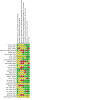
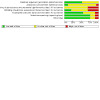
We included 29 studies (9566 participants) in the review. Most studies were small (median study sample size: 101 participants). The average age of participants ranged from 47.0 to 85.3 years (median: 76.0 years). Participants were mainly from acute care settings. We analysed data for seven comparisons in the review: foam surfaces compared with: (1) alternating pressure air surfaces, (2) reactive air surfaces, (3) reactive fibre surfaces, (4) reactive gel surfaces, (5) reactive foam and gel surfaces, (6) reactive water surfaces, and (7) another type of foam surface. Of the 29 included studies, 17 (58.6%) presented findings which were considered at high overall risk of bias.
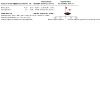
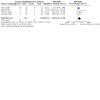
pressure ulcer incidence Low-certainty evidence suggests that foam surfaces may increase the risk of developing new pressure ulcers compared with (1) alternating pressure (active) air surfaces (risk ratio (RR) 1.59, 95% confidence interval (CI) 0.86 to 2.95; I = 63%; 4 studies, 2247 participants), and (2) reactive air surfaces (RR 2.40, 95% CI 1.04 to 5.54; I = 25%; 4 studies, 229 participants). We are uncertain regarding the difference in pressure ulcer incidence in people treated with foam surfaces and the following surfaces: (1) reactive fibre surfaces (1 study, 68 participants); (2) reactive gel surfaces (1 study, 135 participants); (3) reactive gel and foam surfaces (1 study, 91 participants); and (4) another type of foam surface (6 studies, 733 participants). These had very low-certainty evidence. Included studies have data on time to pressure ulcer development for two comparisons. When time to ulcer development is considered using hazard ratios, the difference in the risk of having new pressure ulcers, over 90 days' follow-up, between foam surfaces and alternating pressure air surfaces is uncertain (2 studies, 2105 participants; very low-certainty evidence). Two further studies comparing different types of foam surfaces also reported time-to-event data, suggesting that viscoelastic foam surfaces with a density of 40 to 60 kg/m may decrease the risk of having new pressure ulcers over 11.5 days' follow-up compared with foam surfaces with a density of 33 kg/m (1 study, 62 participants); and solid foam surfaces may decrease the risk of having new pressure ulcers over one month's follow-up compared with convoluted foam surfaces (1 study, 84 participants). Both had low-certainty evidence. There was no analysable data for the comparison of foam surfaces with reactive water surfaces (one study with 117 participants). Secondary outcomes Support-surface-associated patient comfort: the review contains data for three comparisons for this outcome. It is uncertain if there is a difference in patient comfort measure between foam surfaces and alternating pressure air surfaces (1 study, 76 participants; very low-certainty evidence); foam surfaces and reactive air surfaces (1 study, 72 participants; very low-certainty evidence); and different types of foam surfaces (4 studies, 669 participants; very low-certainty evidence). All reported adverse events: the review contains data for two comparisons for this outcome. We are uncertain about differences in adverse effects between foam surfaces and alternating pressure (active) air surfaces (3 studies, 2181 participants; very low-certainty evidence), and between foam surfaces and reactive air surfaces (1 study, 72 participants; very low-certainty evidence). Health-related quality of life: only one study reported data on this outcome. It is uncertain if there is a difference (low-certainty evidence) between foam surfaces and alternating pressure (active) air surfaces in health-related quality of life measured with two different questionnaires, the EQ-5D-5L (267 participants) and the PU-QoL-UI (233 participants). Cost-effectiveness: one study reported trial-based cost-effectiveness evaluations. Alternating pressure (active) air surfaces are probably more cost-effective than foam surfaces in preventing pressure ulcer incidence (2029 participants; moderate-certainty evidence).
AUTHORS' CONCLUSIONS: Current evidence suggests uncertainty about the differences in pressure ulcer incidence, patient comfort, adverse events and health-related quality of life between using foam surfaces and other surfaces (reactive fibre surfaces, reactive gel surfaces, reactive foam and gel surfaces, or reactive water surfaces). Foam surfaces may increase pressure ulcer incidence compared with alternating pressure (active) air surfaces and reactive air surfaces. Alternating pressure (active) air surfaces are probably more cost-effective than foam surfaces in preventing new pressure ulcers. Future research in this area should consider evaluation of the most important support surfaces from the perspective of decision-makers. Time-to-event outcomes, careful assessment of adverse events and trial-level cost-effectiveness evaluation should be considered in future studies. Trials should be designed to minimise the risk of detection bias; for example, by using digital photography and by blinding adjudicators of the photographs to group allocation. Further review using network meta-analysis will add to the findings reported here.
压力性溃疡(也称为压力性损伤)是由于未缓解的压力、剪切力或摩擦力导致的皮肤或皮下软组织局部损伤。泡沫表面(床、床垫或覆盖物)被广泛用于预防压力性溃疡。
评估泡沫床、床垫或覆盖物与任何支撑面相比在任何环境中预防压力性溃疡的发生率。
2019 年 11 月,我们检索了 Cochrane 伤口专业注册库;Cochrane 对照试验中心注册库(CENTRAL);Ovid MEDLINE(包括在研和其他非索引引文);Ovid Embase 和 EBSCO CINAHL Plus。我们还检索了正在进行和未发表研究的临床试验登记处,并扫描了相关纳入研究的参考文献以及综述、荟萃分析和卫生技术报告,以确定其他研究。我们没有对语言、出版日期或研究设置进行任何限制。
我们纳入了将任何年龄的参与者随机分配到泡沫床、床垫或覆盖物的随机对照试验。对照组为任何床、床垫或覆盖物。
至少两名综述作者独立使用预定的纳入标准评估研究。我们进行了数据提取、使用 Cochrane“风险偏倚”工具评估“风险偏倚”以及根据推荐评估、制定和评估(Grading of Recommendations, Assessment, Development and Evaluations)方法评估证据确定性。如果泡沫表面与未明确指定的表面进行比较,则将包括的研究记录并描述,但不在任何数据分析中进一步考虑。
我们纳入了 29 项研究(9566 名参与者)。大多数研究规模较小(中位研究样本量:101 名参与者)。参与者的平均年龄为 47.0 至 85.3 岁(中位数:76.0 岁)。参与者主要来自急性护理环境。我们在综述中分析了七个比较的结果:泡沫表面与:(1)交替压力空气表面,(2)反应性空气表面,(3)反应性纤维表面,(4)反应性凝胶表面,(5)反应性凝胶和泡沫表面,(6)反应性水表面,和(7)另一种类型的泡沫表面。在纳入的 29 项研究中,17 项(58.6%)的研究结果被认为存在整体高偏倚风险。
压力性溃疡发生率低确定性证据表明,与(1)交替压力(主动)空气表面(RR 1.59,95%置信区间(CI)0.86 至 2.95;I = 63%;4 项研究,2247 名参与者)和(2)反应性空气表面(RR 2.40,95%CI 1.04 至 5.54;I = 25%;4 项研究,229 名参与者)相比,泡沫表面可能增加发生新的压力性溃疡的风险。我们不确定在与以下表面相比时,泡沫表面的压力性溃疡发生率差异:(1)反应性纤维表面(1 项研究,68 名参与者);(2)反应性凝胶表面(1 项研究,135 名参与者);(3)反应性凝胶和泡沫表面(1 项研究,91 名参与者);和(4)另一种类型的泡沫表面(6 项研究,733 名参与者)。这些研究的证据确定性非常低。纳入的研究有关于压力性溃疡发展时间的研究数据。当使用危险比考虑溃疡发展时间时,在 90 天随访期间,泡沫表面与交替压力空气表面之间新发压力性溃疡风险的差异不确定(2 项研究,2105 名参与者;低确定性证据)。另外两项比较不同类型泡沫表面的研究也报告了时间事件数据,表明密度为 40 至 60kg/m3 的粘弹泡沫表面可能会降低在 11.5 天随访期间发生新的压力性溃疡的风险,而密度为 33kg/m3 的泡沫表面(1 项研究,62 名参与者);和固体泡沫表面可能会降低在一个月的随访期间发生新的压力性溃疡的风险,与卷曲泡沫表面相比(1 项研究,84 名参与者)。两者均具有低确定性证据。对于泡沫表面与反应性水表面的比较,没有可分析的数据(一项研究,117 名参与者)。
综述包含了用于该结局的三项比较的数据。不确定泡沫表面与交替压力空气表面(1 项研究,76 名参与者;低确定性证据);泡沫表面与反应性空气表面(1 项研究,72 名参与者;低确定性证据)之间的患者舒适度测量是否存在差异。对于不同类型的泡沫表面(4 项研究,669 名参与者;低确定性证据),也不确定是否存在差异。所有报告的不良事件:综述包含了用于该结局的两项比较的数据。我们不确定泡沫表面与交替压力(主动)空气表面(3 项研究,2181 名参与者;低确定性证据)和泡沫表面与反应性空气表面(1 项研究,72 名参与者;低确定性证据)之间的不良影响是否存在差异。健康相关生活质量:只有一项研究报告了这方面的数据。不确定泡沫表面与交替压力(主动)空气表面(267 名参与者的 EQ-5D-5L 和 233 名参与者的 PU-QoL-UI)在健康相关生活质量方面是否存在差异(低确定性证据)。
一项研究报告了基于试验的成本效益评估。与泡沫表面相比,交替压力(主动)空气表面可能更具成本效益,可预防压力性溃疡的发生(2029 名参与者;中等确定性证据)。
目前的证据表明,在压力性溃疡发生率、患者舒适度、不良事件和健康相关生活质量方面,使用泡沫表面与其他表面(反应性纤维表面、反应性凝胶表面、反应性凝胶和泡沫表面或反应性水表面)之间的差异存在不确定性。泡沫表面可能会增加与交替压力(主动)空气表面和反应性空气表面相比发生新的压力性溃疡的风险。与泡沫表面相比,交替压力(主动)空气表面可能更具成本效益,可预防新的压力性溃疡的发生。未来该领域的研究应考虑从决策者的角度评估最重要的支撑面。应考虑时间事件结局、仔细评估不良事件和试验水平的成本效益评估。应设计试验以最大程度地降低检测偏倚的风险;例如,通过使用数字摄影,并使照片的裁决者对分组分配保持盲法。进一步的网络荟萃分析综述将增加这里报告的结果。