Department of Biological Sciences, Ulsan National Institute of Science and Technology (UNIST), Ulsan 44919, Korea.
Mol Cells. 2021 Jun 30;44(6):384-391. doi: 10.14348/molcells.2021.0068.
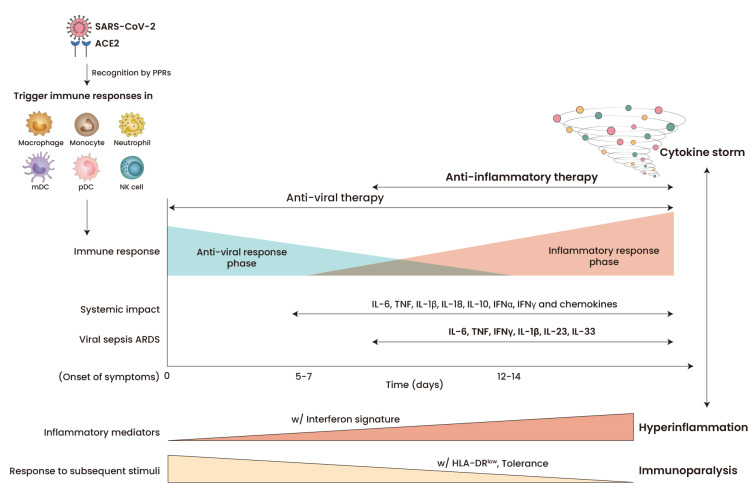
The recent appearance of severe acute respiratory syndrome coronavirus 2 (SARS-CoV-2) has affected millions of people around the world and caused a global pandemic of coronavirus disease 2019 (COVID-19). It has been suggested that uncontrolled, exaggerated inflammation contributes to the adverse outcomes of COVID-19. In this review, we summarize our current understanding of the innate immune response elicited by SARS-CoV-2 infection and the hyperinflammation that contributes to disease severity and death. We also discuss the immunological determinants behind COVID-19 severity and propose a rationale for the underlying mechanisms.
最近出现的严重急性呼吸综合征冠状病毒 2(SARS-CoV-2)已经影响了全球数百万人,并导致了 2019 年冠状病毒病(COVID-19)的全球大流行。有人认为,不受控制的、过度的炎症反应是导致 COVID-19 不良后果的原因。在这篇综述中,我们总结了我们目前对 SARS-CoV-2 感染引起的先天免疫反应以及导致疾病严重程度和死亡的过度炎症的理解。我们还讨论了 COVID-19 严重程度背后的免疫学决定因素,并提出了潜在机制的基本原理。