Endocrinology and Nephrology Unit, CHU de Québec-Université Laval Research Center, Québec (QC), Canada.
Obesity, Type 2 Diabetes and Metabolism Unit, Institut universitaire de cardiologie et de pneumologie de Québec-Université Laval Research Center, Québec (QC), Canada.
PLoS One. 2021 Jun 8;16(6):e0252487. doi: 10.1371/journal.pone.0252487. eCollection 2021.
The association between obesity and fracture risk may be skeletal site- and sex-specific but results among studies are inconsistent. Whilst several studies reported higher bone mineral density (BMD) in patients with obesity, altered bone quality could be a major determinant of bone fragility in this population.
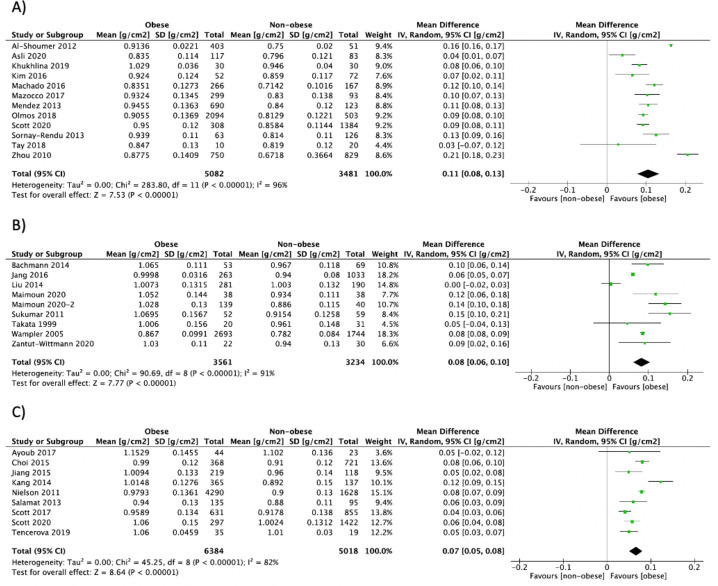
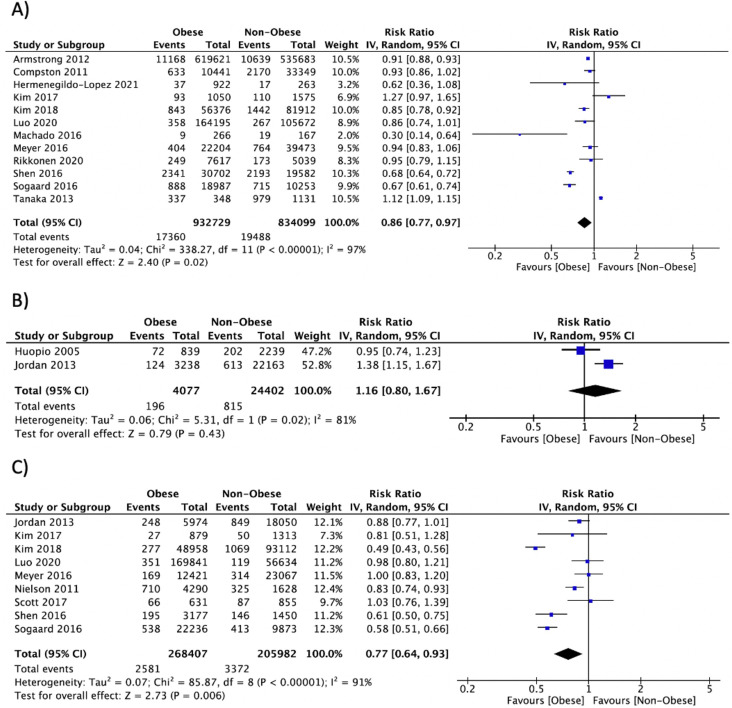
This systematic review and meta-analysis aimed to compare, in men, premenopausal women and postmenopausal women with obesity vs. individuals without obesity: 1) the incidence of fractures overall and by site; 2) BMD; and 3) bone quality parameters (circulating bone turnover markers and bone microarchitecture and strength by advanced imaging techniques).
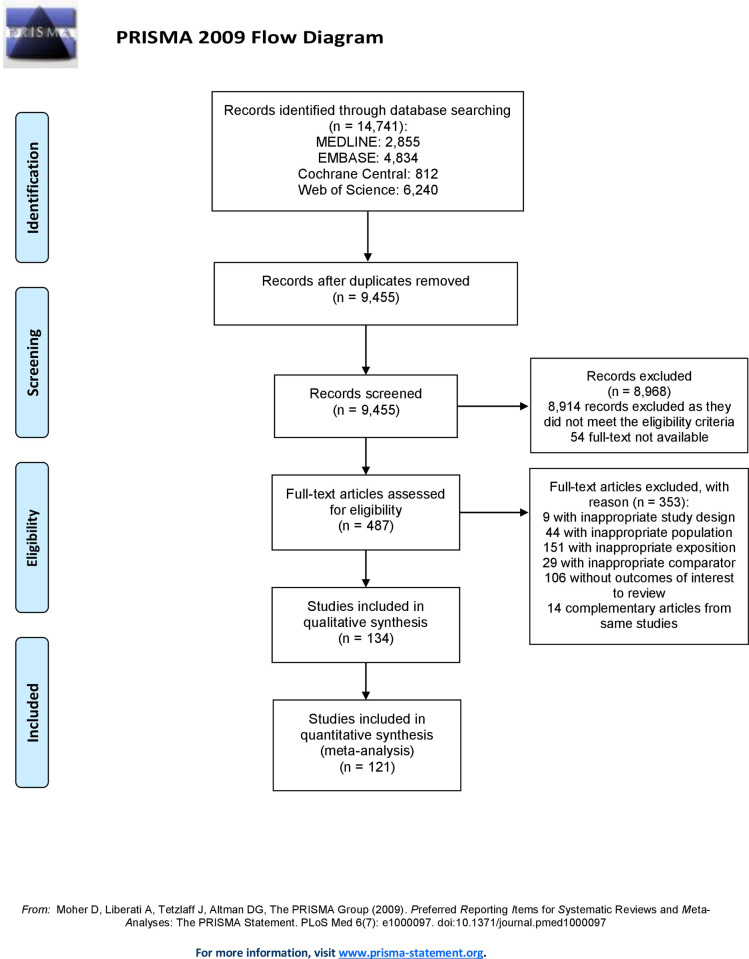
PubMed (MEDLINE), EMBASE, Cochrane Library and Web of Science were searched from inception of databases until the 13th of January 2021.
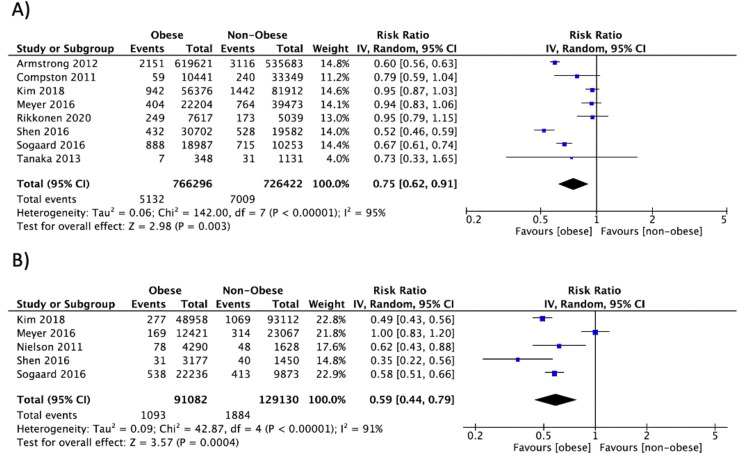
Each outcome was stratified by sex and menopausal status in women. The meta-analysis was performed using a random-effect model with inverse-variance method. The risks of hip and wrist fracture were reduced by 25% (n = 8: RR = 0.75, 95% CI: 0.62, 0.91, P = 0.003, I2 = 95%) and 15% (n = 2 studies: RR = 0.85, 95% CI: 0.81, 0.88), respectively, while ankle fracture risk was increased by 60% (n = 2 studies: RR = 1.60, 95% CI: 1.52, 1.68) in postmenopausal women with obesity compared with those without obesity. In men with obesity, hip fracture risk was decreased by 41% (n = 5 studies: RR = 0.59, 95% CI: 0.44, 0.79). Obesity was associated with increased BMD, better bone microarchitecture and strength, and generally lower or unchanged circulating bone resorption, formation and osteocyte markers. However, heterogeneity among studies was high for most outcomes, and overall quality of evidence was very low to low for all outcomes.
This meta-analysis highlights areas for future research including the need for site-specific fracture studies, especially in men and premenopausal women, and studies comparing bone microarchitecture between individuals with and without obesity.
CRD42020159189.
肥胖与骨折风险之间的关联可能因骨骼部位和性别而异,但研究结果并不一致。尽管有几项研究报道肥胖患者的骨密度(BMD)较高,但改变的骨质量可能是该人群骨脆弱的主要决定因素。
本系统评价和荟萃分析旨在比较肥胖男性、绝经前女性和绝经后女性与非肥胖个体相比:1)总体和部位的骨折发生率;2)BMD;3)骨质量参数(循环骨转换标志物和骨微结构和强度的先进成像技术)。
从数据库创建开始,PubMed(MEDLINE)、EMBASE、Cochrane 图书馆和 Web of Science 一直搜索到 2021 年 1 月 13 日。
根据性别和女性的绝经状态对每个结果进行分层。使用随机效应模型和倒数方差法进行荟萃分析。髋部和腕部骨折的风险分别降低了 25%(n = 8:RR = 0.75,95%CI:0.62,0.91,P = 0.003,I2 = 95%)和 15%(n = 2 项研究:RR = 0.85,95%CI:0.81,0.88),而肥胖绝经后女性的踝部骨折风险增加了 60%(n = 2 项研究:RR = 1.60,95%CI:1.52,1.68)。与非肥胖者相比,肥胖男性的髋部骨折风险降低了 41%(n = 5 项研究:RR = 0.59,95%CI:0.44,0.79)。肥胖与 BMD 增加、骨微结构和强度改善以及循环骨吸收、形成和骨细胞标志物普遍降低或不变相关。然而,大多数结果的研究之间存在高度异质性,所有结果的证据总体质量均为极低至低。
本荟萃分析强调了未来研究的领域,包括需要进行部位特异性骨折研究,特别是在男性和绝经前女性中,以及比较肥胖和非肥胖个体之间的骨微结构的研究。
CRD42020159189。