Peto Tim
Nuffield Department of Medicine, University of Oxford, Oxford OX3 9DU, England.
EClinicalMedicine. 2021 Jun;36:100924. doi: 10.1016/j.eclinm.2021.100924. Epub 2021 May 30.
Lateral flow device (LFD) viral antigen immunoassays have been developed around the world as diagnostic tests for SARS-CoV-2 infection. They have been proposed to deliver an infrastructure-light, cost-economical solution giving results within half an hour.
LFDs were initially reviewed by a Department of Health and Social Care team, part of the UK government, from which 64 were selected for further evaluation from 1st August to 15th December 2020. Standardised laboratory evaluations, and for those that met the published criteria, field testing in the Falcon-C19 research study and UK pilots were performed (UK COVID-19 testing centres, hospital, schools, armed forces).
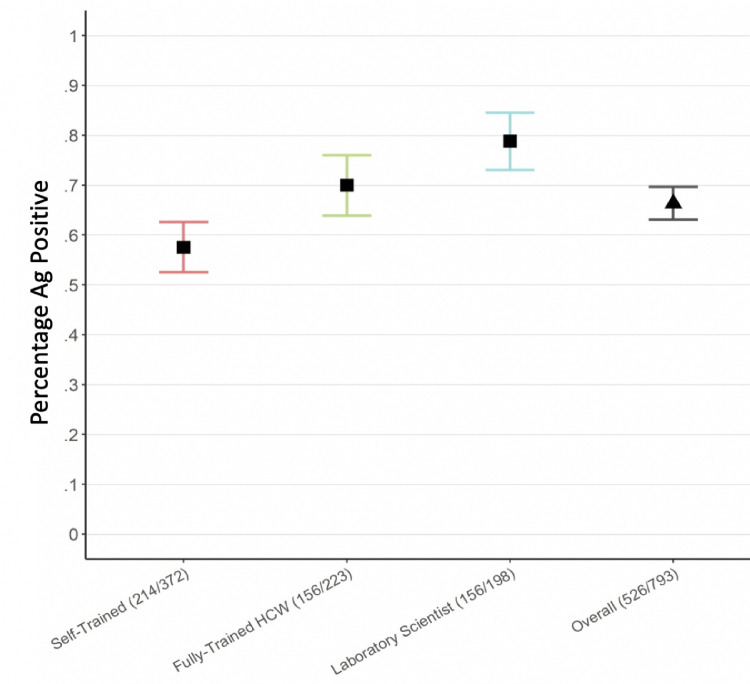
4/64 LFDs so far have desirable performance characteristics (orient Gene, Deepblue, Abbott and Innova SARS-CoV-2 Antigen Rapid Qualitative Test). All these LFDs have a viral antigen detection of >90% at 100,000 RNA copies/ml. 8951 Innova LFD tests were performed with a kit failure rate of 5.6% (502/8951, 95% CI: 5.1-6.1), false positive rate of 0.32% (22/6954, 95% CI: 0.20-0.48). Viral antigen detection/sensitivity across the sampling cohort when performed by laboratory scientists was 78.8% (156/198, 95% CI 72.4-84.3).
Our results suggest LFDs have promising performance characteristics for mass population testing and can be used to identify infectious positive individuals. The Innova LFD shows good viral antigen detection/sensitivity with excellent specificity, although kit failure rates and the impact of training are potential issues. These results support the expanded evaluation of LFDs, and assessment of greater access to testing on COVID-19 transmission.
Department of Health and Social Care. University of Oxford. Public Health England Porton Down, Manchester University NHS Foundation Trust, National Institute of Health Research.
作为严重急性呼吸综合征冠状病毒2(SARS-CoV-2)感染的诊断检测方法,侧向流动装置(LFD)病毒抗原免疫测定已在全球范围内得到开发。它们被认为是一种轻基础设施、经济实惠的解决方案,能在半小时内给出检测结果。
英国政府卫生和社会保健部的一个团队最初对LFD进行了审查,从审查的产品中,在2020年8月1日至12月15日期间挑选了64种进行进一步评估。进行了标准化实验室评估,对于符合既定标准的产品,在Falcon-C19研究和英国试点项目(英国新冠病毒检测中心、医院、学校、武装部队)中进行了现场测试。
到目前为止,64种LFD中有4种具有理想的性能特征(Orient Gene、深蓝、雅培和Innova SARS-CoV-2抗原快速定性检测)。所有这些LFD在每毫升100000个RNA拷贝数时的病毒抗原检测率均>90%。对8951份Innova LFD检测进行了评估,试剂盒故障率为5.6%(502/8951,95%置信区间:5.1-6.1),假阳性率为0.32%(22/6954,95%置信区间:0.20-0.48)。实验室科学家进行检测时,整个采样队列的病毒抗原检测/灵敏度为78.8%(156/198,95%置信区间72.4-84.3)。
我们的结果表明,LFD在大规模人群检测方面具有良好的性能特征,可用于识别感染阳性个体。Innova LFD显示出良好的病毒抗原检测/灵敏度和出色的特异性,尽管试剂盒故障率和培训的影响是潜在问题。这些结果支持对LFD进行扩大评估,并评估增加检测机会对新冠病毒传播的影响。
卫生和社会保健部、牛津大学、英国公共卫生部波顿唐、曼彻斯特大学国民保健服务基金会信托基金、英国国家卫生研究院。