Amphibian Research Center, Graduate School of Integrated Sciences for Life, Hiroshima University, 1-3-1 Kagamiyama, Higashi-Hiroshima, Hiroshima, 739-8526, Japan.
National Xenopus Resource and Eugene Bell Center for Regenerative Biology and Tissue Engineering, Marine Biological Laboratory, Woods Hole, MA 02543, USA.
Biochem Biophys Res Commun. 2021 Aug 6;565:91-96. doi: 10.1016/j.bbrc.2021.05.082. Epub 2021 Jun 5.
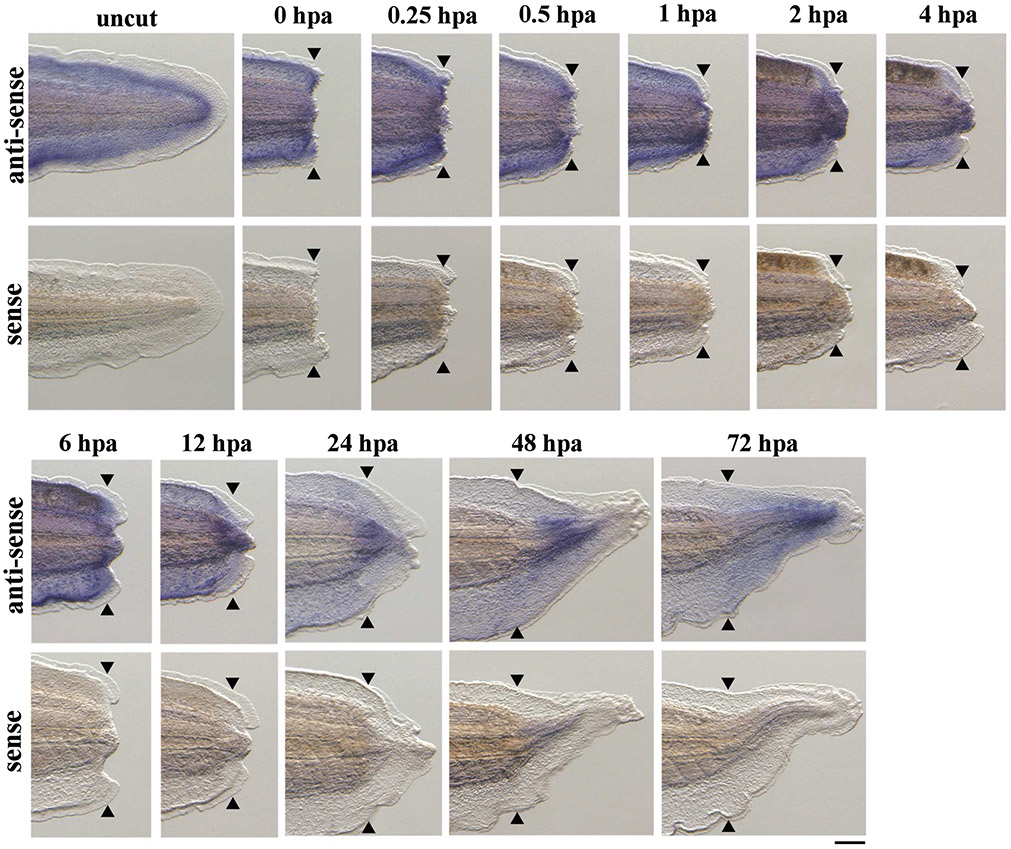
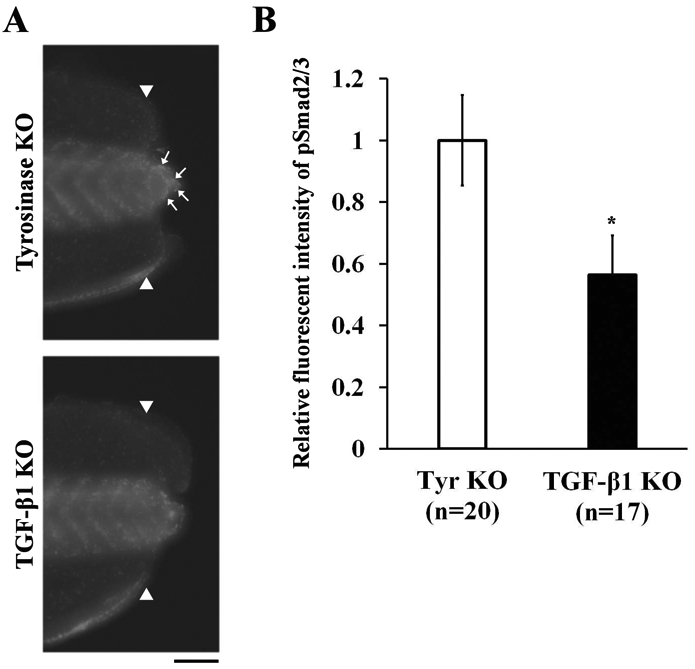
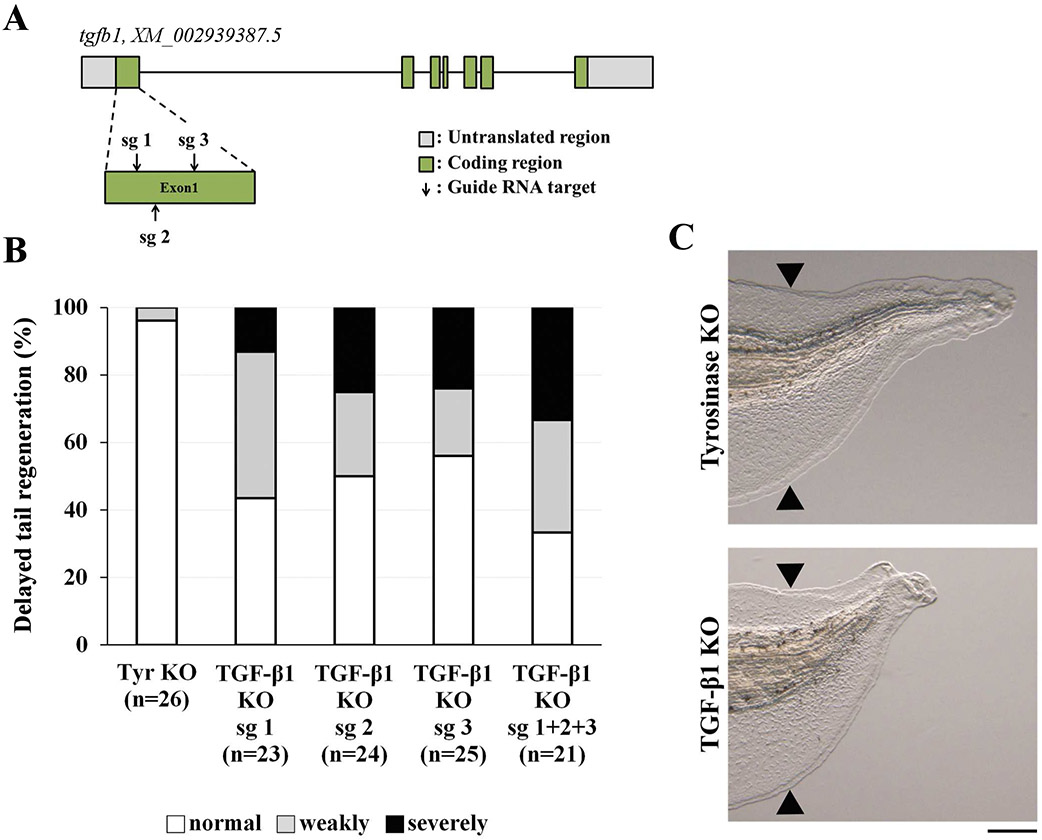
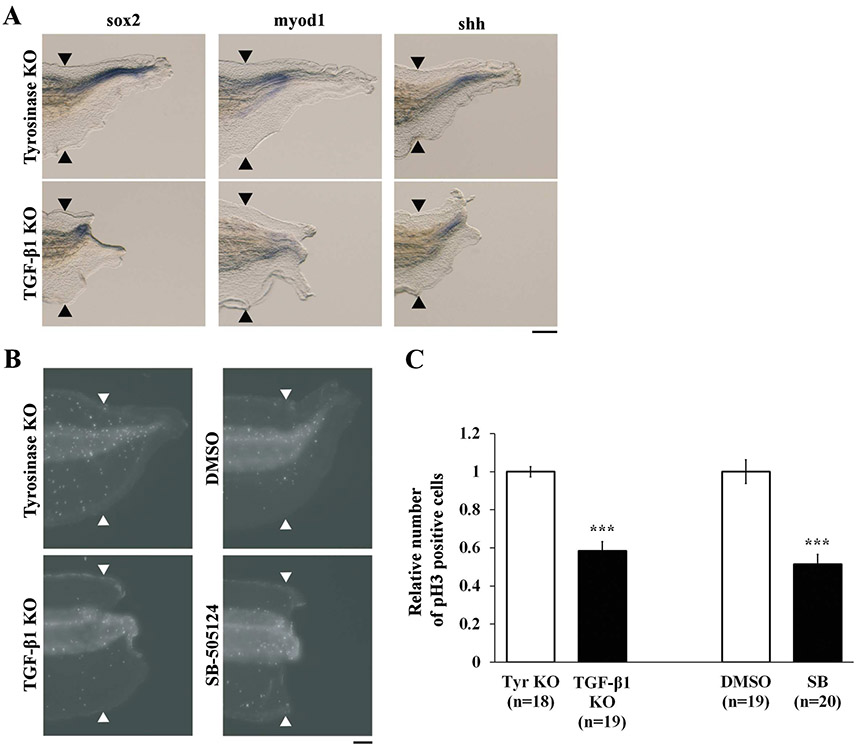
Amphibians such as Xenopus tropicalis exhibit a remarkable capacity for tissue regeneration after traumatic injury. Although transforming growth factor-β (TGF-β) receptor signaling is known to be essential for tissue regeneration in fish and amphibians, the role of TGF-β ligands in this process is not well understood. Here, we show that inhibition of TGF-β1 function prevents tail regeneration in Xenopus tropicalis tadpoles. We found that expression of tgfb1 is present before tail amputation and is sustained throughout the regeneration process. CRISPR-mediated knock-out (KO) of tgfb1 retards tail regeneration; the phenotype of tgfb1 KO tadpoles can be rescued by injection of tgfb1 mRNA. Cell proliferation, a critical event for the success of tissue regeneration, is downregulated in tgfb1 KO tadpoles. In addition, tgfb1 KO reduces the expression of phosphorylated Smad2/3 (pSmad2/3) which is important for TGF-β signal-mediated cell proliferation. Collectively, our results show that TGF-β1 regulates cell proliferation through the activation of Smad2/3. We therefore propose that TGF-β1 plays a critical role in TGF-β receptor-dependent tadpole tail regeneration in Xenopus.
爪蟾具有很强的组织再生能力,在受到创伤后能够进行再生。尽管转化生长因子-β(TGF-β)受体信号对于鱼类和两栖类动物的组织再生是必需的,但 TGF-β配体在这个过程中的作用还不是很清楚。在这里,我们表明 TGF-β1 功能的抑制会阻止爪蟾幼体的尾巴再生。我们发现 tgfb1 的表达在尾巴切除之前就存在,并在整个再生过程中持续存在。CRISPR 介导的 tgfb1 敲除(KO)会延迟尾巴再生;tgfb1 KO 幼体的表型可以通过注射 tgfb1 mRNA 来挽救。细胞增殖是组织再生成功的关键事件,在 tgfb1 KO 幼体中被下调。此外,tgfb1 KO 降低了磷酸化 Smad2/3(pSmad2/3)的表达,这对于 TGF-β 信号介导的细胞增殖很重要。总之,我们的结果表明 TGF-β1 通过激活 Smad2/3 来调节细胞增殖。因此,我们提出 TGF-β1 在 TGF-β 受体依赖性爪蟾尾巴再生中起着关键作用。