Department of Orthopedics, Ningbo No. 6 Hospital, 1059 Zhongsandong Road, Ningbo, Zhejiang, 315040, People's Republic of China.
Department of Hepatobiliary Surgery, Shangyu People's Hospital of Shaoxing, 517 Citizen's Avenue, Shangyu, Shaoxing, Zhejiang, 312300, People's Republic of China.
J Orthop Surg Res. 2021 Jun 9;16(1):366. doi: 10.1186/s13018-021-02505-3.
Closed reduction and pinning entry fixation have been proposed as treatment strategies for displaced supracondylar humeral fractures (SCHFs) in children. However, controversy exists regarding the selection of the appropriate procedure. Hence, this meta-analysis was conducted to compare the effect of lateral and crossed pin fixation for pediatric SCHFs, providing a reference for clinical treatment.
Online databases were systematically searched for randomized controlled trials (RCTs) comparing lateral pinning entry and crossed pinning entry for children with SCHFs. The primary endpoints were iatrogenic ulnar nerve injuries, complications, and radiographic and functional outcomes.
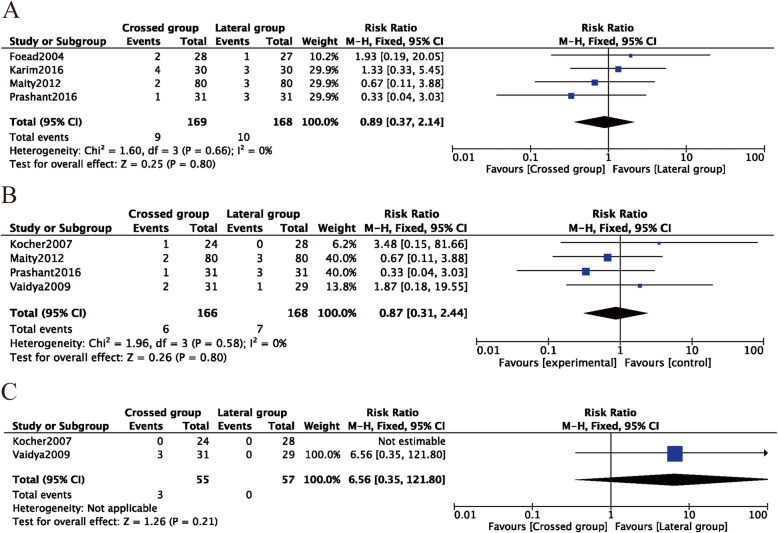
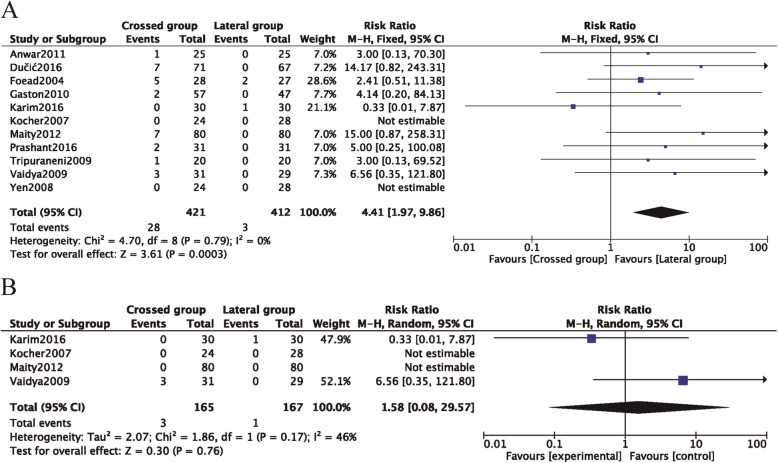
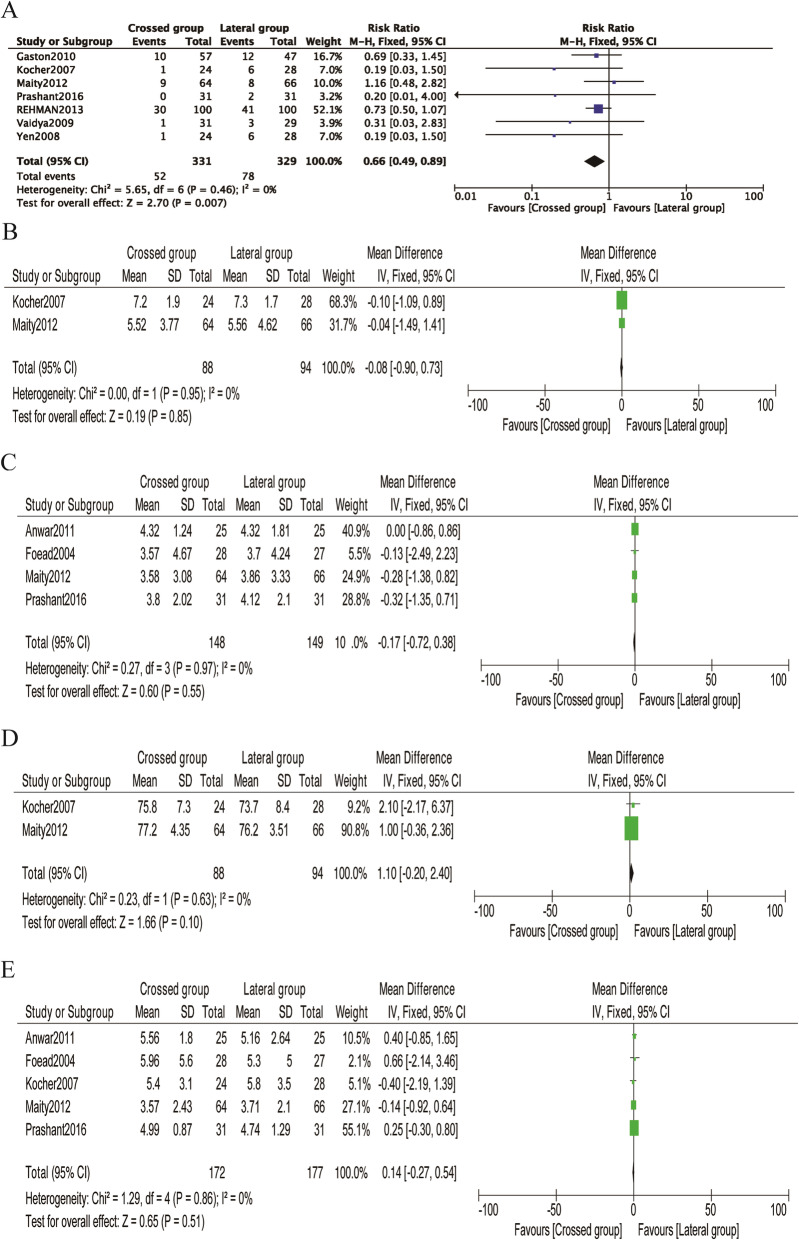
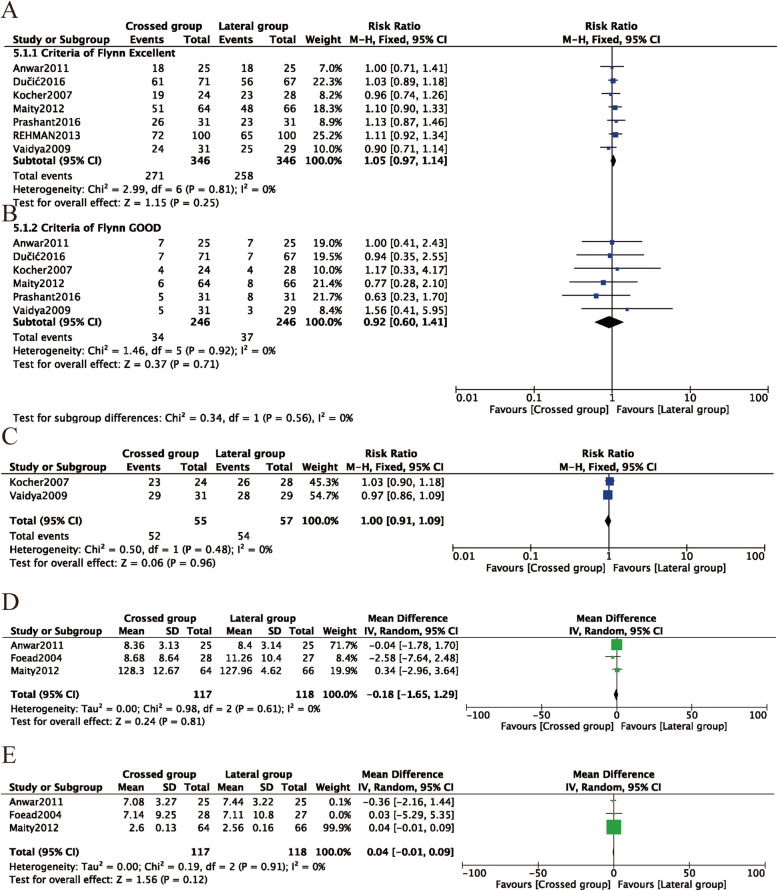
Our results showed that iatrogenic ulnar nerve injuries occurred more commonly in the crossed pinning entry group than in the lateral pinning entry group (RR = 4.41, 95% CI 1.97-9.86, P < 0.05). However, its risk between the crossed pinning with mini-open incisions group and the lateral pinning entry group was not significantly different (RR = 1.58, 95% CI 0.008-29.57, P = 0.76). The loss of reduction risk was higher in the lateral pinning entry group than in the crossed pinning entry group (RR = 0.66; 95% CI 0.49-0.89, P < 0.05). There were no significant differences in the carry angle, Baumann angle, Flynn scores, infections, and other complications between these two groups.
The crossed pinning entry with mini-open incision technique reduced the loss of reduction risk, and the risk of iatrogenic ulnar nerve injury was lower than in the lateral pinning entry group. The crossed pinning entry with mini-open incision technique is an effective therapeutic strategy for managing displaced supracondylar humeral fractures in children.
闭合复位和克氏针固定已被提议作为儿童移位性肱骨髁上骨折(SCHF)的治疗策略。然而,对于选择合适的手术方法仍存在争议。因此,进行这项荟萃分析是为了比较外侧入路和交叉克氏针固定治疗儿童 SCHF 的效果,为临床治疗提供参考。
系统地检索了比较儿童 SCHF 外侧入路和交叉入路克氏针固定的随机对照试验(RCT)的在线数据库。主要终点是医源性尺神经损伤、并发症以及影像学和功能结果。
我们的结果显示,交叉入路克氏针固定组医源性尺神经损伤的发生率高于外侧入路克氏针固定组(RR=4.41,95%CI 1.97-9.86,P<0.05)。然而,交叉入路克氏针固定联合小切口组与外侧入路克氏针固定组之间的风险并无显著差异(RR=1.58,95%CI 0.008-29.57,P=0.76)。外侧入路克氏针固定组的复位丢失风险高于交叉入路克氏针固定组(RR=0.66;95%CI 0.49-0.89,P<0.05)。两组间携带角、Baumann 角、Flynn 评分、感染和其他并发症无显著差异。
交叉入路克氏针固定联合小切口技术降低了复位丢失风险,医源性尺神经损伤的风险低于外侧入路克氏针固定组。交叉入路克氏针固定联合小切口技术是治疗儿童移位性肱骨髁上骨折的有效治疗策略。