Faculty of Health Sciences, Simon Fraser University, Burnaby, British Columbia, Canada
Centre for Health Evaluation and Outcome Sciences, St. Paul's Hospital, Vancouver, British Columbia, Canada.
BMJ Open. 2021 Jun 9;11(6):e048353. doi: 10.1136/bmjopen-2020-048353.
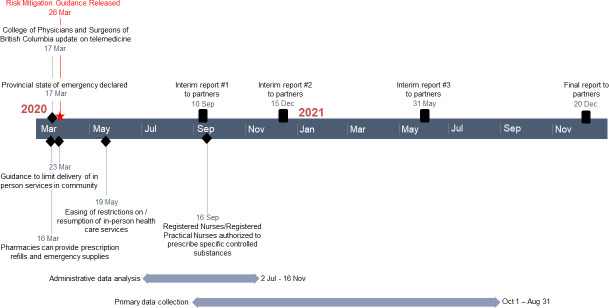
The COVID-19 pandemic was preceded by an ongoing overdose crisis and linked to escalating drug overdose deaths in British Columbia (BC). At the outset of these dual public health emergencies, the BC government announced interim Risk Mitigation Guidance (RMG) that permitted prescribing medication alternatives to substances, including opioids, alcohol, stimulants and benzodiazepines, an intervention sometimes referred to as 'safe supply'. This protocol outlines the approach for a study of the implementation of RMG and its impacts on COVID-19 infection, drug-related and systemic harms, continuity of care for people with substance use disorder (SUD), as well as their behavioural, psychosocial and well-being outcomes.
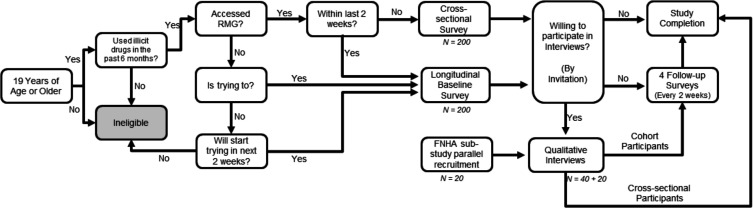
We conducted a parallel mixed-method study that involved both analysis of population-level administrative health data and primary data collection, including a 10-week longitudinal observational study (target n=200), a cross-sectional survey (target n=200) and qualitative interviews (target n=60). We implemented a participatory approach to this evaluation, partnering with people with lived or living expertise of drug use, and researchers and public health decision-makers across the province. Linked population-level administrative databases will analyse data from a cohort of BC residents with an indication of SUD between 1996 and 2020. We will execute high-dimensional propensity score matching and marginal structural modelling to construct a control group and to assess the impact of RMG dispensation receipt on a collaboratively determined set of primary and secondary outcomes.
Study activities were developed to adhere to the Tri-Council Policy Statement: Ethical Conduct for Research Involving Humans, recommended COVID-19 research practices, and guided by the Truth and Reconciliation Commission's Calls to Action for public health, data governance and research ethics related to Indigenous people. Results will be disseminated incrementally, on an ongoing basis, through the consortium established for this study, then published in peer-reviewed journals.
COVID-19 大流行之前,不列颠哥伦比亚省(BC)持续存在药物过量危机,并与药物过量死亡人数的上升有关。在这双重公共卫生紧急情况开始时,BC 省政府宣布了临时风险缓解指南(RMG),允许开处方替代物质的药物,包括阿片类药物、酒精、兴奋剂和苯二氮䓬类药物,这种干预有时被称为“安全供应”。本方案概述了实施 RMG 的方法及其对 COVID-19 感染、与药物相关的和系统性危害、药物使用障碍(SUD)患者的护理连续性,以及他们的行为、心理社会和福祉结果的影响的研究方法。
我们进行了一项平行的混合方法研究,包括对人群水平的行政健康数据的分析和主要数据收集,包括一项为期 10 周的纵向观察性研究(目标 n=200)、横断面调查(目标 n=200)和定性访谈(目标 n=60)。我们对这项评估采用了参与式方法,与有吸毒生活或生活经验的人以及全省的研究人员和公共卫生决策者合作。链接的人群水平行政数据库将分析 1996 年至 2020 年间有 SUD 指征的 BC 居民队列的数据。我们将执行高维倾向评分匹配和边缘结构模型,以构建对照组,并评估 RMG 配药接收对合作确定的一组主要和次要结果的影响。
研究活动的制定是为了遵守三理事会政策声明:涉及人类的研究的道德行为准则,建议的 COVID-19 研究实践,并遵循真相与和解委员会的行动呼吁,这些呼吁涉及与土著人民有关的公共卫生、数据治理和研究伦理。结果将通过为此研究建立的联盟逐步、持续地传播,然后在同行评议的期刊上发表。