Ellis Ursula, Kitchin Vanessa, Vis-Dunbar Mathew
Woodward Library, University of British Columbia, Vancouver, BC, Canada.
University of British Columbia Okanagan Library, Kelowna, BC, Canada.
J Particip Med. 2021 Jun 10;13(2):e27141. doi: 10.2196/27141.
Patient and public involvement (PPI) in health research is an area of growing interest. Several studies have examined the use and impact of PPI in knowledge syntheses (systematic, scoping, and related reviews); however, few studies have focused specifically on the patient or public coauthorship of such reviews.
This study seeks to identify published systematic and scoping reviews coauthored by patient or public partners and examine the characteristics of these coauthored reviews, such as which journals publish them, geographic location of research teams, and terms used to describe patient or public partner authors in affiliations, abstracts, or article text.
We searched CAB Direct, CINAHL, Cochrane Database of Systematic Reviews (Ovid), Embase (Ovid), MEDLINE (Ovid), and PsycInfo from 2011 to May 2019, with a supplementary search of several PPI-focused databases. We refined the Ovid MEDLINE search by examining frequently used words and phrases in relevant search results and searched Ovid MEDLINE using the modified search strategy in June 2020.
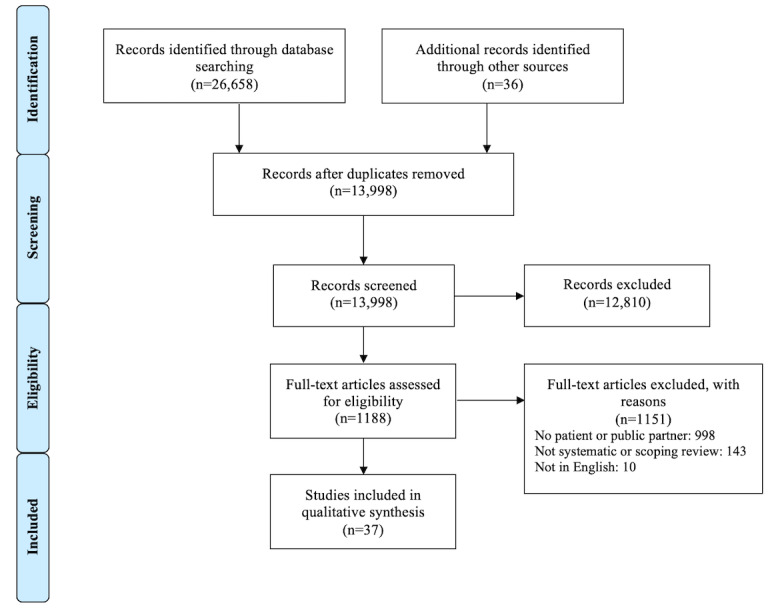
We screened 13,998 results and found 37 studies that met our inclusion criteria. In line with other PPI research, we found that a wide range of terms were used for patient and public authors in author affiliations. In some cases, partners were easy to identify with titles such as patient, caregiver or consumer representative, patient partner, expert by experience, citizen researcher, or public contributor. In 11% (n=4) of studies, they were identified as members of a panel or advisory council. In 27% (n=10) of articles, it was either impossible or difficult to tell whether an author was a partner solely from the affiliation, and confirmation was found elsewhere in the article. We also investigated where in the reviews the partner coauthors' roles were described, and when possible, what their specific roles were. Often, there was little or no information about which review tasks the partner coauthors contributed to. Furthermore, only 14% (5/37) of reviews mentioned patient or public involvement as authors in the abstract; involvement was often only indicated in the author affiliation field or in the review text (most often in the methods or contributions section).
Our findings add to the evidence that searching for coproduced research is difficult because of the diversity of terms used to describe patient and public partners, and the lack of consistent, detailed reporting about PPI. For better discoverability, we recommend ensuring that patient and public authorships are indicated in commonly searched database fields. When patient and public-authored research is easier to find, its impact will be easier to measure.
患者及公众参与(PPI)健康研究是一个日益受到关注的领域。多项研究探讨了PPI在知识综合(系统评价、范围综述及相关综述)中的应用及影响;然而,很少有研究专门聚焦于此类综述的患者或公众共同作者情况。
本研究旨在识别由患者或公众合作伙伴共同撰写的已发表系统评价和范围综述,并考察这些共同撰写综述的特征,如发表它们的期刊、研究团队的地理位置,以及在作者单位、摘要或文章正文里用于描述患者或公众合作伙伴作者的术语。
我们检索了2011年至2019年5月期间的CAB Direct、CINAHL、Cochrane系统评价数据库(Ovid)、Embase(Ovid)、MEDLINE(Ovid)和PsycInfo,并对几个聚焦PPI的数据库进行了补充检索。我们通过检查相关检索结果中常用的单词和短语来优化Ovid MEDLINE检索,并于2020年6月使用修改后的检索策略检索Ovid MEDLINE。
我们筛选了13998条结果,发现37项研究符合我们的纳入标准。与其他PPI研究一致,我们发现作者单位中用于患者和公众作者的术语多种多样。在某些情况下,合作伙伴很容易通过患者、护理人员或消费者代表、患者合作伙伴、经验专家、公民研究员或公众贡献者等头衔来识别。在11%(n = 4)的研究中,他们被确定为小组或咨询委员会的成员。在27%(n = 10)的文章中,仅从作者单位无法判断或很难判断一位作者是否为合作伙伴,需要在文章其他地方确认。我们还调查了在综述中合作伙伴共同作者的角色在何处被描述,以及在可能的情况下,他们的具体角色是什么。通常,关于合作伙伴共同作者参与了哪些综述任务的信息很少或没有。此外,只有14%(5/37)的综述在摘要中提及患者或公众作为作者的参与情况;这种参与通常仅在作者单位字段或综述正文(最常在方法或贡献部分)中有所体现。
我们的研究结果进一步证明,由于用于描述患者和公众合作伙伴的术语多样,以及缺乏关于PPI的一致、详细报告,寻找共同产生的研究很困难。为了提高可发现性,我们建议确保在常用检索的数据库字段中注明患者和公众作者身份。当更容易找到患者和公众撰写的研究时,其影响将更容易衡量。