School of Nursing, University of Rochester, 601 Elmwood Avenue, Rochester, NY, 14642, USA.
School of Public Health, University of Rochester, 265 Crittenden Blvd, Rochester, NY, 14642, USA.
Appetite. 2021 Nov 1;166:105442. doi: 10.1016/j.appet.2021.105442. Epub 2021 Jun 8.
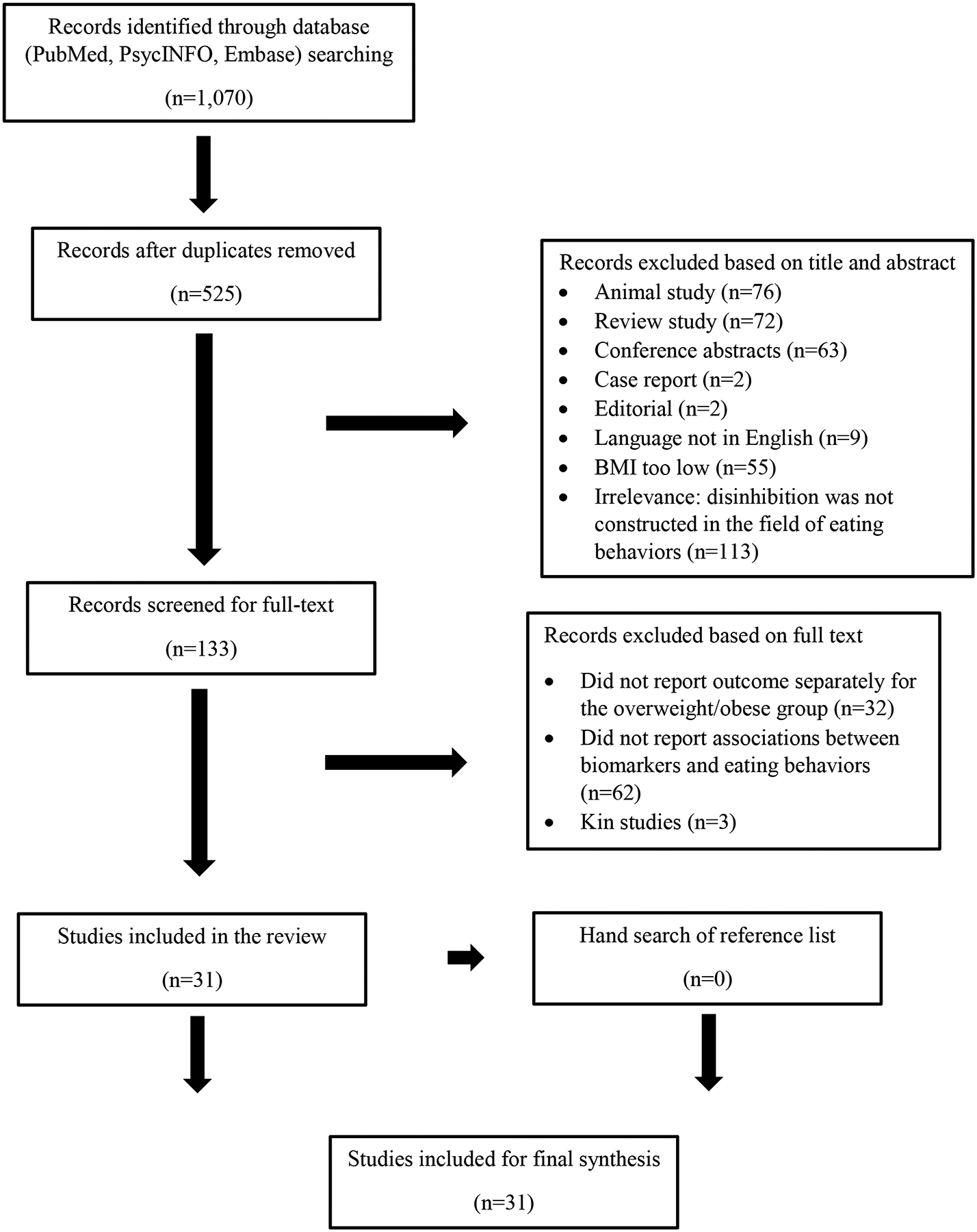
Loss of control (LOC) eating is the defining feature of binge-eating disorder, and it has particular relevance for bariatric patients. The biomarkers of LOC eating are unclear; however, gut hormones (i.e., ghrelin, cholecystokinin [CCK], peptide YY [PYY], glucagon-like peptide 1 [GLP-1], and pancreatic polypeptide [PP]), adipokines (i.e., leptin, adiponectin), and pro- and anti-inflammatory cytokines/markers (e.g., high-sensitivity C-reactive protein [hsCRP]) are candidates due to their involvement in the psychophysiological mechanisms of LOC eating. This review aimed to synthesize research that has investigated these biomarkers with LOC eating. Because LOC eating is commonly examined within the context of binge-eating disorder, is sometimes used interchangeably with subclinical binge-eating, and is the latent construct underlying disinhibition, uncontrolled eating, and food addiction, these eating behaviors were included in the search. Only studies among individuals with overweight or obesity were included. Among the identified 31 studies, 2 studies directly examined LOC eating and 4 studies were conducted among bariatric patients. Most studies were case-control in design (n = 16) and comprised female-dominant (n = 13) or female-only (n = 13) samples. Studies generally excluded fasting total ghrelin, fasting CCK, fasting PYY, and fasting PP as correlates of the examined eating behaviors. However, there was evidence that the examined eating behaviors were associated with lower levels of fasting acyl ghrelin (the active form of ghrelin) and adiponectin, higher levels of leptin and hsCRP, and altered responses of postprandial ghrelin, CCK, and PYY. The use of GLP-1 analog was able to decrease binge-eating. In conclusion, this review identified potential biomarkers of LOC eating. Future studies would benefit from a direct focus on LOC eating (especially in the bariatric population), using longitudinal designs, exploring potential mediators and moderators, and increased inclusion of the male population.
失控进食(LOC)是暴食症的主要特征,这对减重手术患者尤其相关。LOC 进食的生物标志物尚不清楚;然而,胃肠激素(即胃饥饿素、胆囊收缩素 [CCK]、肽 YY [PYY]、胰高血糖素样肽 1 [GLP-1] 和胰多肽 [PP])、脂肪因子(即瘦素、脂联素)和促炎及抗炎细胞因子/标志物(如高敏 C 反应蛋白 [hsCRP])可能是候选物,因为它们参与了 LOC 进食的心理生理机制。本综述旨在综合研究与 LOC 进食相关的这些生物标志物。由于 LOC 进食通常在暴食症的背景下进行检查,有时与亚临床暴食行为互换使用,并且是抑制作用、失控进食和食物成瘾的潜在结构,因此这些进食行为也包括在搜索范围内。仅包括超重或肥胖个体的研究。在确定的 31 项研究中,有 2 项研究直接检查了 LOC 进食,4 项研究是在减重手术患者中进行的。大多数研究采用病例对照设计(n=16),且样本以女性为主(n=13)或仅为女性(n=13)。研究一般排除了空腹总胃饥饿素、空腹 CCK、空腹 PYY 和空腹 PP 作为所检查的进食行为的相关因素。然而,有证据表明,所检查的进食行为与空腹酰化胃饥饿素(胃饥饿素的活性形式)和脂联素水平降低、瘦素和 hsCRP 水平升高以及餐后胃饥饿素、CCK 和 PYY 反应改变有关。GLP-1 类似物的使用能够减少暴食行为。总之,本综述确定了 LOC 进食的潜在生物标志物。未来的研究将受益于直接关注 LOC 进食(特别是在减重手术人群中),采用纵向设计,探索潜在的中介和调节因素,并增加男性人群的纳入。