Department of Respiratory and Critical Care Medicine, The Second Hospital of Hebei Medical University, Shijiazhuang, 050000, China.
Department of orthopedics, No. 7 Hospital of Wuhan, Wuhan, China.
BMC Infect Dis. 2021 Jun 10;21(1):549. doi: 10.1186/s12879-021-06282-6.
Due to the latent onset of novel coronavirus disease 2019 (COVID-19), it is important to identify patients with increased probabilities for disease progression early in order to implement timely medical strategies. This study aimed to identify the factors associated with increased COVID-19 severity and evaluate the current antiviral drugs, especially in severe patients.
This was a retrospective observational study performed at the No. 7 Hospital of Wuhan (Wuhan, China) with hospitalized patients confirmed with COVID-19 from January 11 to March 13, 2020. Multivariable logistic regression analysis was used to identify the associated factors of severe COVID. Treatments of antivirus drugs were collected and evaluated.
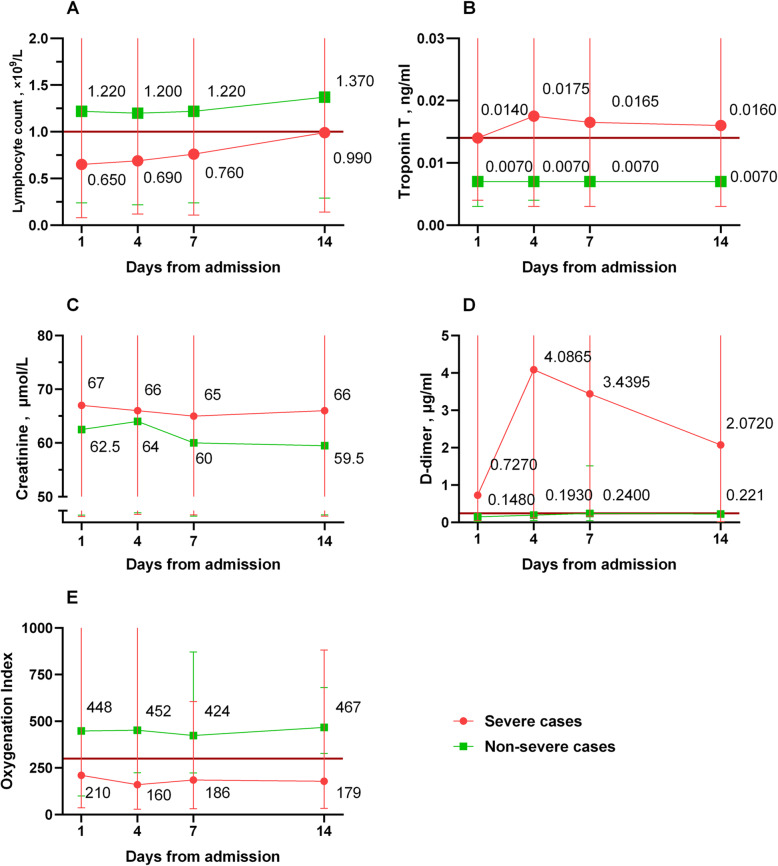
Of the 550 patients, 292 (53.1%) were female and 277 (50.4%) were > 60 years old. The most common symptom was fever (n = 372, 67.7%), followed by dry cough (n = 257, 46.7%), and dyspnea (n = 237, 43.1%), and fatigue (n = 224, 40.7%). Among the severe patients, 20.2% required invasive ventilator support and 18.0% required non-invasive ventilator. The identified risk factors for severe cases were: age ≥ 60 years (odds ratio (OR) =3.02, 95% confidence interval (CI): 1.13-8.08, P = 0.028), D-dimer > 0.243 μg/ml (OR = 2.734, 95%CI: 1.012-7.387, P = 0.047), and low oxygenation index (OR = 0.984, 95%CI: 0.980-0.989, P < 0.001). In severe cases, the benefits (relief of clinical symptoms, clinical outcome, and discharge rate) of arbidol alone was 73.3%, which was better than ribavirin (7/17, 41.2%, P = 0.029).
Age > 60 years, D-dimer > 0.243 μg/ml, and lower oxygenation index were associated with severe COVID-19. Arbidol might provide more clinical benefits in treating patients with severe COVID-19 compared with ribavirin.
由于新型冠状病毒病 2019(COVID-19)潜伏期的存在,早期识别疾病进展风险较高的患者以实施及时的医疗策略非常重要。本研究旨在确定与 COVID-19 严重程度增加相关的因素,并评估目前的抗病毒药物,特别是在重症患者中的应用。
这是一项回顾性观察性研究,在武汉第七医院(武汉,中国)进行,纳入 2020 年 1 月 11 日至 3 月 13 日确诊的 COVID-19 住院患者。多变量逻辑回归分析用于确定重症 COVID 的相关因素。收集并评估抗病毒药物的治疗效果。
550 例患者中,292 例(53.1%)为女性,277 例(50.4%)年龄>60 岁。最常见的症状是发热(n=372,67.7%),其次是干咳(n=257,46.7%)、呼吸困难(n=237,43.1%)和乏力(n=224,40.7%)。重症患者中,20.2%需要有创呼吸机支持,18.0%需要无创呼吸机。重症病例的危险因素包括:年龄≥60 岁(比值比(OR)=3.02,95%置信区间(CI):1.13-8.08,P=0.028)、D-二聚体>0.243μg/ml(OR=2.734,95%CI:1.012-7.387,P=0.047)和低氧合指数(OR=0.984,95%CI:0.980-0.989,P<0.001)。在重症患者中,利巴韦林单独使用的获益(缓解临床症状、临床结局和出院率)为 73.3%,优于利巴韦林(7/17,41.2%,P=0.029)。
年龄>60 岁、D-二聚体>0.243μg/ml 和低氧合指数与 COVID-19 严重程度相关。与利巴韦林相比,阿比多尔可能为重症 COVID-19 患者提供更多的临床获益。