Department of Hematology, Zealand University Hospital, Roskilde, Vestermarksvej 9, 4000, Roskilde, Denmark.
Department of Hematology and Oncology, UT Health San Antonio MD Anderson Cancer Center, 7979 Wurzbach Rd, San Antonio, TX, 78229, USA.
BMC Cancer. 2021 Jun 10;21(1):691. doi: 10.1186/s12885-021-08439-7.
Patients with Philadelphia-negative Myeloproliferative Neoplasms (MPN) suffer from numerous symptoms and decreased quality of life. Smoking is associated with an increased symptom burden in several malignancies. The aim of this study was to analyze the association between smoking and MPN-related symptom burden and explore MPN patients' opinions on smoking.
A total of 435 patients with MPN participated in a cross-sectional internet-based survey developed by the Mayo Clinic and the Myeloproliferative Neoplasm Quality of Life Group. Patients reported their demographics, disease characteristics, tobacco use, and opinions on tobacco use. In addition, MPN-related symptoms were reported via the validated 10-item version of the Myeloproliferative Neoplasms Symptom Assessment Form.
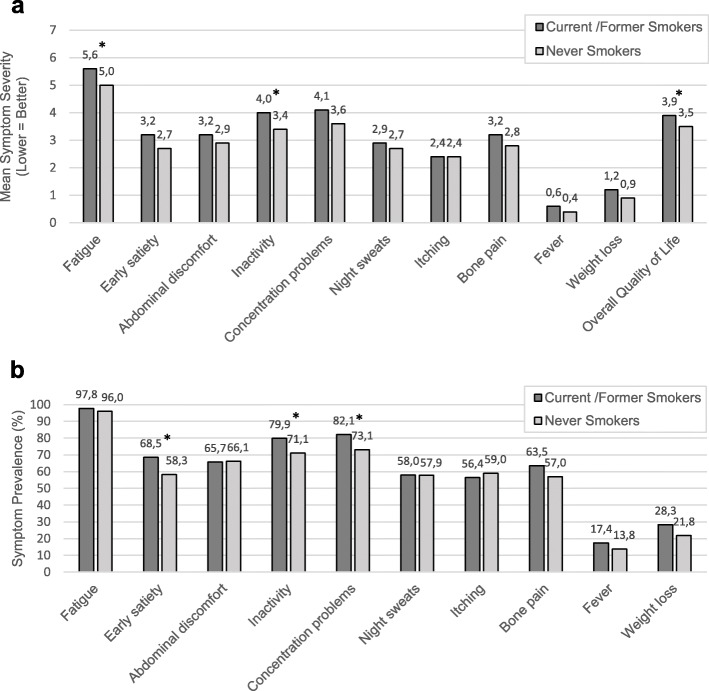
Current/former smokers reported worse fatigue (mean severity 5.6 vs. 5.0, p = 0.02) and inactivity (mean severity 4.0 vs. 3.4, p = 0.03) than never smokers. Moreover, current/former smokers more frequently experienced early satiety (68.5% vs. 58.3%, p = 0.03), inactivity (79.9% vs. 71.1%, p = 0.04), and concentration difficulties (82.1% vs. 73.1%, p = 0.04). Although not significant, a higher total symptom burden was observed for current/former smokers (mean 30.4 vs. 27.0, p = 0.07). Accordingly, overall quality of life was significantly better among never smokers than current/former smokers (mean 3.5 vs. 3.9, p = 0.03). Only 43.2% of the current/former smokers reported having discussed tobacco use with their physician, and 17.5% did not believe smoking increased the risk of thrombosis.
The current study suggests that smoking may be associated with increased prevalence and severity of MPN symptoms and underscores the need to enhance patient education and address tobacco use in the care of MPN patients.
费城阴性骨髓增殖性肿瘤(MPN)患者有多种症状,生活质量下降。吸烟与多种恶性肿瘤的症状负担增加有关。本研究旨在分析吸烟与 MPN 相关症状负担之间的关系,并探讨 MPN 患者对吸烟的看法。
共有 435 名 MPN 患者参与了由梅奥诊所和骨髓增殖性肿瘤生活质量小组开发的基于互联网的横断面调查。患者报告了他们的人口统计学特征、疾病特征、烟草使用情况以及对烟草使用的看法。此外,通过经过验证的 10 项骨髓增殖性肿瘤症状评估表报告 MPN 相关症状。
目前/曾经吸烟者报告的疲劳(平均严重程度 5.6 比 5.0,p=0.02)和不活动(平均严重程度 4.0 比 3.4,p=0.03)比从不吸烟者更严重。此外,目前/曾经吸烟者更容易出现早饱(68.5%比 58.3%,p=0.03)、不活动(79.9%比 71.1%,p=0.04)和注意力困难(82.1%比 73.1%,p=0.04)。虽然不显著,但目前/曾经吸烟者的总症状负担更高(平均 30.4 比 27.0,p=0.07)。因此,从不吸烟者的总体生活质量明显好于目前/曾经吸烟者(平均 3.5 比 3.9,p=0.03)。目前/曾经吸烟者中只有 43.2%报告与医生讨论过吸烟问题,17.5%不认为吸烟会增加血栓形成的风险。
本研究表明,吸烟可能与 MPN 症状的发生率和严重程度增加有关,并强调需要加强患者教育,在 MPN 患者的护理中解决吸烟问题。