Department of General Surgery & Pancreatic Injury and Repair Key Laboratory of Sichuan Province, The General Hospital of Western Theater Command, Chengdu, 610083, China.
Tianjin Medical University, Tianjin, 300070, China.
Stem Cell Res Ther. 2021 Jun 10;12(1):337. doi: 10.1186/s13287-021-02411-9.
Mesenchymal stem cells (MSCs) hold promising potential to treat systemic inflammatory diseases including severe acute pancreatitis (SAP). In our previous study, placental chorionic plate-derived MSCs (CP-MSCs) were found to possess superior immunoregulatory capability. However, the therapeutic efficacy of CP-MSCs on SAP and their underlying mechanism remain unclear.
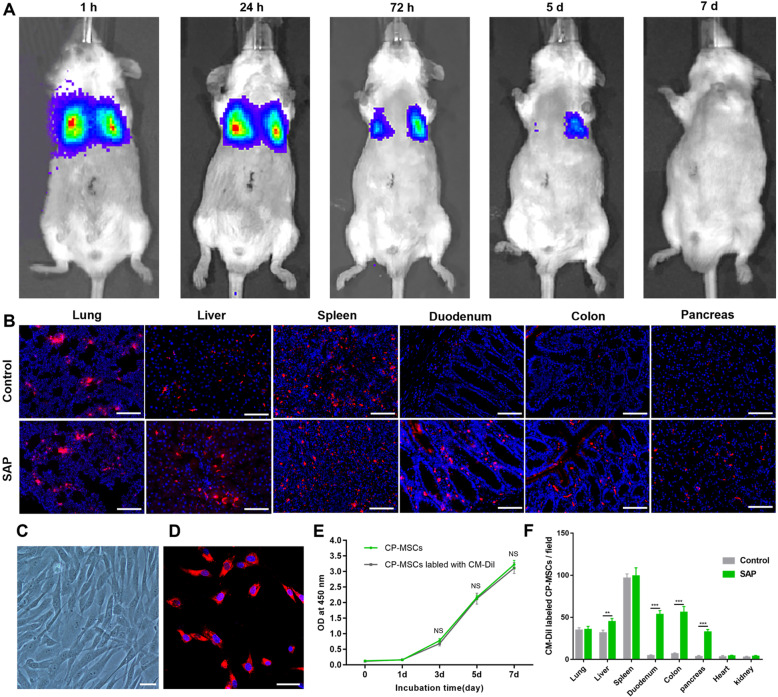
The survival and colonization of exogenous CP-MSCs were observed by bioluminescence imaging and CM-Dil labeling in rodent animal models of SAP. The therapeutic efficacy of CP-MSCs on SAP rats was evaluated by pathology scores, the levels of pancreatitis biomarkers as well as the levels of inflammatory factors in the pancreas and serum. The potential protective mechanism of CP-MSCs in SAP rats was explored by selectively depleting M1 or M2 phenotype macrophages and knocking down the expression of TSG-6.
Exogenous CP-MSCs could survive and colonize in the injured tissue of SAP such as the lung, pancreas, intestine, and liver. Meanwhile, we found that CP-MSCs alleviated pancreatic injury and systemic inflammation by inducing macrophages to polarize from M1 to M2 in SAP rats. Furthermore, our data suggested that CP-MSCs induced M2 polarization of macrophages by secreting TSG-6, and TSG-6 played a vital role in alleviating pancreatic injury and systemic inflammation in SAP rats. Notably, we found that a high inflammation environment could stimulate CP-MSCs to secrete TSG-6.
Exogenous CP-MSCs tended to colonize in the injured tissue and reduced pancreatic injury and systemic inflammation in SAP rats through inducing M2 polarization of macrophages by secreting TSG-6. Our study provides a new treatment strategy for SAP and initially explains the potential protective mechanism of CP-MSCs on SAP rats.
间充质干细胞(MSCs)在治疗包括重症急性胰腺炎(SAP)在内的全身性炎症性疾病方面具有很大的潜力。在我们之前的研究中,发现胎盘绒毛膜板来源的间充质干细胞(CP-MSCs)具有优越的免疫调节能力。然而,CP-MSCs 对 SAP 的治疗效果及其潜在的机制仍不清楚。
通过生物发光成像和 CM-Dil 标记观察 CP-MSCs 在 SAP 啮齿动物模型中的存活和定植情况。通过胰腺病理评分、胰腺炎生物标志物水平以及胰腺和血清中炎症因子水平评估 CP-MSCs 对 SAP 大鼠的治疗效果。通过选择性耗竭 M1 或 M2 表型巨噬细胞以及敲低 TSG-6 的表达来探索 CP-MSCs 在 SAP 大鼠中的潜在保护机制。
外源性 CP-MSCs 可以在 SAP 大鼠的损伤组织中存活和定植,如肺、胰腺、肠道和肝脏。同时,我们发现 CP-MSCs 通过诱导巨噬细胞在 SAP 大鼠中从 M1 向 M2 极化来减轻胰腺损伤和全身炎症。此外,我们的数据表明 CP-MSCs 通过分泌 TSG-6 诱导巨噬细胞向 M2 极化,并且 TSG-6 在减轻 SAP 大鼠的胰腺损伤和全身炎症中起着至关重要的作用。值得注意的是,我们发现高炎症环境可以刺激 CP-MSCs 分泌 TSG-6。
外源性 CP-MSCs 倾向于在损伤组织中定植,并通过分泌 TSG-6 诱导巨噬细胞向 M2 极化,从而减轻 SAP 大鼠的胰腺损伤和全身炎症。我们的研究为 SAP 提供了一种新的治疗策略,并初步解释了 CP-MSCs 对 SAP 大鼠的潜在保护机制。