Department of Medicine, Marshfield Clinic Health System, Marshfield, Wisconsin, USA.
Center for Humanizing Critical Care, Intermountain Medical Center, Murray, Utah, USA.
Thorax. 2022 Jan;77(1):22-30. doi: 10.1136/thoraxjnl-2020-216613. Epub 2021 Jun 10.
Prior acute respiratory distress syndrome (ARDS) trials have identified hypoinflammatory and hyperinflammatory subphenotypes, with distinct differences in short-term outcomes. It is unknown if such differences extend beyond 90 days or are associated with physical, mental health or cognitive outcomes.
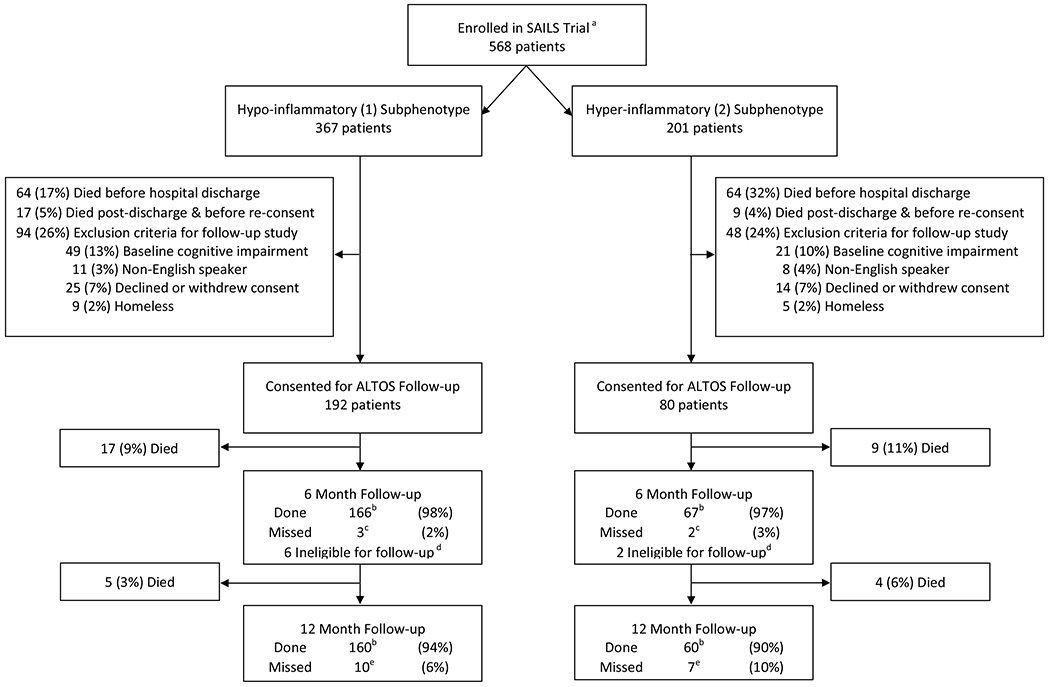
568 patients in the multicentre Statins for Acutely Injured Lungs from Sepsis trial of rosuvastatin versus placebo were included and assigned a subphenotype. Among 6-month and 12-month survivors (N=232 and 219, respectively, representing 243 unique survivors), subphenotype status was evaluated for association with a range of patient-reported outcomes (eg, mental health symptoms, quality of life). Patient subsets also were evaluated with performance-based tests of physical function (eg, 6 min walk test) and cognition.
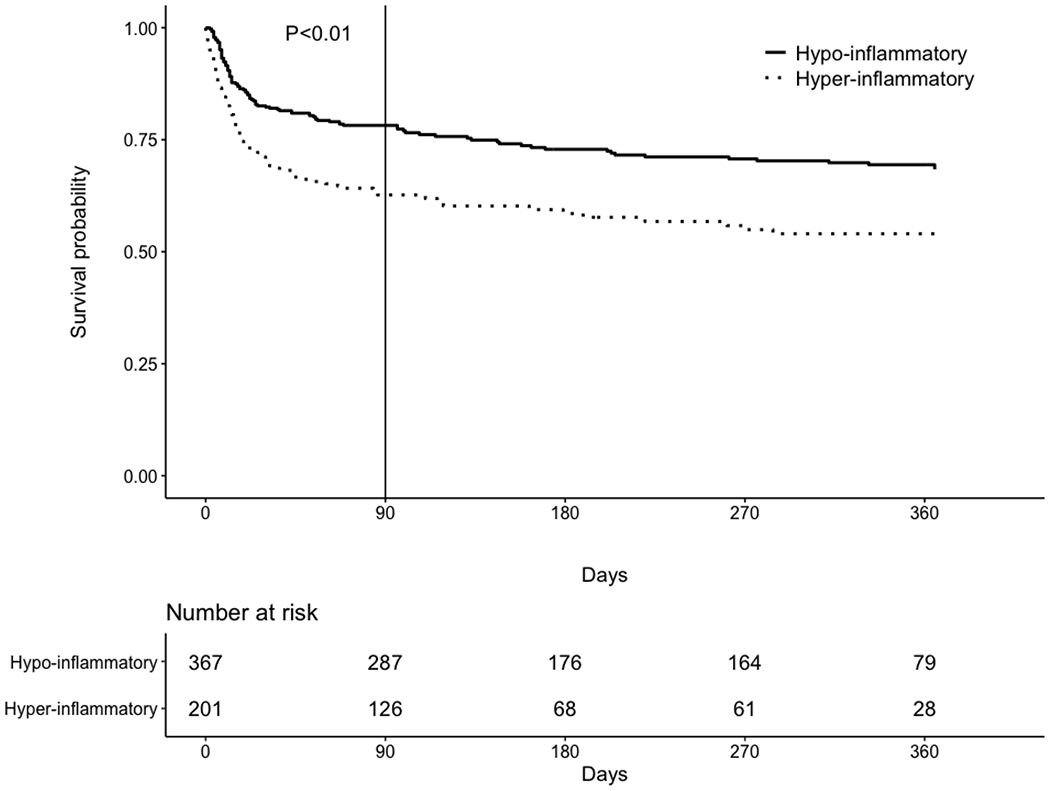
The hyperinflammatory versus hypoinflammatory subphenotype had lower overall 12-month cumulative survival (58% vs 72%, p<0.01); however, there was no significant difference in survival beyond 90 days (86% vs 89%, p=0.70). Most survivors had impairment across the range of outcomes, with little difference between subphenotypes at 6-month and 12-month assessments. For instance, at 6 months, in comparing the hypoinflammatory versus hyperinflammatory subphenotypes, respectively, the median (IQR) patient-reported SF-36 mental health domain score was 47 (33-56) vs 44 (35-56) (p=0.99), and the per cent predicted 6 min walk distance was 66% (48%, 80%) vs 66% (49%, 79%) (p=0.76).
Comparing the hyperinflammatory versus hypoinflammatory ARDS subphenotype, there was no significant difference in survival beyond 90 days and no consistent findings of important differences in 6-month or 12-month physical, cognitive and mental health outcomes. These findings, when considered with prior results, suggest that inflammatory subphenotypes largely reflect the acute phase of illness and its short-term impact.
先前的急性呼吸窘迫综合征(ARDS)试验已经确定了低炎症和高炎症亚表型,其短期结局存在明显差异。目前尚不清楚这些差异是否会持续超过 90 天,或者是否与身体、心理健康或认知结局相关。
纳入了多中心分离他汀治疗脓毒症急性肺损伤试验中瑞舒伐他汀与安慰剂的 568 例患者,并对其进行了亚表型分类。在 6 个月和 12 个月的幸存者(分别为 232 例和 219 例,代表 243 例独特的幸存者)中,评估了亚表型状态与一系列患者报告结局(例如,心理健康症状、生活质量)之间的关系。还对患者亚组进行了身体功能(如 6 分钟步行试验)和认知方面的基于表现的测试。
高炎症亚表型与低炎症亚表型相比,12 个月总累积生存率较低(分别为 58%和 72%,p<0.01);然而,90 天后的生存率没有显著差异(分别为 86%和 89%,p=0.70)。大多数幸存者在一系列结局中均存在障碍,亚表型之间的差异在 6 个月和 12 个月评估中不大。例如,在 6 个月时,与低炎症亚表型相比,高炎症亚表型的患者报告 SF-36 心理健康量表的中位数(IQR)分别为 47(33-56)和 44(35-56)(p=0.99),6 分钟步行距离预测百分比分别为 66%(48%,80%)和 66%(49%,79%)(p=0.76)。
与高炎症和低炎症 ARDS 亚表型相比,90 天后的生存率无显著差异,6 个月或 12 个月的身体、认知和心理健康结局也没有一致的重要差异发现。这些发现与先前的结果相结合表明,炎症亚表型主要反映了疾病的急性期及其短期影响。