Papathanakos Georgios, Andrianopoulos Ioannis, Xenikakis Menelaos, Papathanasiou Athanasios, Koulenti Despoina, Blot Stijn, Koulouras Vasilios
Department of Intensive Care Medicine, University Hospital of Ioannina, 45500 Ioannina, Greece.
UQ Centre for Clinical Research, Faculty of Medicine, The University of Queensland, Brisbane, QL 4029, Australia.
Microorganisms. 2023 Aug 27;11(9):2165. doi: 10.3390/microorganisms11092165.
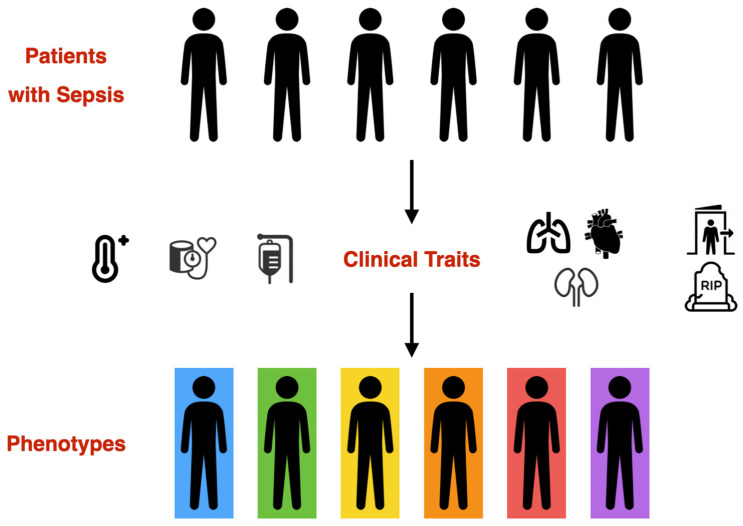
Sepsis, defined as the life-threatening dysregulated host response to an infection leading to organ dysfunction, is considered as one of the leading causes of mortality worldwide, especially in intensive care units (ICU). Moreover, sepsis remains an enigmatic clinical syndrome, with complex pathophysiology incompletely understood and a great heterogeneity both in terms of clinical expression, patient response to currently available therapeutic interventions and outcomes. This heterogeneity proves to be a major obstacle in our quest to deliver improved treatment in septic critical care patients; thus, identification of clinical phenotypes is absolutely necessary. Although this might be seen as an extremely difficult task, nowadays, artificial intelligence and machine learning techniques can be recruited to quantify similarities between individuals within sepsis population and differentiate them into distinct phenotypes regarding not only temperature, hemodynamics or type of organ dysfunction, but also fluid status/responsiveness, trajectories in ICU and outcome. Hopefully, we will eventually manage to determine both the subgroup of septic patients that will benefit from a therapeutic intervention and the correct timing of applying the intervention during the disease process.
脓毒症被定义为宿主对感染的危及生命的失调反应,导致器官功能障碍,它被认为是全球范围内主要的死亡原因之一,尤其是在重症监护病房(ICU)。此外,脓毒症仍然是一种难以捉摸的临床综合征,其复杂的病理生理学尚未完全了解,在临床表现、患者对现有治疗干预措施的反应以及预后方面都存在很大的异质性。这种异质性被证明是我们为脓毒症重症患者提供更好治疗的主要障碍;因此,识别临床表型绝对必要。尽管这可能被视为一项极其困难的任务,但如今,可以利用人工智能和机器学习技术来量化脓毒症患者群体中个体之间的相似性,并将他们区分为不同的表型,不仅涉及体温、血流动力学或器官功能障碍的类型,还包括液体状态/反应性、在ICU的病程以及预后。有望最终我们能够确定哪些脓毒症患者亚组将从治疗干预中获益,以及在疾病过程中应用干预措施的正确时机。