Jalal Hawre, Trikalinos Thomas A, Alarid-Escudero Fernando
Department of Health Policy and Management, University of Pittsburgh, Graduate School of Public Health, Pittsburgh, PA, United States.
Departments of Health Services, Policy & Practice and Biostatistics, Brown University, Providence, RI, United States.
Front Physiol. 2021 May 25;12:662314. doi: 10.3389/fphys.2021.662314. eCollection 2021.
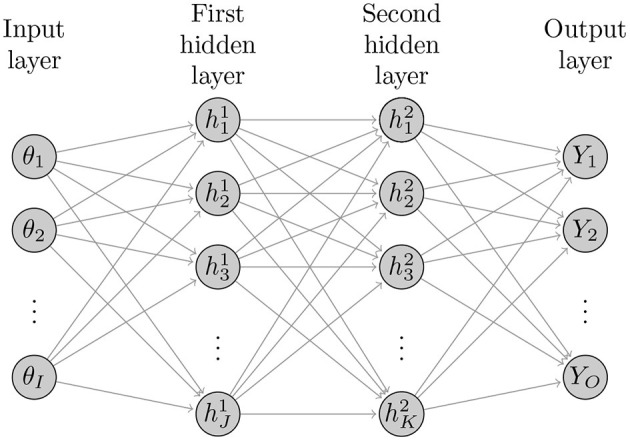
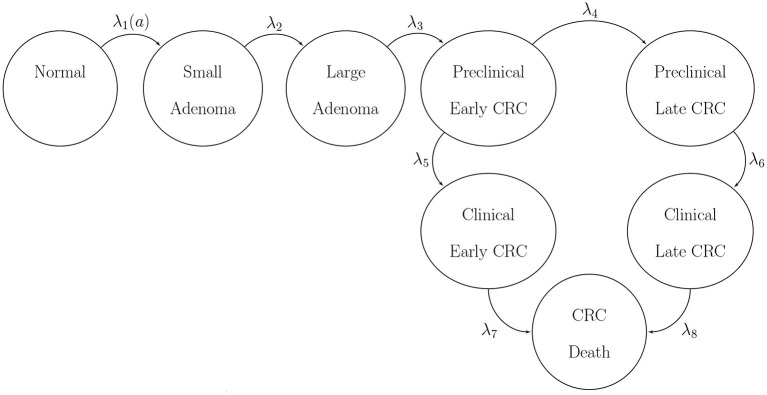
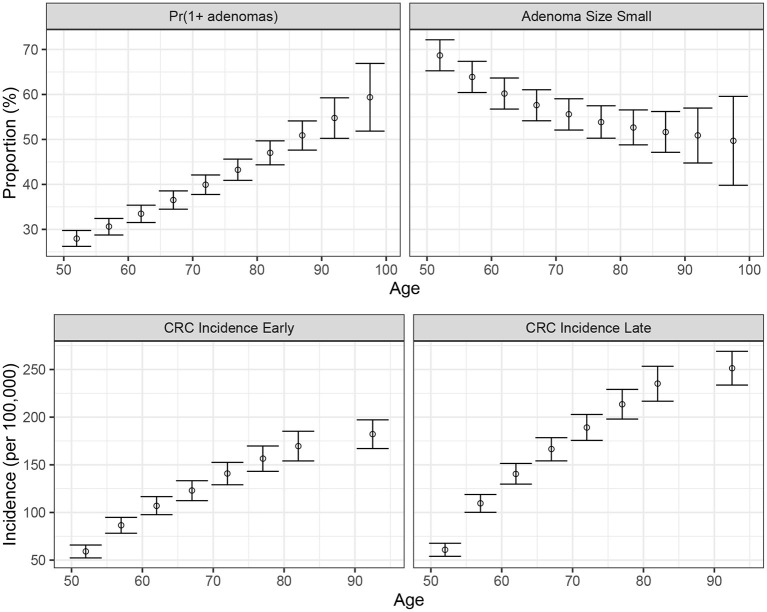
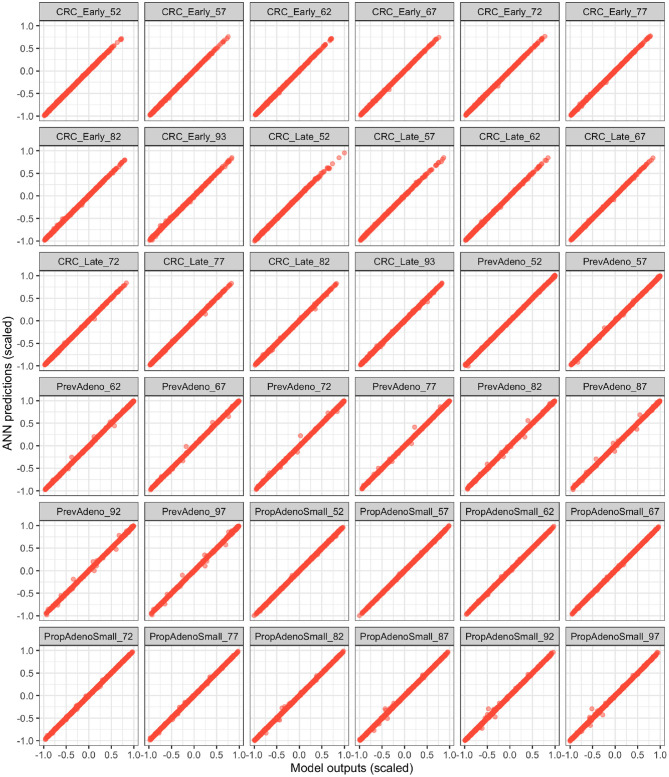
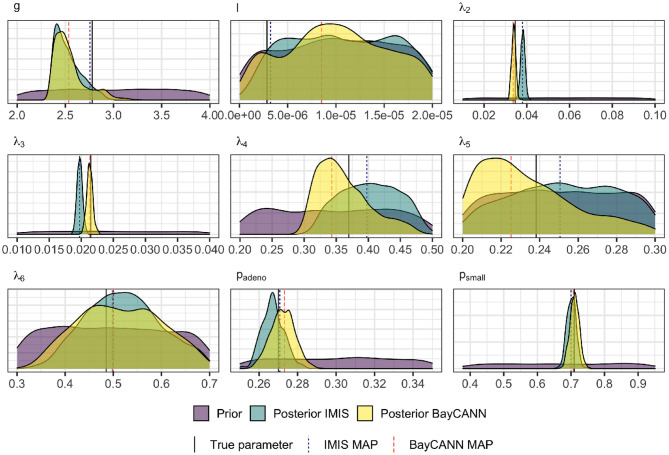
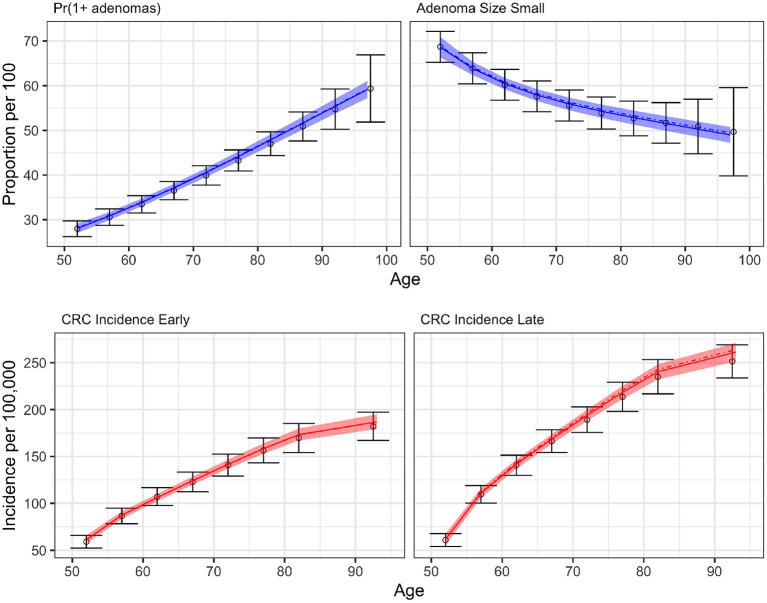
Bayesian calibration is generally superior to standard direct-search algorithms in that it estimates the full joint posterior distribution of the calibrated parameters. However, there are many barriers to using Bayesian calibration in health decision sciences stemming from the need to program complex models in probabilistic programming languages and the associated computational burden of applying Bayesian calibration. In this paper, we propose to use artificial neural networks (ANN) as one practical solution to these challenges. Bayesian Calibration using Artificial Neural Networks (BayCANN) involves (1) training an ANN metamodel on a sample of model inputs and outputs, and (2) then calibrating the trained ANN metamodel instead of the full model in a probabilistic programming language to obtain the posterior joint distribution of the calibrated parameters. We illustrate BayCANN using a colorectal cancer natural history model. We conduct a confirmatory simulation analysis by first obtaining parameter estimates from the literature and then using them to generate adenoma prevalence and cancer incidence targets. We compare the performance of BayCANN in recovering these "true" parameter values against performing a Bayesian calibration directly on the simulation model using an incremental mixture importance sampling (IMIS) algorithm. We were able to apply BayCANN using only a dataset of the model inputs and outputs and minor modification of BayCANN's code. In this example, BayCANN was slightly more accurate in recovering the true posterior parameter estimates compared to IMIS. Obtaining the dataset of samples, and running BayCANN took 15 min compared to the IMIS which took 80 min. In applications involving computationally more expensive simulations (e.g., microsimulations), BayCANN may offer higher relative speed gains. BayCANN only uses a dataset of model inputs and outputs to obtain the calibrated joint parameter distributions. Thus, it can be adapted to models of various levels of complexity with minor or no change to its structure. In addition, BayCANN's efficiency can be especially useful in computationally expensive models. To facilitate BayCANN's wider adoption, we provide BayCANN's open-source implementation in R and Stan.
贝叶斯校准通常优于标准直接搜索算法,因为它能估计校准参数的完整联合后验分布。然而,在健康决策科学中使用贝叶斯校准存在诸多障碍,这源于需要用概率编程语言编写复杂模型以及应用贝叶斯校准相关的计算负担。在本文中,我们提议使用人工神经网络(ANN)作为应对这些挑战的一种实际解决方案。使用人工神经网络的贝叶斯校准(BayCANN)包括:(1)在模型输入和输出样本上训练一个ANN元模型;(2)然后在校准后的ANN元模型而非用概率编程语言编写的完整模型上进行校准,以获得校准参数的后验联合分布。我们使用结直肠癌自然史模型来说明BayCANN。我们首先通过从文献中获取参数估计值,然后用它们生成腺瘤患病率和癌症发病率目标,进行了一项验证性模拟分析。我们将BayCANN在恢复这些“真实”参数值方面的性能与使用增量混合重要性抽样(IMIS)算法直接在模拟模型上进行贝叶斯校准的性能进行了比较。我们仅使用模型输入和输出的数据集以及对BayCANN代码进行少量修改就能应用BayCANN。在此示例中,与IMIS相比,BayCANN在恢复真实后验参数估计值方面略更准确。获取样本数据集并运行BayCANN耗时15分钟,而IMIS则耗时80分钟。在涉及计算成本更高的模拟(例如微观模拟)的应用中,BayCANN可能会带来更高的相对速度提升。BayCANN仅使用模型输入和输出的数据集来获得校准后的联合参数分布。因此,它可以适应各种复杂程度的模型,而其结构只需进行少量更改或无需更改。此外BayCANN的效率在计算成本高的模型中可能特别有用。为便于更广泛地采用BayCANN,我们在R和Stan中提供了BayCANN的开源实现。