Cislo Christine, Clingan Caroline, Gilley Kristen, Rozwadowski Michelle, Gainsburg Izzy, Bradley Christina, Barabas Jenny, Sandford Erin, Olesnavich Mary, Tyler Jonathan, Mayer Caleb, DeMoss Matthew, Flora Christopher, Forger Daniel B, Cunningham Julia Lee, Tewari Muneesh, Choi Sung Won
Division of Pediatric Hematology Oncology, Department of Pediatrics, University of Michigan, 1500 E. Medical Center DrD4118 Medical Professional Building, Ann Arbor, US.
Division of Hematology Oncology, Department of Internal Medicine, University of Michigan, Ann Arbor, US.
JMIR Res Protoc. 2021 Jun 4;10(6). doi: 10.2196/29561.
The COVID-19 pandemic has impacted lives significantly and greatly affected an already vulnerable population, college students, in relation to mental health and public safety. Social distancing and isolation have brought about challenges to student's mental health. Mobile health apps and wearable sensors may help to monitor students at risk for COVID-19 and support their mental well-being.
Through the use of a wearable sensor and smartphone-based survey completion, this study aimed to monitor students at risk for COVID-19.
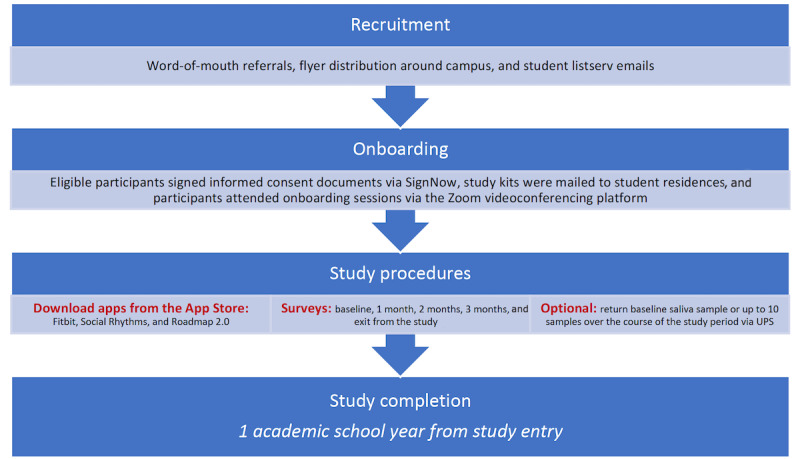
We conducted a prospective study of students, undergraduate and graduate, at a public university in the Midwest. Students were instructed to download the Fitbit, Social Rhythms, and Roadmap 2.0 apps onto their personal mobile devices (Android or iOS). Subjects consented to provide up to 10 saliva samples during the study period. Surveys were administered through the Roadmap 2.0 app at five timepoints - at baseline, 1-month later, 2-months later, 3-months later, and at study completion. The surveys gathered information regarding demographics, COVID-19 diagnoses and symptoms, and mental health resilience, with the aim of documenting the impact of COVID-19 on the college student population.
This study enrolled 2,158 college students between September 2020 and January 2021. Subjects are currently being followed on-study for one academic year. Data collection and analysis are ongoing.
This study examined student health and well-being during the COVID-19 pandemic. It also assessed the feasibility of wearable sensor use and survey completion in a college student population, which may inform the role of our mobile health tools on student health and well-being. Finally, using wearable sensor data, biospecimen collection, and self-reported COVID-19 diagnosis, our results may provide key data towards the development of a model for the early prediction and detection of COVID-19.
ClinicalTrials.gov NCT04766788.
新冠疫情对人们的生活产生了重大影响,极大地影响了本就脆弱的群体——大学生的心理健康和公共安全。社交距离和隔离给学生的心理健康带来了挑战。移动健康应用程序和可穿戴传感器可能有助于监测有感染新冠风险的学生,并支持他们的心理健康。
通过使用可穿戴传感器和基于智能手机的调查完成情况,本研究旨在监测有感染新冠风险的学生。
我们对美国中西部一所公立大学的本科生和研究生进行了一项前瞻性研究。学生们被指示在其个人移动设备(安卓或iOS)上下载Fitbit、Social Rhythms和Roadmap 2.0应用程序。受试者同意在研究期间提供多达10份唾液样本。调查通过Roadmap 2.0应用程序在五个时间点进行——基线时、1个月后、2个月后、3个月后以及研究结束时。这些调查收集了有关人口统计学、新冠诊断和症状以及心理健康恢复力的信息,目的是记录新冠疫情对大学生群体的影响。
本研究在2020年9月至2021年1月期间招募了2158名大学生。目前正在对受试者进行为期一学年的跟踪研究。数据收集和分析正在进行中。
本研究考察了新冠疫情期间学生的健康和幸福状况。它还评估了在大学生群体中使用可穿戴传感器和完成调查的可行性,这可能为我们的移动健康工具在学生健康和幸福方面的作用提供参考。最后,利用可穿戴传感器数据、生物样本收集以及自我报告的新冠诊断结果,我们的研究结果可能为开发一个新冠疫情早期预测和检测模型提供关键数据。
ClinicalTrials.gov NCT04766788