COVID-19 Response, US Centers for Disease Control and Prevention, Atlanta, Georgia.
Office of the Deputy Directory for Infectious Diseases, US Centers for Disease Control and Prevention, Atlanta, Georgia.
JAMA Netw Open. 2021 Jan 4;4(1):e2035057. doi: 10.1001/jamanetworkopen.2020.35057.
Severe acute respiratory syndrome coronavirus 2 (SARS-CoV-2), the etiology of coronavirus disease 2019 (COVID-19), is readily transmitted person to person. Optimal control of COVID-19 depends on directing resources and health messaging to mitigation efforts that are most likely to prevent transmission, but the relative importance of such measures has been disputed.
To assess the proportion of SARS-CoV-2 transmissions in the community that likely occur from persons without symptoms.
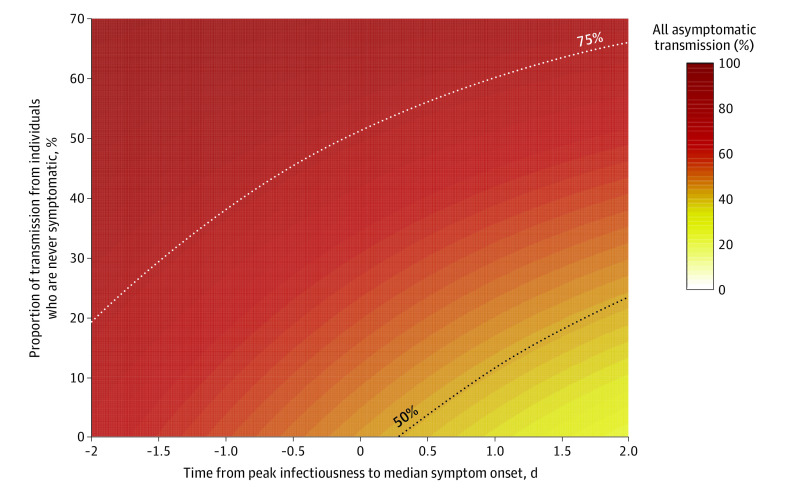
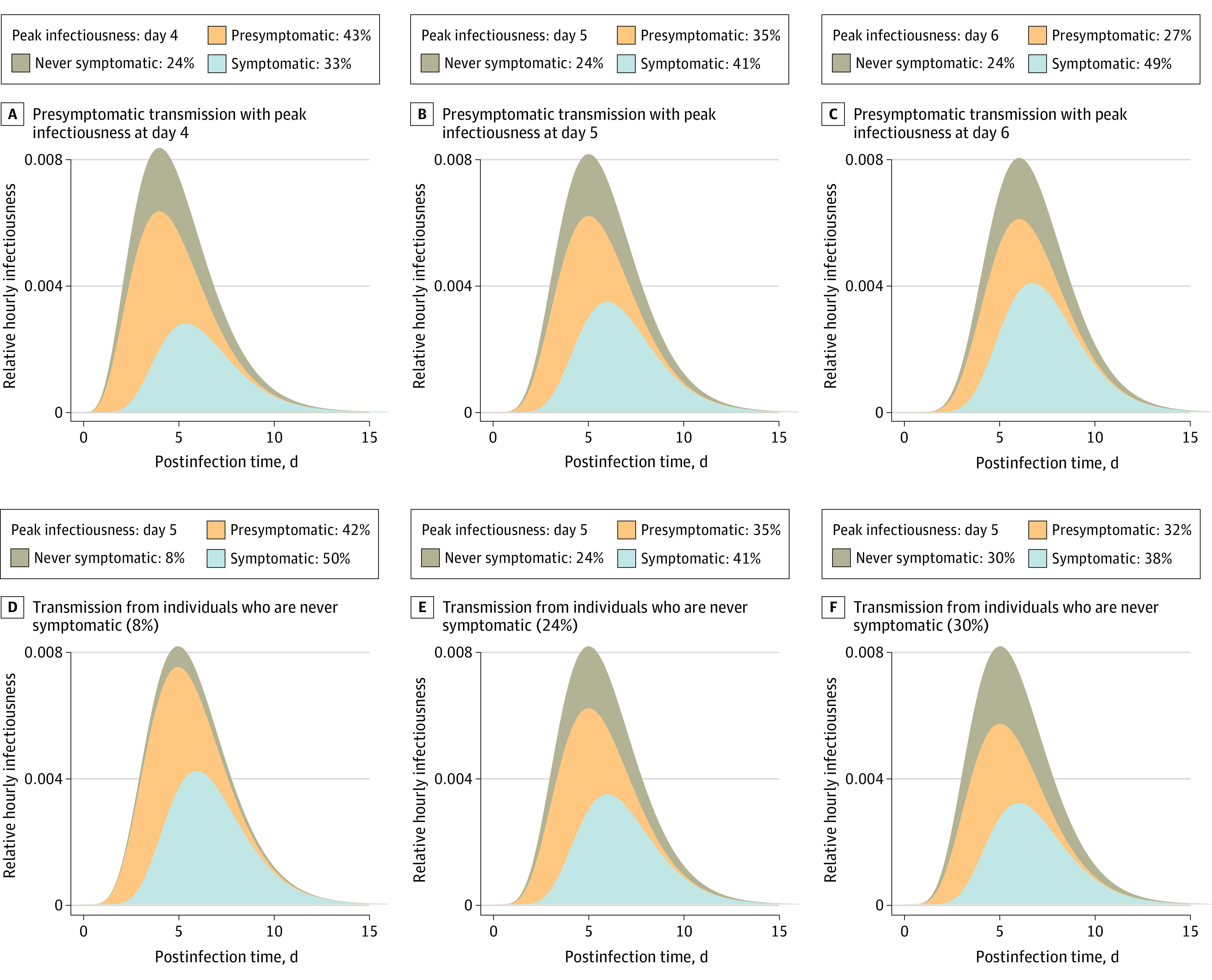
DESIGN, SETTING, AND PARTICIPANTS: This decision analytical model assessed the relative amount of transmission from presymptomatic, never symptomatic, and symptomatic individuals across a range of scenarios in which the proportion of transmission from people who never develop symptoms (ie, remain asymptomatic) and the infectious period were varied according to published best estimates. For all estimates, data from a meta-analysis was used to set the incubation period at a median of 5 days. The infectious period duration was maintained at 10 days, and peak infectiousness was varied between 3 and 7 days (-2 and +2 days relative to the median incubation period). The overall proportion of SARS-CoV-2 was varied between 0% and 70% to assess a wide range of possible proportions.
Level of transmission of SARS-CoV-2 from presymptomatic, never symptomatic, and symptomatic individuals.
The baseline assumptions for the model were that peak infectiousness occurred at the median of symptom onset and that 30% of individuals with infection never develop symptoms and are 75% as infectious as those who do develop symptoms. Combined, these baseline assumptions imply that persons with infection who never develop symptoms may account for approximately 24% of all transmission. In this base case, 59% of all transmission came from asymptomatic transmission, comprising 35% from presymptomatic individuals and 24% from individuals who never develop symptoms. Under a broad range of values for each of these assumptions, at least 50% of new SARS-CoV-2 infections was estimated to have originated from exposure to individuals with infection but without symptoms.
In this decision analytical model of multiple scenarios of proportions of asymptomatic individuals with COVID-19 and infectious periods, transmission from asymptomatic individuals was estimated to account for more than half of all transmissions. In addition to identification and isolation of persons with symptomatic COVID-19, effective control of spread will require reducing the risk of transmission from people with infection who do not have symptoms. These findings suggest that measures such as wearing masks, hand hygiene, social distancing, and strategic testing of people who are not ill will be foundational to slowing the spread of COVID-19 until safe and effective vaccines are available and widely used.
严重急性呼吸系统综合症冠状病毒 2(SARS-CoV-2)是导致 2019 年冠状病毒病(COVID-19)的病因,易于在人与人之间传播。COVID-19 的最佳控制取决于将资源和健康信息引导至最有可能预防传播的缓解措施,但这些措施的相对重要性存在争议。
评估社区中可能因无症状者传播 SARS-CoV-2 的比例。
设计、地点和参与者:本决策分析模型评估了在一系列情况下,从无症状、从未出现症状和出现症状的个体中传播 SARS-CoV-2 的比例,其中从不出现症状的人(即无症状)的传播比例和感染期根据已发表的最佳估计值而变化。对于所有估计值,使用荟萃分析的数据将潜伏期设定为中位数 5 天。感染期持续时间保持在 10 天,而发病高峰期在潜伏期中位数的正负 2 天内波动,为 3 至 7 天。SARS-CoV-2 的总体比例在 0%至 70%之间变化,以评估广泛的可能比例。
从无症状、从未出现症状和出现症状的个体中传播 SARS-CoV-2 的水平。
模型的基线假设是发病高峰期出现在症状出现的中位数,30%的感染者从未出现症状,其传染性与出现症状的感染者相同,传染性为 75%。这些基线假设综合表明,从未出现症状的感染者可能占所有传播的约 24%。在这种基本情况下,所有传播的 59%来自无症状传播,其中 35%来自发病前个体,24%来自从未出现症状的个体。在这些假设的广泛值下,估计至少有 50%的新 SARS-CoV-2 感染源自接触无症状感染者。
在这个关于 COVID-19 无症状个体比例和感染期的多个场景的决策分析模型中,来自无症状个体的传播估计占所有传播的一半以上。除了识别和隔离有症状的 COVID-19 患者外,有效控制传播还需要降低无症状感染者的传播风险。这些发现表明,佩戴口罩、手部卫生、社交距离以及对未患病者进行有针对性的检测等措施将成为减缓 COVID-19 传播的基础,直到安全有效的疫苗广泛使用。