Jayaraj Gautham, Cao Xiao, Horwitz Adam, Rozwadowski Michelle, Shea Skyla, Hanauer Shira N, Hanauer David A, Tewari Muneesh, Shedden Kerby, Choi Sung Won
Department of Pediatrics, Medical School, University of Michigan, Ann Arbor, MI, United States.
Department of Psychiatry, Medical School, University of Michigan, Ann Arbor, MI, United States.
J Med Internet Res. 2025 Jan 9;27:e67627. doi: 10.2196/67627.
The mental health crisis among college students intensified amid the COVID-19 pandemic, suggesting an urgent need for innovative solutions to support them. Previous efforts to address mental health concerns have been constrained, often due to the underuse or shortage of services. Mobile health (mHealth) technology holds significant potential for providing resilience-building support and enhancing access to mental health care.
This study aimed to examine the trends in mental health and well-being outcomes over 3 years among college students, with an exploratory aim to assess the potential impact of the Roadmap mHealth app on these outcomes.
A fully automated longitudinal observational study was conducted remotely from a large public academic institution in the Midwestern United States, evaluating mental health and well-being outcomes among college students using the Roadmap mHealth app over 3 fall semesters from 2020 to 2022. The study enrolled 2164 college students in Year I, with 1128 and 1033 students returning in Years II and III, respectively. Participants completed various self-reported measures, including the Patient Health Questionnaire-9 for depression, Generalized Anxiety Disorder-7 for anxiety, and additional metrics for coping, flourishing, and loneliness.
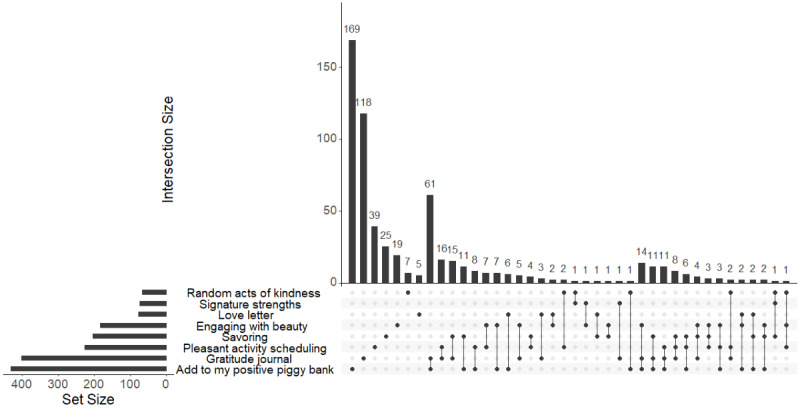
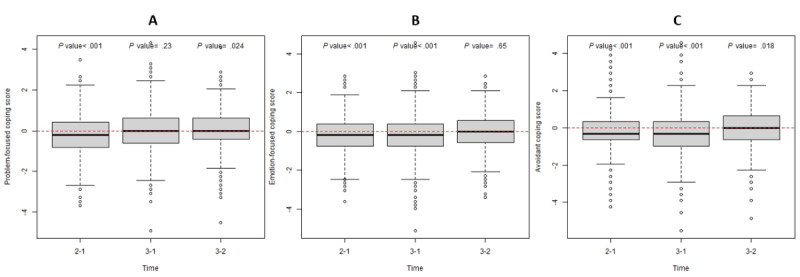
The findings indicated an evolving trajectory in students' mental health. In Year I, depression and anxiety levels were higher compared with levels reported between 2014 and 2019, remaining stable into Year II. However, significant decreases were noted by Year III for both depression (Year I mean 7.78, SD 5.65 vs Year III mean 6.21, SD 4.68; t=-2.90; P=.01) and anxiety (Year I mean 6.61, SD 4.91 vs Year III mean 5.62, SD 4.58; t=-2.02; P=.046). Problem-focused coping decreased initially from Year I (mean 2.46, SD 0.58) to Year II (mean 2.36, SD 0.60; t=-5.87; P<.001), then increased by Year III (mean 2.40, SD 0.63; t=2.26; P=.02). Emotion-focused (Year I mean 2.33, SD 0.41 vs Year III mean 2.22, SD 0.47; t=-7.47; P<.001) and avoidant coping (Year I mean 1.76, SD 0.37 vs Year III mean 1.65, SD 0.38; t=-8.53; P=.02) consistently decreased. Loneliness significantly decreased from Year I (mean 5.79, SD 1.74) to Year III (mean 5.17, SD 1.78; t=-10.74; P<.001), accompanied by an increase in flourishing from Year I (mean 63.78, SD 14.76) to Year III (mean 66.98, SD 15.06; t=7.22; P<.001). Analysis of app usage indicated that the positive piggy bank and gratitude journal were the favored activities. Greater engagement with the app was positively correlated with enhanced flourishing, even after adjusting for demographic and sociobehavioral factors (β=.04, SE .016; t=2.17; P=.03).
In this study, students' mental health and well-being improved, with notable reductions in depression, anxiety, and loneliness, associated with an increase in flourishing. The app did not appear to worsen students' mental health. Based on the usage pattern, it is possible the app enhanced positive psychology-based practices. Future research should explore the efficacy of mHealth interventions through randomized controlled trials to further understand their impact on college students' mental health outcomes.
ClinicalTrials.gov NCT04766788; https://clinicaltrials.gov/ct2/show/NCT04766788.
INTERNATIONAL REGISTERED REPORT IDENTIFIER (IRRID): RR2-10.2196/29561.
在新冠疫情期间,大学生心理健康危机加剧,这表明迫切需要创新解决方案来支持他们。以往解决心理健康问题的努力受到限制,这往往是由于服务利用不足或短缺所致。移动健康(mHealth)技术在提供增强心理韧性的支持和增加获得心理健康护理的机会方面具有巨大潜力。
本研究旨在调查大学生3年期间心理健康和幸福感的变化趋势,并探索性评估“路线图”移动健康应用程序对这些结果的潜在影响。
在美国中西部一所大型公立学术机构远程开展了一项全自动纵向观察性研究,评估2020年至2022年3个秋季学期使用“路线图”移动健康应用程序的大学生的心理健康和幸福感。该研究在第一年招募了2164名大学生,第二年和第三年分别有1128名和1033名学生返回。参与者完成了各种自我报告测量,包括用于评估抑郁的患者健康问卷-9、用于评估焦虑的广泛性焦虑障碍-7,以及用于评估应对、蓬勃发展和孤独感的其他指标。
研究结果表明学生心理健康呈动态变化轨迹。在第一年,抑郁和焦虑水平高于2014年至2019年报告的水平,并在第二年保持稳定。然而,到第三年,抑郁(第一年平均值7.78,标准差5.65;第三年平均值6.21,标准差4.68;t=-2.90;P=.01)和焦虑(第一年平均值6.61,标准差4.91;第三年平均值5.62,标准差4.58;t=-2.02;P=.046)均显著下降。以问题为中心的应对方式最初从第一年(平均值2.46,标准差0.58)降至第二年(平均值2.36,标准差0.60;t=-5.87;P<.001),然后在第三年有所增加(平均值2.40,标准差0.63;t=2.26;P=.02)。以情绪为中心的应对方式(第一年平均值2.33,标准差0.41;第三年平均值2.22,标准差0.47;t=-7.47;P<.001)和回避应对方式(第一年平均值1.76,标准差0.37;第三年平均值1.65,标准差0.38;t=-8.53;P=.02)持续下降。孤独感从第一年(平均值5.79,标准差1.74)到第三年(平均值5.17,标准差1.78;t=-10.74;P<.001)显著降低,同时蓬勃发展感从第一年(平均值63.78,标准差14.76)到第三年(平均值66.98,标准差15.06;t=7.22;P<.001)有所增加。对应用程序使用情况的分析表明,积极储蓄罐和感恩日记是最受欢迎的活动。即使在调整了人口统计学和社会行为因素后,更多地使用该应用程序与更强的蓬勃发展感呈正相关(β=.04,标准误.016;t=2.17;P=.03)。
在本研究中,学生的心理健康和幸福感有所改善,抑郁、焦虑和孤独感显著降低,同时蓬勃发展感增加。该应用程序似乎并未使学生的心理健康恶化。根据使用模式来看,该应用程序可能增强了基于积极心理学的实践。未来的研究应通过随机对照试验探索移动健康干预措施的效果,以进一步了解其对大学生心理健康结果的影响。
ClinicalTrials.gov NCT04766788;https://clinicaltrials.gov/ct2/show/NCT04766788。
国际注册报告识别码(IRRID):RR2-10.2196/29561。