Bruehlman-Senecal Emma, Hook Cayce J, Pfeifer Jennifer H, FitzGerald Caroline, Davis Brittany, Delucchi Kevin L, Haritatos Jana, Ramo Danielle E
Hopelab, San Francisco, CA, United States.
Department of Psychology, University of Oregon, Eugene, OR, United States.
JMIR Ment Health. 2020 Oct 20;7(10):e21496. doi: 10.2196/21496.
Loneliness is a widespread and significant problem on college campuses. Prolonged loneliness in young adulthood is a risk factor for concurrent and future mental health problems and attrition, making college a critical time for support. Cognitive and behavioral interventions show promise for decreasing loneliness and can be widely disseminated through technology.
This pilot randomized controlled trial was conducted to examine the initial efficacy, feasibility, and desirability of a smartphone app, Nod, designed to deliver cognitive and behavioral skill-building exercises to reduce loneliness during the transition to college.
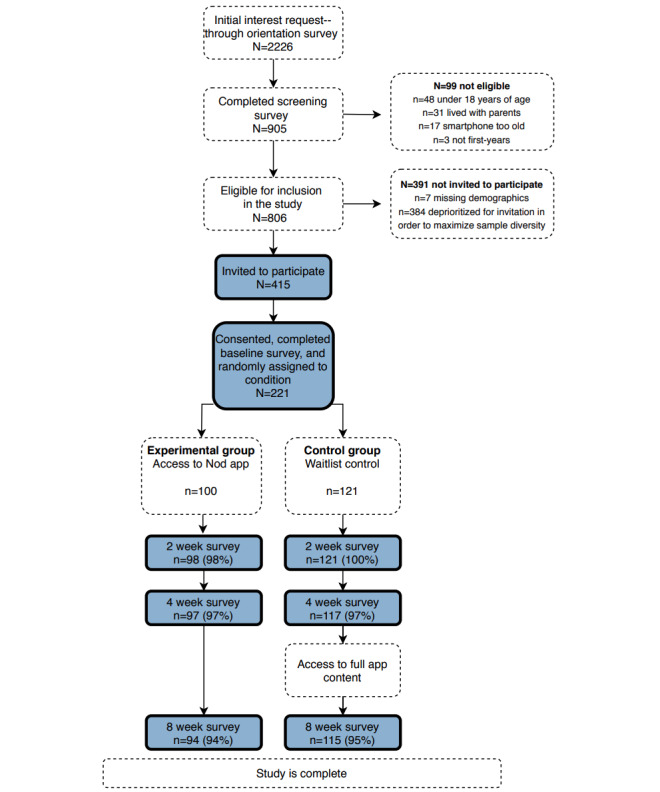
First-year college students (N=221, mean age 18.7 years, 59% female) were recruited online during incoming student orientation, and randomized to either receive immediate access to Nod (experimental group, n=100) or access after 4 weeks (control group, n=121). The app delivered skills via fully automated (1) "social challenges," suggested activities designed to build social connections; (2) reflections, brief cognitive reframing exercises; and (3) student testimonials that encouraged a growth mindset toward social connection building. Main intention-to-treat analyses were used to compare the conditions on self-assessed loneliness, depressive symptoms, and other mental health and college adjustment outcomes at week 4, controlling for baseline values on those variables. Analyses were also performed to test the hypothesis that the treatment benefits would be particularly pronounced for participants with heightened psychological vulnerability at baseline (ie, higher baseline depressive symptoms and loneliness).
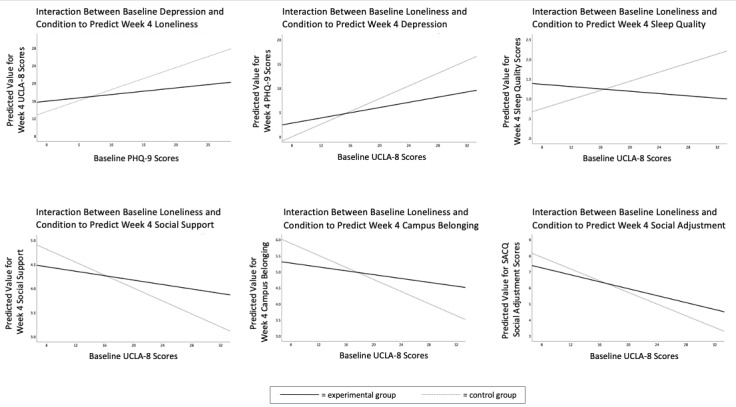
Retention was 97% at week 4, and participants viewed an average 36.7 pages of app content. There were no significant condition differences in loneliness at week 4 (F=0.05, P=.82; η <.001). However, there was a significant condition-by-baseline depression interaction to predict week-4 loneliness (F=9.65, P=.002; η =.04). Simple slope analyses indicated that baseline depression positively predicted week-4 loneliness among control participants (r=0.30, t=3.81, P<.001), but not among experimental participants (r=-0.09, t=-0.84, P=.40), suggesting that Nod buffered participants with high baseline depression scores from experiencing heightened midquarter loneliness. Similarly, there were no significant condition differences in other week-4 outcomes. However, moderation by baseline vulnerability was found for week-4 depressive symptoms, sleep quality, and indices of college adjustment (eg, perceived social support and campus belonging).
Although Nod exposure did not impact outcomes for the full sample, these results provide initial evidence of its benefit for vulnerable students. The results of this trial suggest that cognitive and behavioral skills delivered via a mobile app can buffer psychologically vulnerable college students against heightened loneliness and depressive symptoms, as well as other negative college adjustment outcomes. Future work will aim to improve upon app engagement, and to address loneliness among other key populations.
ClinicalTrials.gov NCT04164654; https://clinicaltrials.gov/ct2/show/NCT04164654.
孤独是大学校园里一个普遍且严重的问题。青年时期长期孤独是当下及未来心理健康问题和退学的一个风险因素,这使得大学成为提供支持的关键时期。认知和行为干预对于减少孤独显示出前景,并且可以通过技术广泛传播。
开展这项初步随机对照试验,以检验一款智能手机应用程序Nod的初始疗效、可行性和可取性,该应用旨在提供认知和行为技能培养练习,以减少大学过渡期间的孤独感。
在新生入学迎新期间,通过网络招募了一年级大学生(N = 221,平均年龄18.7岁,59%为女性),并随机分为两组,一组立即可以使用Nod(实验组,n = 100),另一组在4周后可以使用(对照组,n = 121)。该应用通过完全自动化的方式提供技能:(1)“社交挑战”,即旨在建立社交联系的建议活动;(2)反思,即简短的认知重构练习;(3)学生推荐,鼓励对建立社交联系持成长型思维。主要的意向性分析用于比较两组在第4周时自我评估的孤独感、抑郁症状以及其他心理健康和大学适应结果,同时控制这些变量的基线值。还进行了分析以检验以下假设:对于基线心理脆弱性较高(即基线抑郁症状和孤独感较高)的参与者,治疗益处会特别明显。
第4周时的保留率为97%,参与者平均查看了36.7页的应用内容。第4周时,两组在孤独感方面没有显著差异(F = 0.05,P = 0.82;η < 0.001)。然而,存在一个显著的基线抑郁与分组的交互作用来预测第4周的孤独感(F = 9.65,P = 0.002;η = 0.04)。简单斜率分析表明,基线抑郁正向预测对照组参与者第4周的孤独感(r = 0.30,t = 3.81,P < 0.001),但在实验组参与者中并非如此(r = -0.09,t = -0.84,P = 0.40),这表明Nod缓冲了基线抑郁评分高的参与者在季度中期孤独感的增加。同样,在第4周的其他结果方面,两组没有显著差异。然而,在第4周的抑郁症状、睡眠质量和大学适应指标(如感知到的社会支持和校园归属感)方面,发现了基线脆弱性的调节作用。
虽然接触Nod对整个样本的结果没有影响,但这些结果为其对脆弱学生的益处提供了初步证据。该试验结果表明,通过移动应用程序提供的认知和行为技能可以缓冲心理脆弱的大学生增加的孤独感和抑郁症状,以及其他负面的大学适应结果。未来的工作将旨在改善应用的参与度,并解决其他关键人群中的孤独问题。
ClinicalTrials.gov NCT04164654;https://clinicaltrials.gov/ct2/show/NCT04164654