Deegan Daniel F, Nigam Priya, Engel Nora
Lewis Katz School of Medicine, Fels Institute for Cancer Research, Temple University, Philadelphia, PA, United States.
Front Cardiovasc Med. 2021 May 26;8:668252. doi: 10.3389/fcvm.2021.668252. eCollection 2021.
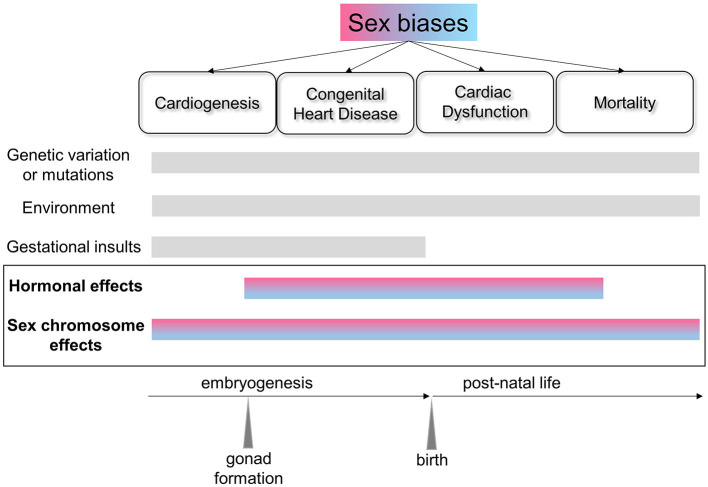
The democratization of genomic technologies has revealed profound sex biases in expression patterns in every adult tissue, even in organs with no conspicuous differences, such as the heart. With the increasing awareness of the disparities in cardiac pathophysiology between males and females, there are exciting opportunities to explore how sex differences in the heart are established developmentally. Although sexual dimorphism is traditionally attributed to hormonal influence, expression and epigenetic sex biases observed in early cardiac development can only be accounted for by the difference in sex chromosome composition, i.e., XX in females and XY in males. In fact, genes linked to the X and Y chromosomes, many of which encode regulatory factors, are expressed in cardiac progenitor cells and at every subsequent developmental stage. The effect of the sex chromosome composition may explain why many congenital heart defects originating before gonad formation exhibit sex biases in presentation, mortality, and morbidity. Some transcriptional and epigenetic sex biases established soon after fertilization persist in cardiac lineages, suggesting that early epigenetic events are perpetuated beyond early embryogenesis. Importantly, when sex hormones begin to circulate, they encounter a cardiac genome that is already functionally distinct between the sexes. Although there is a wealth of knowledge on the effects of sex hormones on cardiac function, we propose that sex chromosome-linked genes and their downstream targets also contribute to the differences between male and female hearts. Moreover, identifying how hormones influence sex chromosome effects, whether antagonistically or synergistically, will enhance our understanding of how sex disparities are established. We also explore the possibility that sexual dimorphism of the developing heart predicts sex-specific responses to environmental signals and foreshadows sex-biased health-related outcomes after birth.
基因组技术的普及揭示了每个成年组织表达模式中存在的深刻性别偏见,即使在没有明显差异的器官中,如心脏。随着人们越来越意识到男性和女性在心脏病理生理学方面的差异,探索心脏性别差异在发育过程中是如何形成的,出现了令人兴奋的机会。虽然传统上认为性二态性是由激素影响所致,但在心脏早期发育中观察到的表达和表观遗传性别偏见,只能由性染色体组成的差异来解释,即女性为XX,男性为XY。事实上,与X和Y染色体相关的基因,其中许多编码调节因子,在心脏祖细胞以及随后的每个发育阶段都有表达。性染色体组成的影响可能解释了为什么许多在性腺形成之前出现的先天性心脏缺陷在表现、死亡率和发病率方面存在性别偏见。受精后不久建立的一些转录和表观遗传性别偏见在心脏谱系中持续存在,这表明早期表观遗传事件在胚胎早期发育之后仍会持续存在。重要的是,当性激素开始循环时,它们会遇到一个在两性之间已经功能不同的心脏基因组。虽然关于性激素对心脏功能的影响已有丰富的知识,但我们认为性染色体相关基因及其下游靶点也导致了雄性和雌性心脏之间的差异。此外,确定激素如何影响性染色体效应,无论是拮抗还是协同作用,将增进我们对性别差异如何形成的理解。我们还探讨了发育中心脏的性二态性是否预测对环境信号的性别特异性反应,并预示出生后与健康相关的性别偏见结果的可能性。