Roberts-Thomson Ian C
Faculty of Health and Medical Sciences University of Adelaide Adelaide South Australia Australia.
JGH Open. 2021 May 18;5(6):636-642. doi: 10.1002/jgh3.12560. eCollection 2021 Jun.
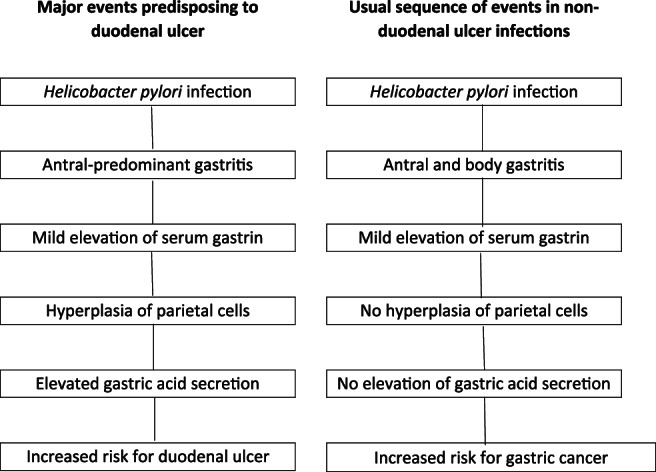
The association of with chronic duodenal ulceration was a seminal observation in the short history of gastroenterology. However, is now known to be an ancient bacterium, whereas there is persuasive evidence that the epidemic of duodenal ulceration began in the second half of the 19th century and continued into the second half of the 20th century. Possible explanations for the epidemic include genomic changes in the organism and environmental or other influences on the human host. While genomic changes resulted in the appearance of virulence factors, these seem likely to have appeared thousands of years ago with minimal effects on gastritis because of coexisting suppression of gastric immunity. In contrast, the emergence of duodenal ulceration is best explained by a change in the pattern of gastritis from inflammation involving the antrum and body in most individuals to a significant minority (10-20%) with antral gastritis but with relative sparing of the body of the stomach. In the latter group, the increase in serum gastrin (particularly G17) associated with antral gastritis had trophic effects on gastric parietal cells with an increase in the parietal cell mass and hypersecretion of gastric acid. Hypersecretion of acid is seen as the major risk factor for duodenal ulceration with significant contributions from environmental factors including smoking and use of nonsteroidal, anti-inflammatory drugs. Host factors favoring changes in the pattern of gastritis include delayed acquisition of infection and improved nutrition; both with enhancing effects on mucosal immunity.
[某种细菌]与慢性十二指肠溃疡的关联是胃肠病学短暂历史中的一项开创性观察。然而,[该细菌]现在已知是一种古老的细菌,而有确凿证据表明十二指肠溃疡的流行始于19世纪后半叶并持续到20世纪后半叶。对这种流行的可能解释包括该生物体的基因组变化以及对人类宿主的环境或其他影响。虽然基因组变化导致了毒力因子的出现,但由于同时存在的胃免疫抑制,这些毒力因子似乎早在数千年前就已出现,对胃炎的影响微乎其微。相比之下,十二指肠溃疡的出现最好解释为胃炎模式的变化,即大多数个体的炎症涉及胃窦和胃体,转变为少数(10 - 20%)患有胃窦胃炎但胃体相对 spared的个体。在后一组中,与胃窦胃炎相关的血清胃泌素(特别是G17)增加对胃壁细胞具有营养作用,导致壁细胞数量增加和胃酸分泌过多。胃酸分泌过多被视为十二指肠溃疡的主要危险因素,环境因素包括吸烟和使用非甾体抗炎药也有重要影响。有利于胃炎模式变化的宿主因素包括感染获取延迟和营养改善;两者都对黏膜免疫有增强作用。 (注:原文中“sparing”有误,推测应为“spared”,翻译时按“相对 spared”处理,可能需要结合更多上下文准确理解其含义)