
软而不弱——刚性管如何在不破裂的情况下扩张。
Soft but Not Too Soft-How a Rigid Tube Expands without Breaking.
机构信息
Karlsruhe Institute of Technology (KIT), Karlsruhe, Germany.
出版信息
mBio. 2021 Jun 29;12(3):e0050121. doi: 10.1128/mBio.00501-21. Epub 2021 Jun 15.
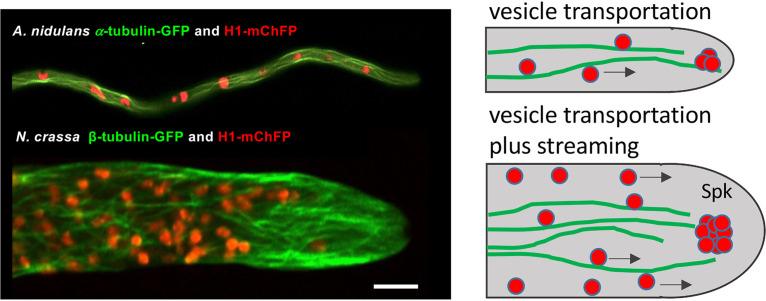
Fungi grow by apical extension of their hyphae. The continuous growth requires constant delivery of vesicles, which fuse with the membrane and secrete cell wall biosynthesis enzymes. The growth mechanism requires the fungal cytoskeleton and turgor pressure. In a recent study by Fukuda et al. (mBio 12:e03196-20, 2021, https://doi.org/10.1128/mBio.03196-20), hyphal growth was studied in microfluidic devices with channels smaller than the hyphal diameter. The authors discovered that fast-growing fungi like Neurospora crassa enter the channels, but hyphal tips become fragile and rupture frequently, whereas slower-growing fungi like Aspergillus nidulans adapt their hyphal diameter and grow without problems through the channels. This study suggests two different growth mechanisms and a tradeoff between hyphal plasticity and growth speed.
真菌通过菌丝的顶端延伸生长。这种持续的生长需要不断输送囊泡,囊泡与细胞膜融合并分泌细胞壁生物合成酶。生长机制需要真菌细胞骨架和膨压。在 Fukuda 等人最近的一项研究中(mBio 12:e03196-20, 2021, https://doi.org/10.1128/mBio.03196-20),作者在通道小于菌丝直径的微流控设备中研究了菌丝生长。他们发现,像粗糙脉孢菌这样快速生长的真菌会进入通道,但菌丝尖端变得脆弱,经常破裂,而生长较慢的真菌,如构巢曲霉,会调整其菌丝直径,并在没有问题的情况下通过通道生长。这项研究提出了两种不同的生长机制和菌丝可塑性与生长速度之间的权衡。
 Zotero 插件