Division of Vitreous and Retina, Department of Ophthalmology, St. Vincent's Hospital, College of Medicine, The Catholic University of Korea, Suwon, Korea.
Food and Nutrition, Obesity/Diabetes Research Center, Hoseo University, Asan, Korea.
J Korean Med Sci. 2021 Jun 14;36(23):e155. doi: 10.3346/jkms.2021.36.e155.
The prevalence of cataracts is steadily increasing among the middle-aged and elderly worldwide. We hypothesized that adults aged > 50 years with age-related cataracts (ARCs) have an association with metabolic syndrome (MS) and its components, and MS has interactions with different dietary patterns and lifestyles that affect ARC risk. We examined the hypothesis using the Korean Genome and Epidemiology Study (KoGES; a large-scale hospital-based cohort study), which collected data between 2004-2013.
Participants ≥ 50 years old were classified as cases (1,972 ARC patients) and controls (38,290 healthy controls) based on a diagnosis of cataract by a physician. MS and its components were defined using WHO definitions for Asians. Dietary consumption was evaluated using a validated semi-quantitative food frequency questionnaire (SQFFQ), which contained 106 foods, and dietary patterns were analyzed by principal component analysis. After adjusting for potential covariates, logistic regression was used to investigate associations between MS and its components and between dietary patterns and a positive cataract history.
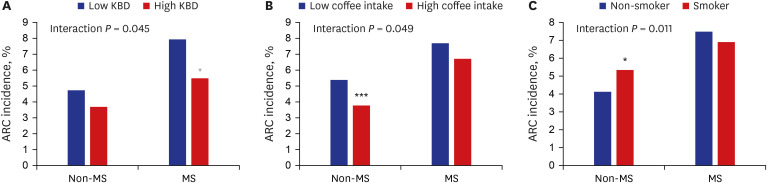
ARC had a positive association with MS after 1.32-fold adjusting for age, sex, residence area, body mass index, and energy intake. Plasma glucose and HbA1c concentrations exhibited an increased ARC risk in the participants with MS by 1.50- and 1.92-fold and without MS by 1.35 and 1.88-fold, respectively. Serum high-density lipoprotein (HDL) concentrations were negatively associated with ARC risk only in the MS patients, but not without MS. However, blood pressure, abdominal obesity, and serum triglyceride concentrations did not associate with ARC risk regardless of MS. High intake of a Korean-balanced diet (KBD) containing fermented food exhibited a negative association with ARC risk (OR = 0.81) only in the MS group. The fat and coffee intake had a negative association with ARC only in the non-MS group. Current- and former-smokers were positively associated with ARC risk.
Persons who have hyperglycemia and low-HDL-cholesterolemia had increased susceptibility of ARC prevalence. A KBD with a proper amount of fat (≥ 15%) is recommended, and smoking should be prohibited.
全球范围内,中年人及老年人的白内障患病率呈稳步上升趋势。我们推测,患有年龄相关性白内障(ARC)的 50 岁以上成年人与代谢综合征(MS)及其组份之间存在关联,而 MS 与不同的饮食模式和生活方式相互影响,从而影响 ARC 的发病风险。我们利用韩国基因与流行病学研究(KoGES;一项大型基于医院的队列研究)来检验这一假说,该研究在 2004-2013 年间收集数据。
基于医生对白内障的诊断,我们将≥50 岁的参与者分为病例组(1972 名 ARC 患者)和对照组(38290 名健康对照者)。采用世界卫生组织(WHO)针对亚洲人的定义来确定 MS 及其组份。通过经过验证的半定量食物频率问卷(SQFFQ)评估饮食摄入情况,该问卷包含 106 种食物,通过主成分分析来分析饮食模式。在调整潜在混杂因素后,我们使用 logistic 回归分析来调查 MS 及其组份与阳性白内障史之间的关系。
在调整年龄、性别、居住地区、体质指数和能量摄入后,ARC 与 MS 呈正相关(比值比为 1.32)。在患有 MS 的参与者中,血糖和糖化血红蛋白(HbA1c)浓度分别增加 1.50 倍和 1.92 倍,而在未患有 MS 的参与者中,这两个浓度分别增加 1.35 倍和 1.88 倍,均与 ARC 发病风险呈正相关。在 MS 患者中,血清高密度脂蛋白(HDL)浓度与 ARC 风险呈负相关,而在无 MS 患者中则无相关性。然而,血压、腹型肥胖和血清甘油三酯浓度与 ARC 发病风险无关,无论是否存在 MS。摄入富含发酵食品的韩国平衡膳食(KBD)与 ARC 风险呈负相关(比值比为 0.81),仅在 MS 组中存在。在非 MS 组中,高脂肪和咖啡摄入与 ARC 呈负相关。当前吸烟者和曾经吸烟者的 ARC 发病风险呈正相关。
患有高血糖和低 HDL-胆固醇血症的人群更易发生 ARC 患病率增加。建议推荐适量脂肪(≥15%)的 KBD,并禁止吸烟。