Guo Chao, Wang Zhenjie, He Ping, Chen Gong, Zheng Xiaoying
Institute of Population Research, Peking University, Beijing 100871, China.
APEC Health Science Academy, Peking University, Beijing 100871, China.
Int J Environ Res Public Health. 2017 Sep 8;14(9):1034. doi: 10.3390/ijerph14091034.
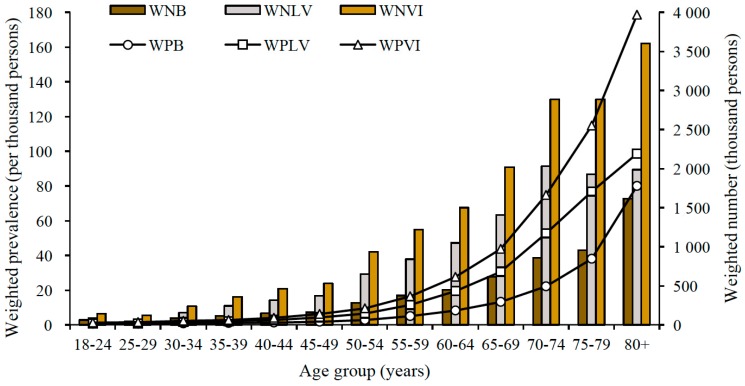
Visual impairment has become a global challenge, especially for developing countries. This study aims to estimate the prevalence, causes and social factors of visual impairment among Chinese adults. Data were from a nationally representative population-based cross-sectional study. The study population were 1,909,199 non-institutionalized adults aged 18 years and older in mainland China. In the survey, low vision and blindness were checked by ophthalmologists according to the WHO best-corrected visual acuity (BCVA) criteria. Population weighted numbers and prevalence of low vision and blindness with 95% confidence intervals (CIs) were estimated where appropriate. Multivariable logistic regression analysis was used to identify the social factors of visual impairment. The weighted prevalence of visual impairment was 17.17 (95% CI, 16.84-17.50) per 1000 Chinese adults aged 18 years and older. Cataract (57.35%), disorders of choroid and retina (9.80%), and disorders of cornea (6.49%) contributed more than 70 percent to the visual impairment in Chinese adults. Older age groups, young or middle-aged male adults, female elders, illiterate, rural dwellers, non-eastern residents, singles, unemployment, and from family with lower income were associated with visual impairment. More efforts are warranted to enhance treatment and rehabilitation among people with eye disorders to prevent visual impairment.
视力障碍已成为一项全球性挑战,对发展中国家而言尤其如此。本研究旨在估算中国成年人视力障碍的患病率、病因及社会因素。数据来自一项具有全国代表性的基于人群的横断面研究。研究人群为中国大陆1909199名年龄在18岁及以上的非机构化成年人。在调查中,眼科医生根据世界卫生组织最佳矫正视力(BCVA)标准对视力低下和失明情况进行检查。在适当情况下,估算了视力低下和失明的人群加权数及患病率,并给出95%置信区间(CI)。采用多变量逻辑回归分析来确定视力障碍的社会因素。在18岁及以上的中国成年人中,视力障碍的加权患病率为每1000人中有17.17例(95%CI,16.84 - 17.50)。白内障(57.35%)、脉络膜和视网膜疾病(9.80%)以及角膜疾病(6.49%)导致中国成年人视力障碍的比例超过70%。年龄较大的人群、中青年男性成年人、老年女性、文盲、农村居民、非东部地区居民、单身人士、失业者以及来自低收入家庭的人群与视力障碍有关。有必要做出更多努力,加强对眼病患者的治疗和康复,以预防视力障碍。