Study Center of the German Society of Surgery (SDGC), University of Heidelberg, Im Neuenheimer Feld 130.3, 69120, Heidelberg, Germany.
Department of General, Visceral and Transplantation Surgery, University of Heidelberg, Im Neuenheimer Feld 420, 69120, Heidelberg, Germany.
Langenbecks Arch Surg. 2021 Sep;406(6):1723-1731. doi: 10.1007/s00423-021-02204-x. Epub 2021 Jun 15.
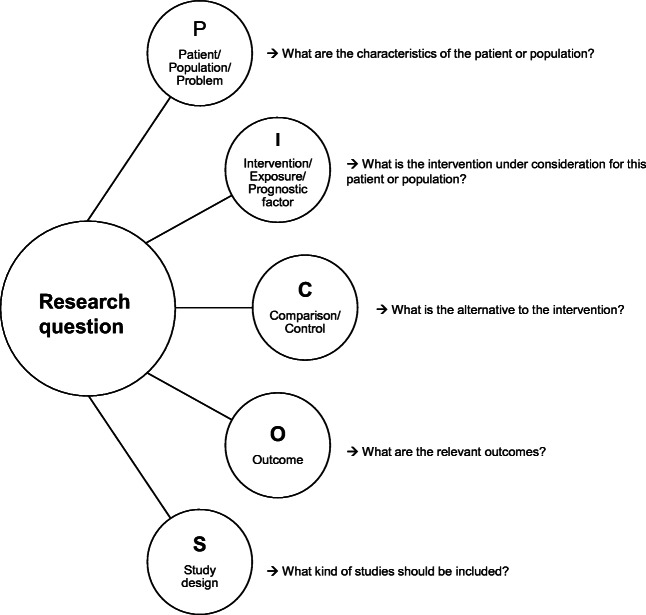
Systematic reviews are an important tool of evidence-based surgery. Surgical systematic reviews and trials, however, require a special methodological approach.
This article provides recommendations for conducting state-of-the-art systematic reviews in surgery with or without meta-analysis.
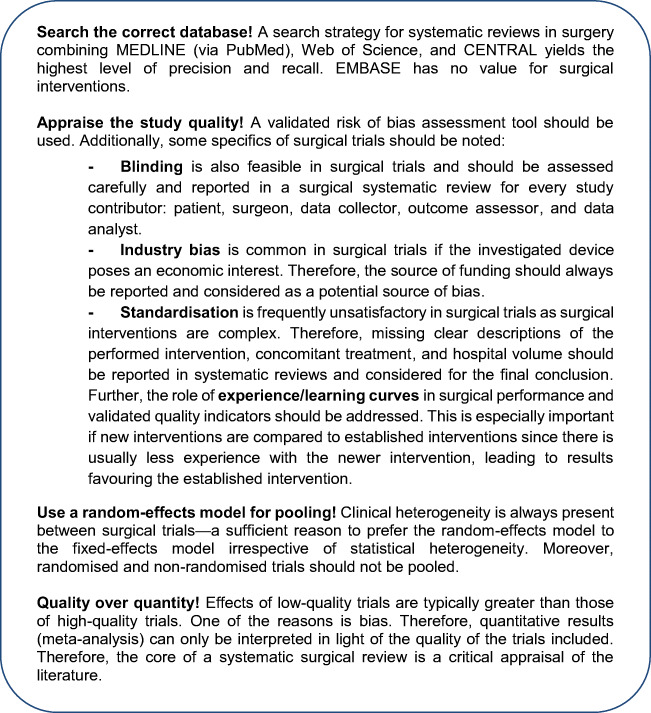
For systematic reviews in surgery, MEDLINE (via PubMed), Web of Science, and Cochrane Central Register of Controlled Trials (CENTRAL) should be searched. Critical appraisal is at the core of every surgical systematic review, with information on blinding, industry involvement, surgical experience, and standardisation of surgical technique holding special importance. Due to clinical heterogeneity among surgical trials, the random-effects model should be used as a default. In the experience of the Study Center of the German Society of Surgery, adherence to these recommendations yields high-quality surgical systematic reviews.
系统评价是循证外科的重要工具。然而,外科系统评价和试验需要特殊的方法学方法。
本文提供了有关在有或没有荟萃分析的情况下进行最先进的外科系统评价的建议。
对于外科系统评价,应检索 MEDLINE(通过 PubMed)、Web of Science 和 Cochrane 对照试验中心注册(CENTRAL)。批判性评价是每一个外科系统评价的核心,其中关于盲法、行业参与、外科经验和手术技术标准化的信息具有特殊重要性。由于外科试验之间存在临床异质性,应默认使用随机效应模型。根据德国外科协会研究中心的经验,遵守这些建议可产生高质量的外科系统评价。