Department of Physical Medicine, Rehabilitation and Occupational Medicine, Medical University of Vienna, Vienna, Austria.
Ludwig Boltzmann Institute for Rehabilitation Research, Reizenpfenninggasse 1, 1140, Vienna, Austria.
Qual Life Res. 2022 Jan;31(1):303-315. doi: 10.1007/s11136-021-02905-2. Epub 2021 Jun 15.
Patient- and clinician-reported outcome measures (PROMs, CROMs) are used in rehabilitation to evaluate and track the patient's health status and recovery. However, controversy still exists regarding their relevance and validity when assessing a change in health status.
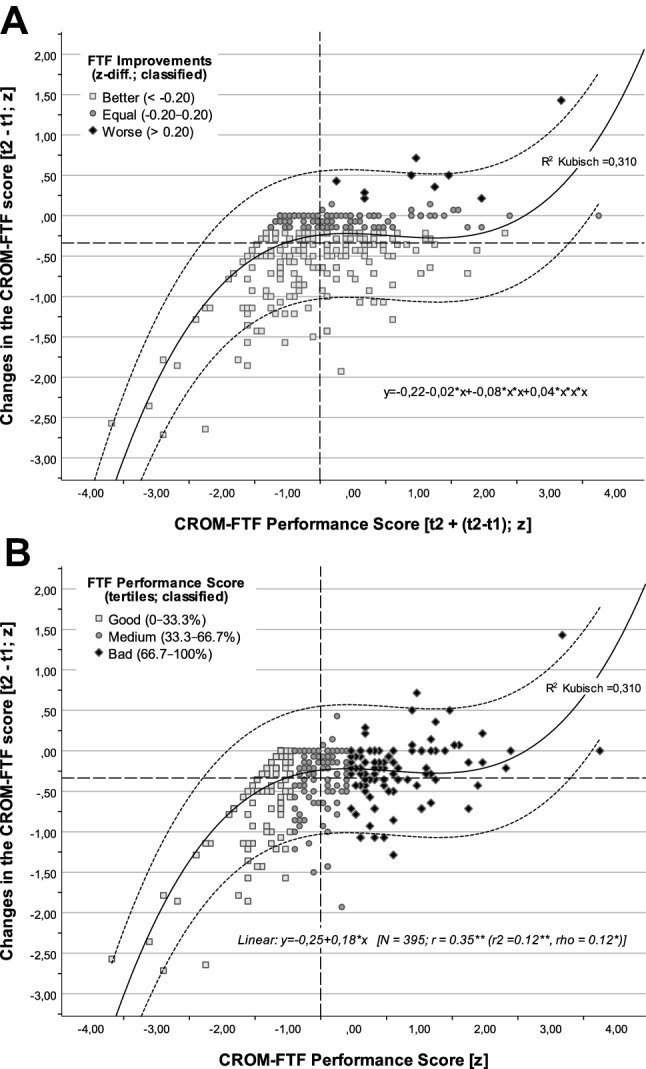
We retrospectively analyzed the changes in a CROM (Fingertip-To-Floor Test - FTF) and PROMs (ODI, HAQ-DI, NPRS, EQ5D) and the associations between these outcomes in 395 patients with lower back pain (57.2 ± 11.8 years, 49.1% female). We introduced a new way to measure and classify outcome performance using a distribution-based approach (t2D). Outcome measures were assessed at baseline and after 21 days of inpatient rehabilitation.
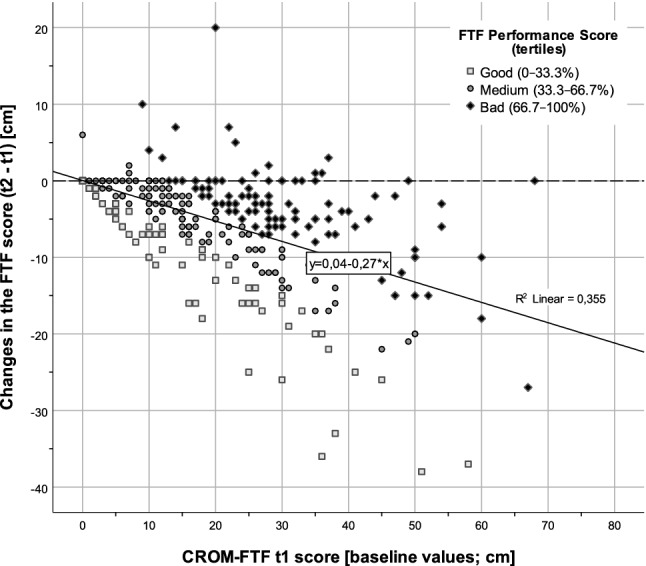
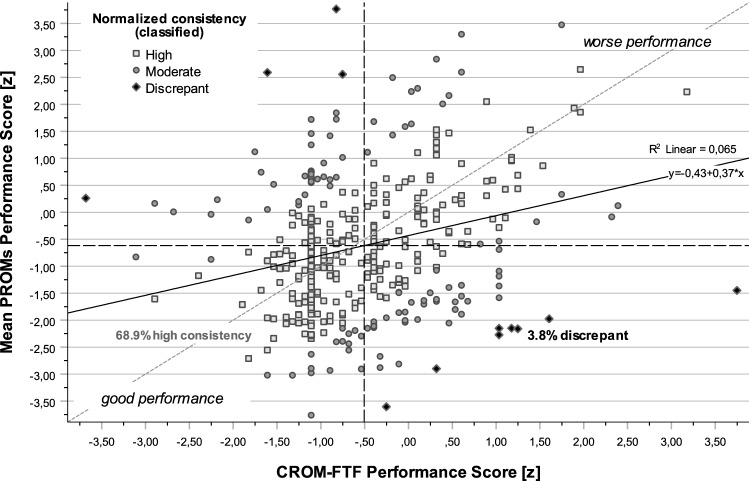
Overall, the rehabilitation (Cohens d = 0.94) resulted in a large effect size outcome. Medium effect sizes were observed for FTF (d = 0.70) and PROMs (d > 0.50). Best performance rating was observed for pain (NPRS). We found that 13.9% of patients exhibited a deterioration in the PROMs, but only 2.3%, in the FTF. The correlation between the PROMs and FTF were low to moderate, with the highest identified for HAQ-DI (rho = 0.30-0.36); no significant correlations could be shown for changes. High consistency levels were observed among the performance scores (t2D) in 68.9% of the patients.
Different and complementary assessment modalities of PROMs and CROMs can be used as valuable tools in the clinical setting. Results from both types of measurements and individual performance assessments in patients provide a valid basis for the meaningful interpretation of the patients' health outcomes.
This clinical study was entered retrospectively on August 14, 2020 into the German Clinical Trials Register (DRKS, registration number: DRKS00022854).
患者报告的结局测量(PROMs)和临床医生报告的结局测量(CROMs)在康复中用于评估和跟踪患者的健康状况和康复情况。然而,在评估健康状况的变化时,它们的相关性和有效性仍存在争议。
我们回顾性分析了 395 例腰痛患者(57.2±11.8 岁,49.1%为女性)的 CROM(指尖到地板测试-FTF)和 PROMs(ODI、HAQ-DI、NPRS、EQ5D)的变化,并分析了这些结果之间的相关性。我们引入了一种基于分布的方法(t2D)来测量和分类结果表现。在住院康复 21 天后,评估了结局测量。
总的来说,康复(Cohens d=0.94)产生了较大的效果量。FTF(d=0.70)和 PROMs(d>0.50)的效果量为中等。疼痛(NPRS)的最佳表现评分最高。我们发现,13.9%的患者 PROMs 恶化,但只有 2.3%的患者 FTF 恶化。PROMs 和 FTF 之间的相关性为低到中度,其中 HAQ-DI 最高(rho=0.30-0.36);变化之间没有显著的相关性。在 68.9%的患者中,表现评分(t2D)的一致性水平较高。
PROMs 和 CROMs 的不同且互补的评估方式可作为临床中的有价值工具。两种类型的测量结果和患者的个体表现评估为有意义地解释患者的健康结局提供了有效的依据。
本临床研究于 2020 年 8 月 14 日在德国临床试验注册处(DRKS)进行了回顾性登记(DRKS 编号:DRKS00022854)。