Department of Anesthesiology, Perioperative and Pain Medicine, Stanford University School of Medicine, Stanford, California.
Department of Anesthesiology, University of Arkansas for Medical Sciences, Little Rock.
JAMA Netw Open. 2021 May 3;4(5):e2111600. doi: 10.1001/jamanetworkopen.2021.11600.
Outpatient postpartum recovery is an underexplored area of obstetrics. There is currently no consensus regarding which patient-reported outcome measure (PROM) clinicians and researchers should use to evaluate postpartum recovery.
To evaluate PROMs of outpatient postpartum recovery using Consensus-Based Standards for the Selection of Health Measurement Instruments (COSMIN) guidelines.
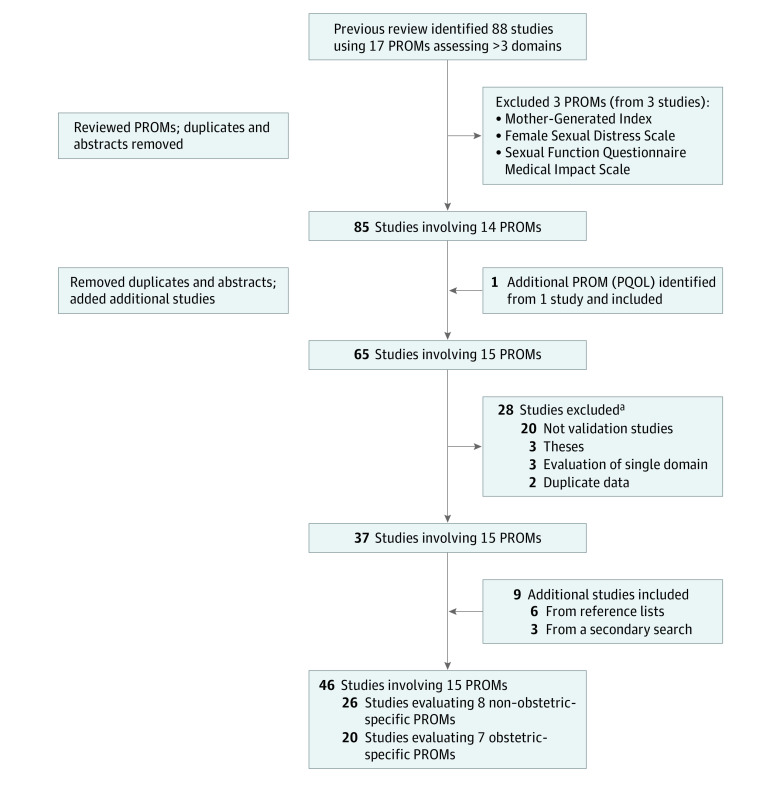
An initial literature search performed in July 2019 identified postpartum recovery PROMs and validation studies. A secondary search in July 2020 identified additional validation studies. Both searches were performed using 4 databases (Web of Science, Embase, PubMed, and CINAHL), with no date limiters. Studies with PROMs evaluating more than 3 proposed outpatient postpartum recovery domains were considered. Studies were included if they assessed any psychometric measurement property of the included PROMs in the outpatient postpartum setting. The PROMs were assessed for the following 8 psychometric measurement properties, as defined by COSMIN: content validity, structural validity, internal consistency, cross-cultural validity and measurement invariance, reliability, measurement error, hypothesis testing, and responsiveness. Psychometric measurement properties were evaluated in each included study using the COSMIN criteria by assessing (1) the quality of the methods (very good, adequate, doubtful, inadequate, or not assessed); (2) overall rating of results (sufficient, insufficient, inconsistent, or indeterminate); (3) level of evidence assessed using the Grading of Recommendations, Assessment, Development and Evaluations assessment tool; and (4) level of recommendation, which included class A (recommended for use; showed adequate content validity with at least low-quality evidence for sufficient internal consistency), class B (not class A or class C), or class C (not recommended).
In total, 15 PROMs (7 obstetric specific and 8 non-obstetric specific) were identified, evaluating outpatient postpartum recovery in 46 studies involving 19 165 women. The majority of psychometric measurement properties of the included PROMs were graded as having very-low-level or low-level evidence. The best-performing PROMs that received class A recommendations were the Maternal Concerns Questionnaire, the Postpartum Quality of Life tool, and the World Health Organization Quality of Life-BREF. The remainder of the evaluated PROMs had insufficient evidence to make recommendations regarding their use (and received class B recommendations).
This review found that the best-performing PROMs currently available to evaluate outpatient postpartum recovery were the Maternal Concerns Questionnaire, the Postpartum Quality of Life tool, and the World Health Organization Quality of Life-BREF; however, these tools all had significant limitations. This study highlights the need to focus future efforts on robustly developing and validating a new PROM that may comprehensively evaluate outpatient postpartum recovery.
产后门诊康复是产科领域中一个尚未得到充分探索的领域。目前,对于评估产后康复,临床医生和研究人员应该使用哪种患者报告结局测量(PROM)工具,尚无共识。
使用基于共识的健康测量仪器选择标准(COSMIN)指南评估门诊产后康复的 PROM。
2019 年 7 月进行的初步文献检索确定了产后康复 PROM 和验证研究。2020 年 7 月的二次检索确定了其他验证研究。这两次搜索均使用了 4 个数据库(Web of Science、Embase、PubMed 和 CINAHL),没有日期限制。考虑了评估超过 3 个门诊产后康复领域的 PROM。如果研究评估了门诊产后环境中包含的 PROM 的任何心理测量特性,则将其纳入研究。使用 COSMIN 标准评估了 PROM 的以下 8 个心理测量特性:内容有效性、结构有效性、内部一致性、跨文化有效性和测量不变性、可靠性、测量误差、假设检验和反应性。在每个纳入的研究中,通过评估(1)方法的质量(非常好、足够、可疑、不足或未评估);(2)结果的总体评估(充分、不充分、不一致或不确定);(3)使用推荐、评估、发展和评估评估工具评估的证据水平;(4)推荐级别,包括 A 级(推荐使用;显示出足够的内容有效性,至少有低质量的证据表明足够的内部一致性)、B 级(非 A 级或 C 级)或 C 级(不推荐),来评估心理测量特性。
总共确定了 15 种 PROM(7 种产科专用和 8 种非产科专用),在涉及 19165 名女性的 46 项研究中评估了门诊产后康复。纳入的 PROM 的大多数心理测量特性的评估结果均为极低或低水平的证据。表现最好的获得 A 级推荐的 PROM 是产妇关注点问卷、产后生活质量工具和世界卫生组织生活质量简表。其余经过评估的 PROM 获得了 B 级推荐,其证据不足以推荐使用。
本综述发现,目前可用于评估门诊产后康复的表现最佳的 PROM 是产妇关注点问卷、产后生活质量工具和世界卫生组织生活质量简表;然而,这些工具都存在显著的局限性。本研究强调需要集中精力未来的研究工作应致力于开发和验证一种新的 PROM,该 PROM可能全面评估门诊产后康复。
