Charles Darwin University, Menzies School of Health Research, Casuarina, Northern Territory, Australia.
Department of Infectious Diseases, Royal Darwin Hospital, Casuarina, Northern Territory, Australia.
BMC Infect Dis. 2021 Jun 16;21(1):584. doi: 10.1186/s12879-021-06286-2.
The demographic of Northern Territory prison population differs than elsewhere in Australia and the prevalence of hepatitis B and hepatitis C may therefore be somewhat different from other jurisdictions. There has been no study which has specifically described the serological results of a large proportion of prisoners in Northern Territory correctional facilities over an extended period of time.
This retrospective longitudinal study reviewed serological results and testing rates for hepatitis B, and hepatitis C performed in correctional facilities in the Northern Territory of Australia between July 1st, 2003 and June 30th, 2017.
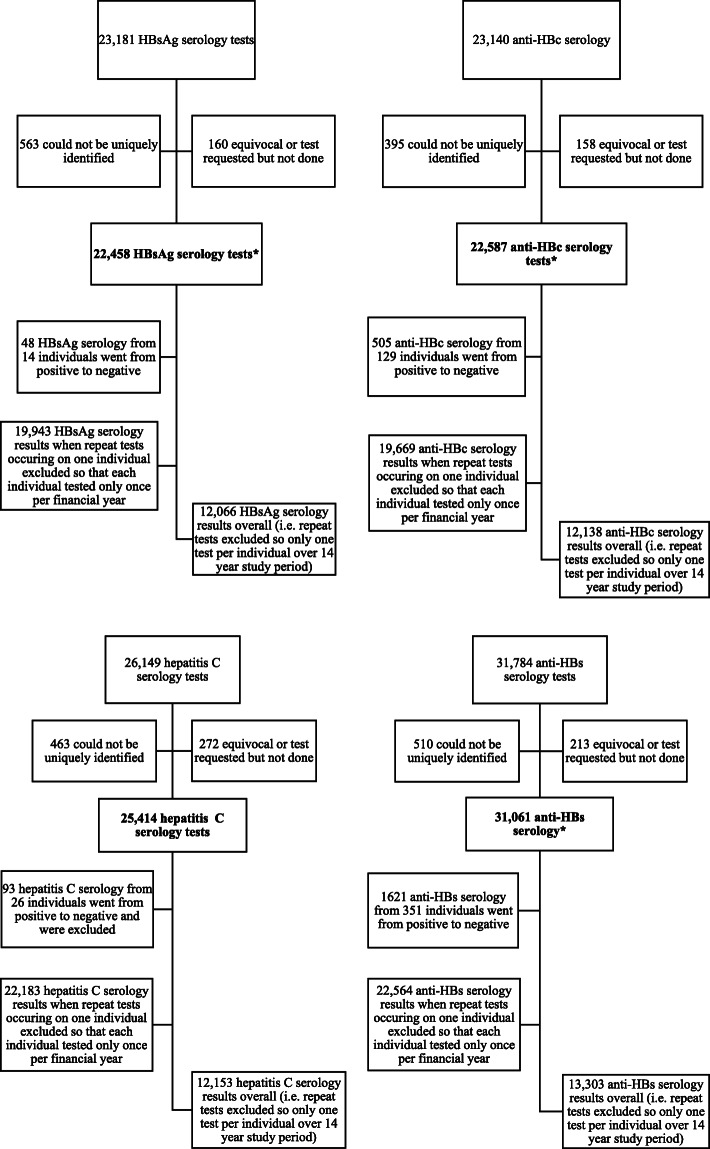
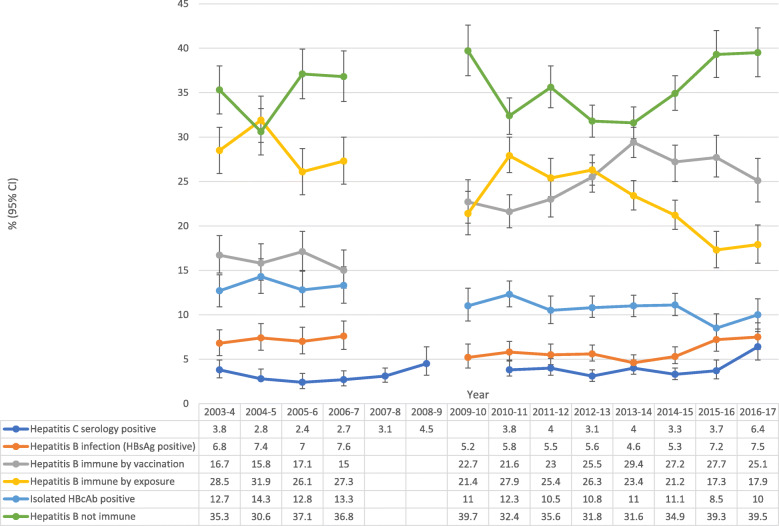
The proportion of positive records over 14 years for hepatitis B surface antigen (HBsAg) was 641/12,066 (5.3, 95% CI 4.9-5.7), for hepatitis B core antibody (anti-HBc) 4937/12,138 (40.1, 95%CI 39.8-41.6), for hepatitis B surface antibody (anti-HBs) 6966/13,303 (52.4, 95% CI 51.5-53.2), and for hepatitis C antibody 569/12,153 (4.7, 95% CI 4.3-5.1). The proportion of prisoners tested for hepatitis B and hepatitis C has decreased since 2015, while a high proportion of prisoners remain non-immune to hepatitis B.
There is a relatively high proportion of positive serological markers of hepatitis B, and a lower proportion of positive hepatitis C serology in the Northern Territory's correctional facilities compared to overall Australian rates. As the proportion of prisoners tested for hepatitis B and C has decreased recently, and a high proportion of prisoners remain non-immune to hepatitis B, there are opportunities to increase testing and vaccination rates in this population.
北领地监狱人口的构成与澳大利亚其他地区不同,因此乙型肝炎和丙型肝炎的流行情况可能也有所不同。以前没有研究专门描述北领地惩教设施中大量囚犯在较长时间内的血清学结果。
这项回顾性纵向研究分析了澳大利亚北领地惩教设施 2003 年 7 月 1 日至 2017 年 6 月 30 日期间乙型肝炎、丙型肝炎的血清学检测结果和检测率。
14 年间乙型肝炎表面抗原(HBsAg)阳性记录的比例为 12066 例中的 641 例(5.3%,95%可信区间 4.9-5.7),乙型肝炎核心抗体(抗-HBc)为 12138 例中的 4937 例(40.1%,95%可信区间 39.8-41.6),乙型肝炎表面抗体(抗-HBs)为 13303 例中的 6966 例(52.4%,95%可信区间 51.5-53.2),丙型肝炎抗体为 12153 例中的 569 例(4.7%,95%可信区间 4.3-5.1)。自 2015 年以来,北领地囚犯乙型肝炎和丙型肝炎检测比例有所下降,而仍有很大一部分囚犯对乙型肝炎没有免疫力。
与澳大利亚整体水平相比,北领地惩教设施的乙型肝炎血清学标志物阳性比例相对较高,丙型肝炎血清学阳性比例较低。由于最近乙型肝炎和丙型肝炎检测比例有所下降,而很大一部分囚犯仍对乙型肝炎没有免疫力,因此有机会提高该人群的检测和疫苗接种率。