Webster Katelyn E, Zhou Weijiao, Gallagher Nancy A, Smith Ellen M Lavoie, Gothe Neha P, Ploutz-Snyder Robert, Colabianchi Natalie, Larson Janet L
University of Michigan School of Nursing, 400 North Ingalls Building, Ann Arbor, MI 48109, USA.
University of Illinois at Urbana-Champaign College of Applied Health Sciences, 1206 South Fourth St., Champaign, IL 61820, USA.
Prev Med Rep. 2021 May 18;23:101405. doi: 10.1016/j.pmedr.2021.101405. eCollection 2021 Sep.
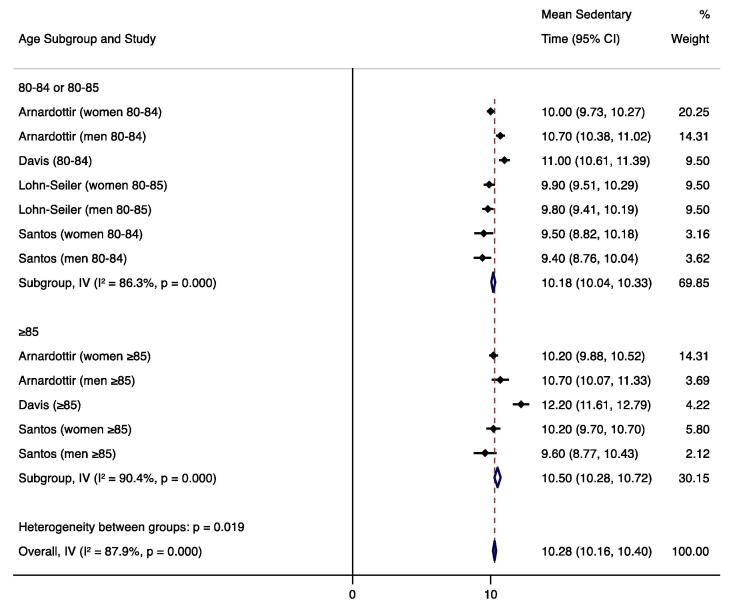
Sedentary behavior contributes to health decline and frailty in older adults, especially the oldest old. The purpose of this systematic review was to synthesize evidence describing the volume of device-measured sedentary behavior and factors that influence sedentary behavior in community-dwelling adults aged 80 and older. Four electronic databases were searched in August 2018; the search was updated in September 2019 and December 2020. Twenty-one articles representing 16 unique datasets from six countries met inclusion criteria. Various devices and data processing methods were used to measure sedentary behavior; the most common device was the ActiGraph accelerometer. Sedentary time during the waking day ranged from 7.6 to 13.4 h/day. Studies using similar measurement methods (hip-worn ActiGraph with uniaxial cut-point <100 counts per minute) had a weighted mean of 10.6 h/day. Subgroup analyses revealed that male gender and age ≥85 may contribute to increased sedentary behavior. Only seven individual articles examined factors that influence sedentary behavior in the 80 and older age group; older age, male gender, non-Hispanic white race/ethnicity, social disadvantage, and declining cognitive function (in men) were associated with increased sedentary behavior. In conclusion, the oldest old are highly sedentary and little is known about factors that influence their sedentary behavior.
久坐行为会导致老年人,尤其是高龄老人健康状况下降和身体虚弱。本系统评价的目的是综合证据,描述通过设备测量的久坐行为量以及影响80岁及以上社区居住成年人久坐行为的因素。2018年8月检索了四个电子数据库;2019年9月和2020年12月对检索进行了更新。来自六个国家的21篇文章代表16个独特数据集符合纳入标准。使用了各种设备和数据处理方法来测量久坐行为;最常用的设备是ActiGraph加速度计。白天清醒时的久坐时间为每天7.6至13.4小时。使用类似测量方法(佩戴在臀部的ActiGraph,单轴切点<每分钟100计数)的研究加权平均为每天10.6小时。亚组分析显示,男性和年龄≥85岁可能导致久坐行为增加。只有七篇独立文章研究了影响80岁及以上年龄组久坐行为的因素;年龄较大、男性、非西班牙裔白人种族/族裔、社会劣势以及认知功能下降(男性)与久坐行为增加有关。总之,高龄老人久坐时间很长,而关于影响他们久坐行为的因素却知之甚少。